
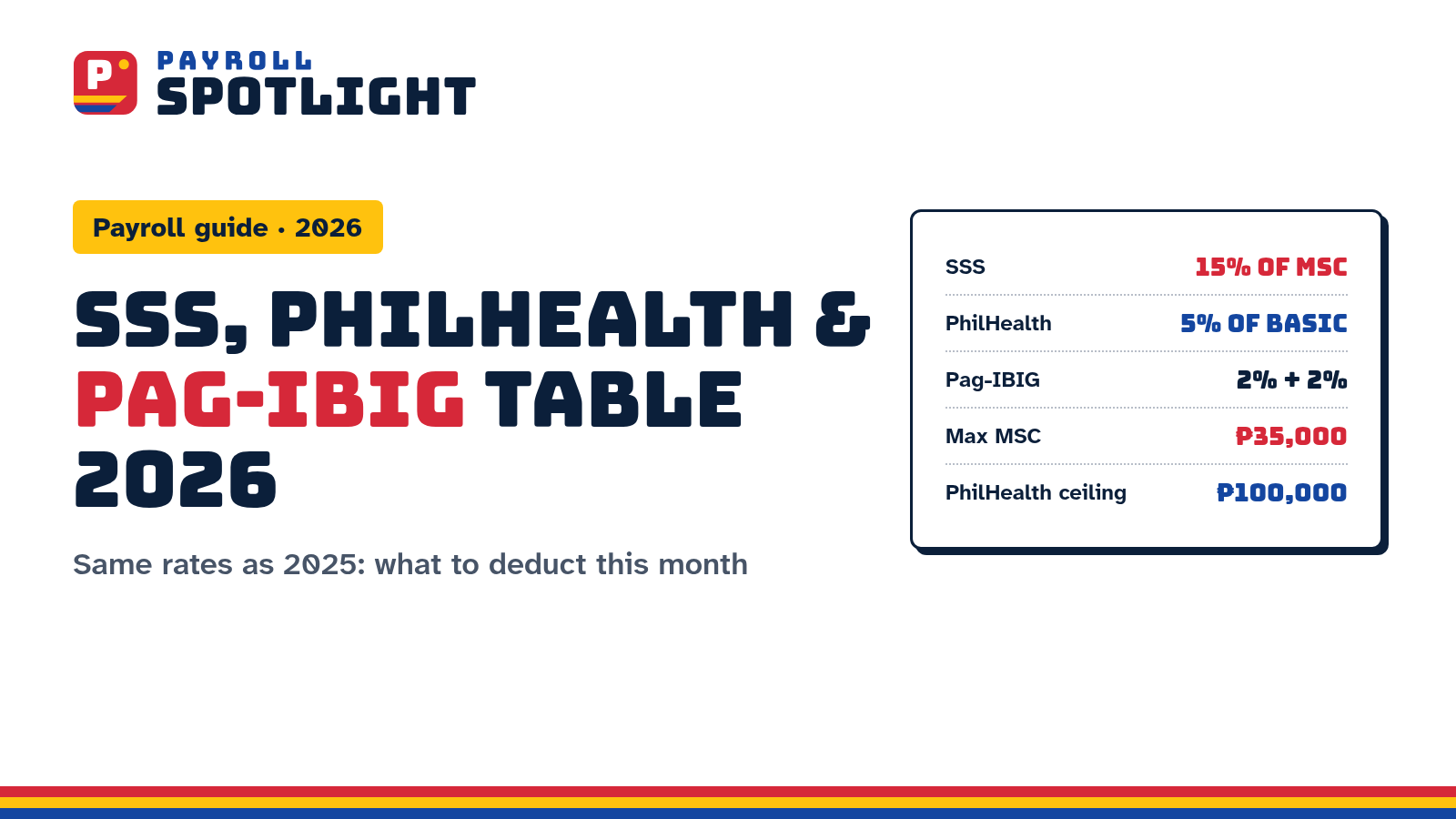
Short answer (as of October 23, 2026): For 2026, the three mandatory contributions for private employees are unchanged from 2025. SSS is 15% of the Monthly Salary Credit (MSC), with the employee paying 5% and the employer 10%, on an MSC of ₱5,000 to ₱35,000, plus an employer-only Employees’ Compensation (EC) premium of ₱10 or ₱30. PhilHealth is 5% of monthly basic salary, split 2.5% each, on a salary floor of ₱10,000 and a ceiling of ₱100,000. Pag-IBIG is 2% each from employee and employer on a Monthly Fund Salary capped at ₱10,000, so ₱200 each is the usual maximum. Sources: the SSS contribution page, the PhilHealth 2026 rate advisory reported by PIA, and HDMF Circular No. 460.
This SSS PhilHealth Pag-IBIG contribution table 2026 guide is for payroll officers, bookkeepers and small business owners who need the right deduction on this month’s payroll, and for employees checking their payslip. It covers the three rules in one place, a combined table for common salaries, worked examples, remittance deadlines and the mistakes that cause penalties.
Why 2026 looks the same as 2025
All three funds reached the end of their legislated schedules before 2026:
- SSS: The Social Security Act of 2018 (RA 11199) raised the rate in steps that ended with the January 2025 schedule: 15%, with an MSC range of ₱5,000 to ₱35,000. There is no 2026 step, so the 2025 table still applies.
- PhilHealth: The Universal Health Care Act (RA 11223) set the premium to rise to 5% with a ₱100,000 ceiling. PhilHealth said in a May 2026 advisory that 5% stays for 2026 and is the final scheduled adjustment.
- Pag-IBIG: HDMF Circular No. 460 raised the Maximum Fund Salary from ₱5,000 to ₱10,000 starting February 2024. The 2% rates have not changed since.
If someone tells you rates “went up again in January 2026”, ask for the circular. As of this writing, none of the three agencies has issued a new employer schedule for 2026.
The 2026 contribution rules at a glance
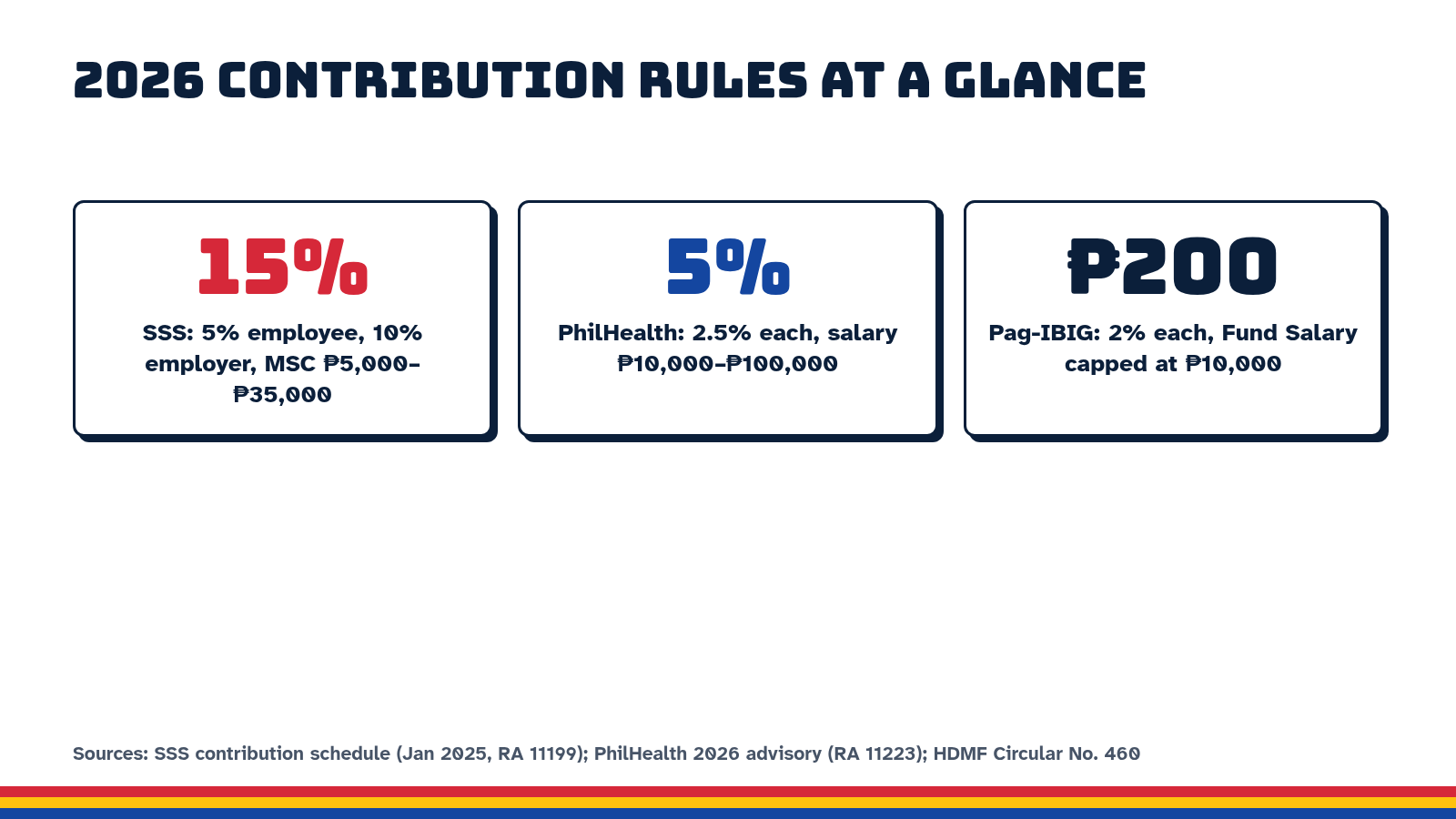
| Fund | Total rate | Employee share | Employer share | Base and limits |
|---|---|---|---|---|
| SSS (regular SS + MPF) | 15% of MSC | 5% | 10% | MSC ₱5,000 to ₱35,000, in ₱500 steps |
| SSS EC | Fixed | None | ₱10 (MSC up to ₱14,500) or ₱30 (MSC ₱15,000 and up) | Employer only |
| PhilHealth | 5% of monthly basic salary | 2.5% | 2.5% | Floor ₱10,000; ceiling ₱100,000 |
| Pag-IBIG | 4% total | 2% (1% if salary is ₱1,500 or less) | 2% | Monthly Fund Salary capped at ₱10,000 |
Two details trip people up. First, SSS uses the Monthly Salary Credit, not your exact salary. Each ₱500 compensation range maps to one MSC; for example, compensation of ₱24,750 to ₱25,249.99 maps to an MSC of ₱25,000. Second, PhilHealth uses monthly basic salary, so overtime, allowances, commissions and the 13th month pay are not part of the base.
For an MSC above ₱20,000, part of the SSS contribution goes to the Mandatory Provident Fund (the WISP), the member’s individual savings account. It’s still within the 15%; it doesn’t add to the deduction.
Combined table for common monthly salaries
The table below shows monthly amounts for an employee whose regular monthly compensation equals the salary shown. It assumes basic salary is the whole compensation, which keeps the arithmetic simple.
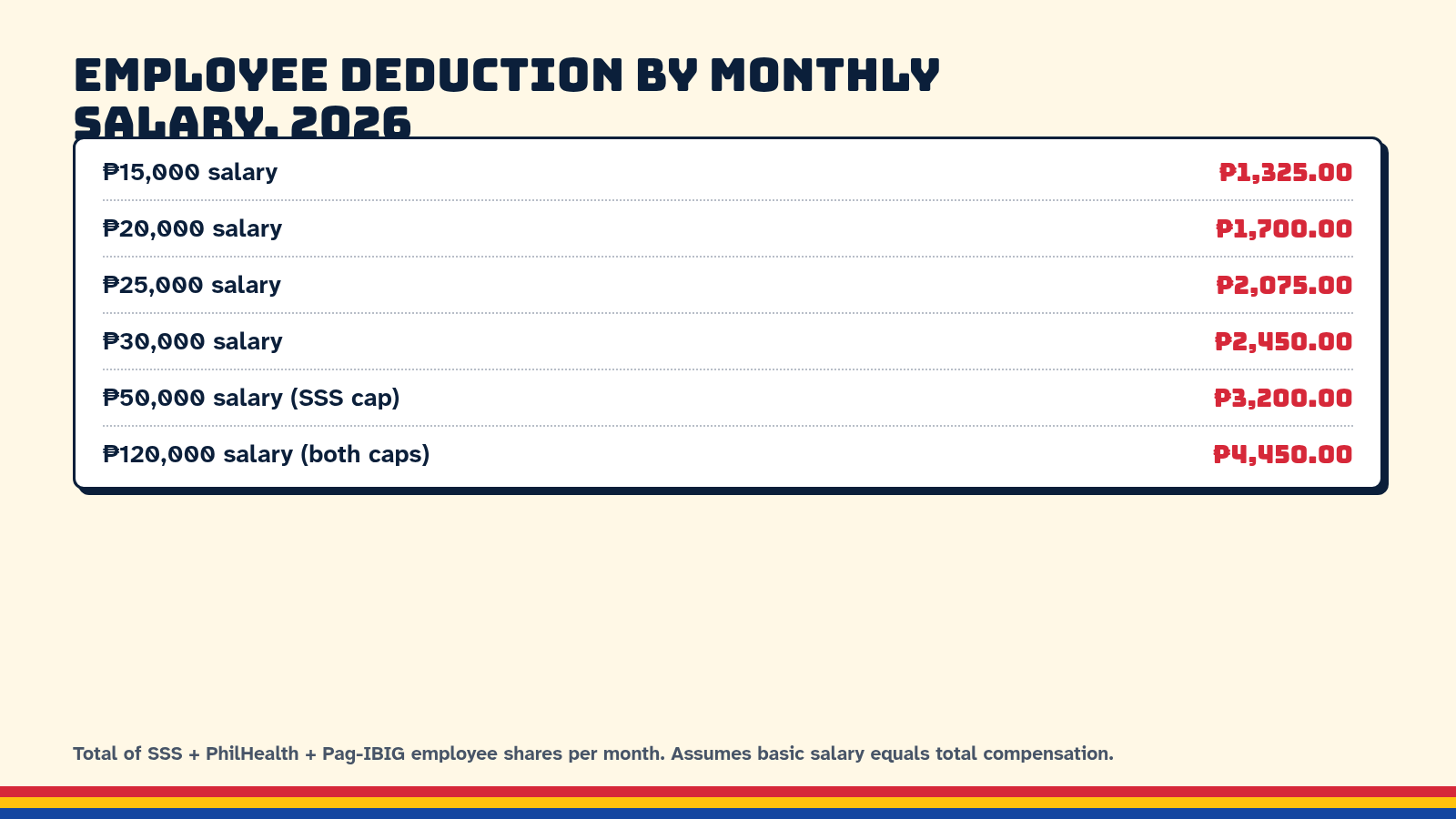
| Monthly salary | SSS employee | PhilHealth employee | Pag-IBIG employee | Total employee deduction | Employer cost (SSS + EC + PhilHealth + Pag-IBIG) |
|---|---|---|---|---|---|
| ₱15,000 | ₱750.00 | ₱375.00 | ₱200.00 | ₱1,325.00 | ₱1,500 + ₱30 + ₱375 + ₱200 = ₱2,105.00 |
| ₱20,000 | ₱1,000.00 | ₱500.00 | ₱200.00 | ₱1,700.00 | ₱2,000 + ₱30 + ₱500 + ₱200 = ₱2,730.00 |
| ₱25,000 | ₱1,250.00 | ₱625.00 | ₱200.00 | ₱2,075.00 | ₱2,500 + ₱30 + ₱625 + ₱200 = ₱3,355.00 |
| ₱30,000 | ₱1,500.00 | ₱750.00 | ₱200.00 | ₱2,450.00 | ₱3,000 + ₱30 + ₱750 + ₱200 = ₱3,980.00 |
| ₱50,000 | ₱1,750.00 (MSC cap) | ₱1,250.00 | ₱200.00 | ₱3,200.00 | ₱3,500 + ₱30 + ₱1,250 + ₱200 = ₱4,980.00 |
| ₱120,000 | ₱1,750.00 (MSC cap) | ₱2,500.00 (ceiling) | ₱200.00 | ₱4,450.00 | ₱3,500 + ₱30 + ₱2,500 + ₱200 = ₱6,230.00 |
Notice where the caps bite. Above ₱35,000 a month the SSS amount stops rising, and above ₱100,000 PhilHealth stops rising. Pag-IBIG reaches its ₱200 cap at ₱10,000.
Worked example: a ₱25,000 monthly employee paid twice a month
Liza (example data) earns ₱25,000 a month, paid on the 15th and 30th.
- SSS: ₱25,000 falls in the ₱24,750 to ₱25,249.99 range, so the MSC is ₱25,000. Employee share: 5% × ₱25,000 = ₱1,250. Employer share: 10% = ₱2,500, plus EC of ₱30.
- PhilHealth: 5% × ₱25,000 = ₱1,250 total. Liza pays ₱625; the employer pays ₱625.
- Pag-IBIG: Fund Salary is capped at ₱10,000. 2% × ₱10,000 = ₱200 each.
- Total deducted from Liza for the month: ₱1,250 + ₱625 + ₱200 = ₱2,075.
- Splitting across two paydays: Many employers deduct the whole month on the second payday; others split it ₱1,037.50 and ₱1,037.50. Both are fine as long as the month’s total is right and the payslip shows each item. If your employees’ salaries vary month to month (commissions, overtime), deduct on the second payday so you know the full month’s compensation before choosing the SSS MSC.
The employer’s total cost on top of salary is ₱2,500 + ₱30 + ₱625 + ₱200 = ₱3,355. Budget it as part of the cost of every hire.
How these deductions affect withholding tax
Employee shares of SSS, PhilHealth and Pag-IBIG are deducted from gross compensation before withholding tax is computed. That’s why getting them right matters twice: a wrong contribution also produces a wrong tax. Our withholding tax on compensation guide for 2026 walks through the next step with the same numbers. Voluntary extra Pag-IBIG savings above the mandatory share are not deductible for tax.
Remittance deadlines and how to pay
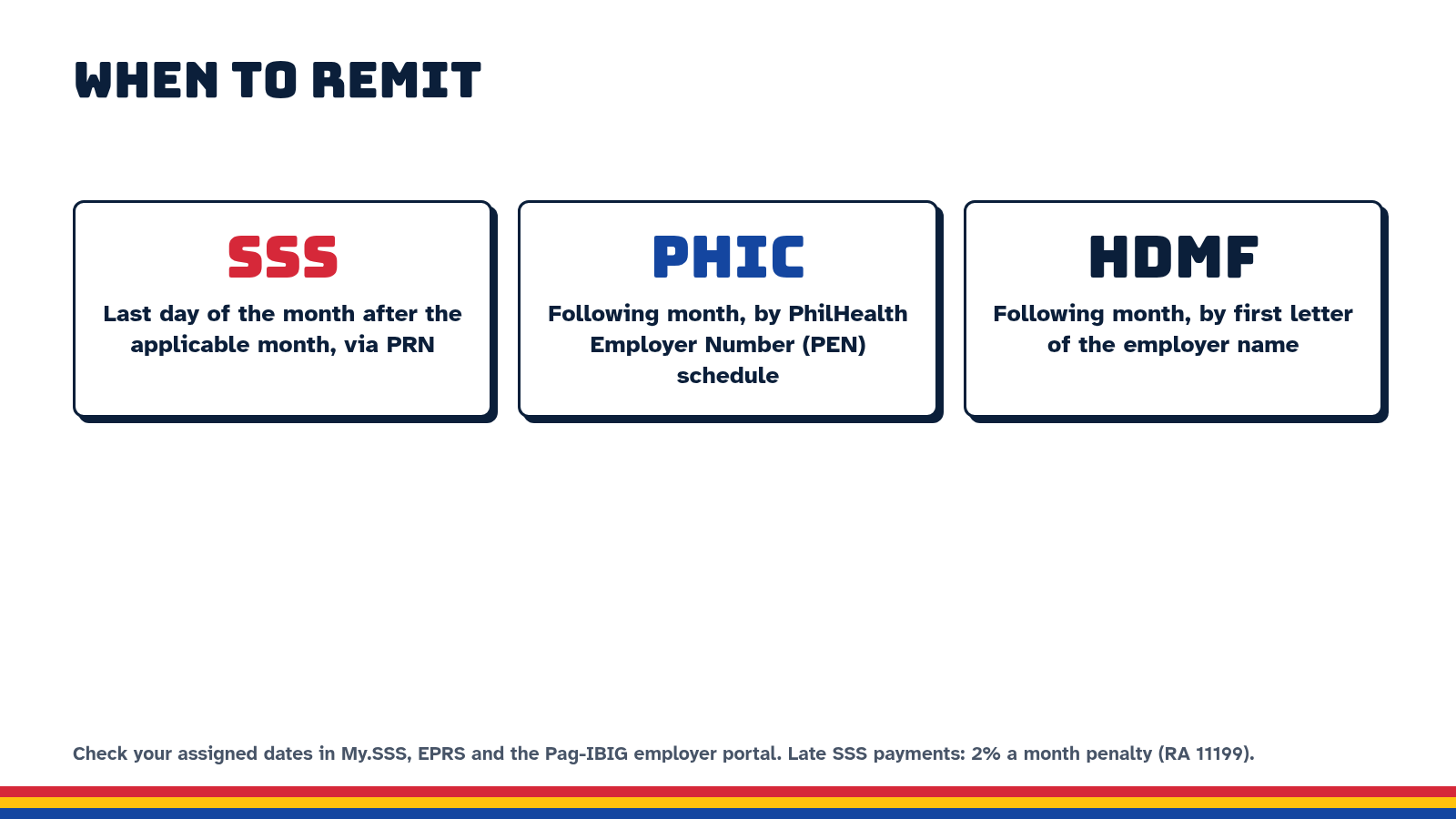
| Fund | When it’s due | How |
|---|---|---|
| SSS | Last day of the month after the applicable month (January contributions by end of February); next working day if it falls on a weekend or holiday | Generate the Contribution Collection List and PRN in My.SSS, then pay through an accredited channel (SSS) |
| PhilHealth | Following month, on a schedule based on your PhilHealth Employer Number (PEN). Employers whose PEN ends in 0 to 4 usually pay earlier in the month than those ending in 5 to 9 | Electronic Premium Remittance System (EPRS) |
| Pag-IBIG | Following month, on a schedule based on the first letter of the employer’s name | Pag-IBIG Fund employer portal or accredited collecting partners |
Check your exact dates inside each portal, because the assigned schedule is what counts. Late SSS remittance carries a penalty of 2% a month under RA 11199, and deducting an employee’s share without remitting it is a criminal offense under all three laws.
Who this table does and doesn’t fit
It fits regular private-sector employees, including probationary, project and part-time staff with an employer-employee relationship. It needs adjusting for:
- Kasambahay: For domestic workers earning less than ₱5,000 a month, the employer pays the employee share too, under the Batas Kasambahay.
- Self-employed, voluntary and OFW members: They pay the full SSS rate on their declared MSC, and PhilHealth on declared income. The employer split doesn’t apply.
- Minimum wage earners: They still pay their contribution shares. Their wages are exempt from income tax, but not from SSS, PhilHealth or Pag-IBIG.
Common mistakes that cause penalties
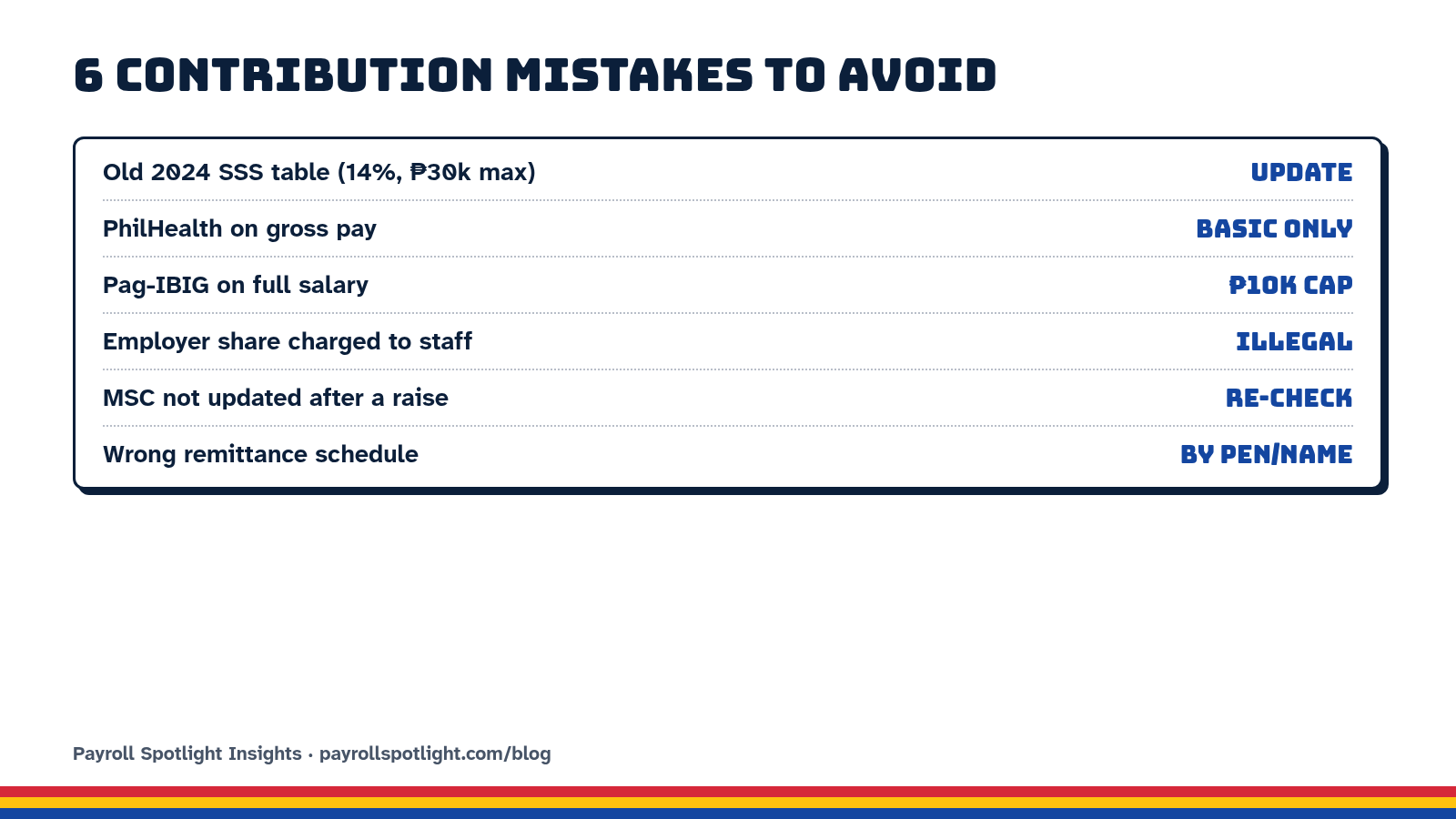
- Using the old 2024 SSS table. The 2024 table had a 14% rate and a ₱30,000 maximum MSC. Payroll files copied from an old template are the usual cause.
- Charging PhilHealth on gross pay. The base is basic salary. Allowances and overtime stay out.
- Deducting Pag-IBIG on full salary. The cap is ₱10,000 Fund Salary, so ₱200 is the normal maximum.
- Passing the employer share to the employee. The employer share and SSS EC are the employer’s own cost. Deducting them from wages is an illegal deduction.
- Not updating the MSC after a raise. Re-check the SSS bracket every time pay changes.
- Remitting on the wrong schedule. PhilHealth and Pag-IBIG schedules depend on your PEN and name, not one fixed date.
A monthly checklist for payroll
- Confirm each employee’s monthly compensation (for SSS) and basic salary (for PhilHealth).
- Look up the SSS MSC bracket; apply 5% and 10%, and add EC.
- Apply PhilHealth 5% within the ₱10,000 to ₱100,000 range and split it.
- Apply Pag-IBIG 2% each on a Fund Salary up to ₱10,000.
- Show every employee share on the payslip by name and amount.
- Generate SSS PRN, PhilHealth and Pag-IBIG remittance files, and pay by your assigned dates.
- Keep proof of payment with the payroll register for at least three years.
FAQ
What is the SSS contribution rate in 2026?
It’s 15% of the Monthly Salary Credit, split 5% employee and 10% employer, with an MSC of ₱5,000 to ₱35,000. The employer also pays an EC premium of ₱10 or ₱30. It’s the same schedule that took effect in January 2025.
How much is the PhilHealth contribution in 2026?
It’s 5% of monthly basic salary, shared equally. The minimum total is ₱500 (₱250 each) for salaries of ₱10,000 or less, and the maximum is ₱5,000 (₱2,500 each) for salaries of ₱100,000 or more.
What is the maximum Pag-IBIG contribution in 2026?
The mandatory maximum is ₱200 from the employee and ₱200 from the employer each month, because the Monthly Fund Salary is capped at ₱10,000 under HDMF Circular No. 460. Employees can voluntarily save more.
Are SSS, PhilHealth and Pag-IBIG deducted before tax?
Yes. The employee’s mandatory shares are subtracted from gross compensation before computing withholding tax on compensation.
Can an employer deduct its own share from the employee’s salary?
No. The employer share and SSS EC must come from the employer. Only the employee share may be deducted from wages.
What to do next
Check this month’s payroll against the combined table above, especially anyone earning above ₱35,000 or whose pay changed this year. Then read how these deductions feed into withholding tax, how they show up on a compliant payslip, and how they come out of an employee’s final pay. If you’d rather have the brackets applied automatically every cut-off, see what Payroll Spotlight does or start a free trial.
Educational overview only, based on the SSS contribution schedule effective January 2025 (RA 11199), PhilHealth’s 2026 premium advisory under RA 11223, and HDMF Circular No. 460, all retrieved October 23, 2026. “Liza” and all worked figures are example data. Check each agency’s portal for your assigned remittance dates. Not legal or tax advice.
Leave a Reply