
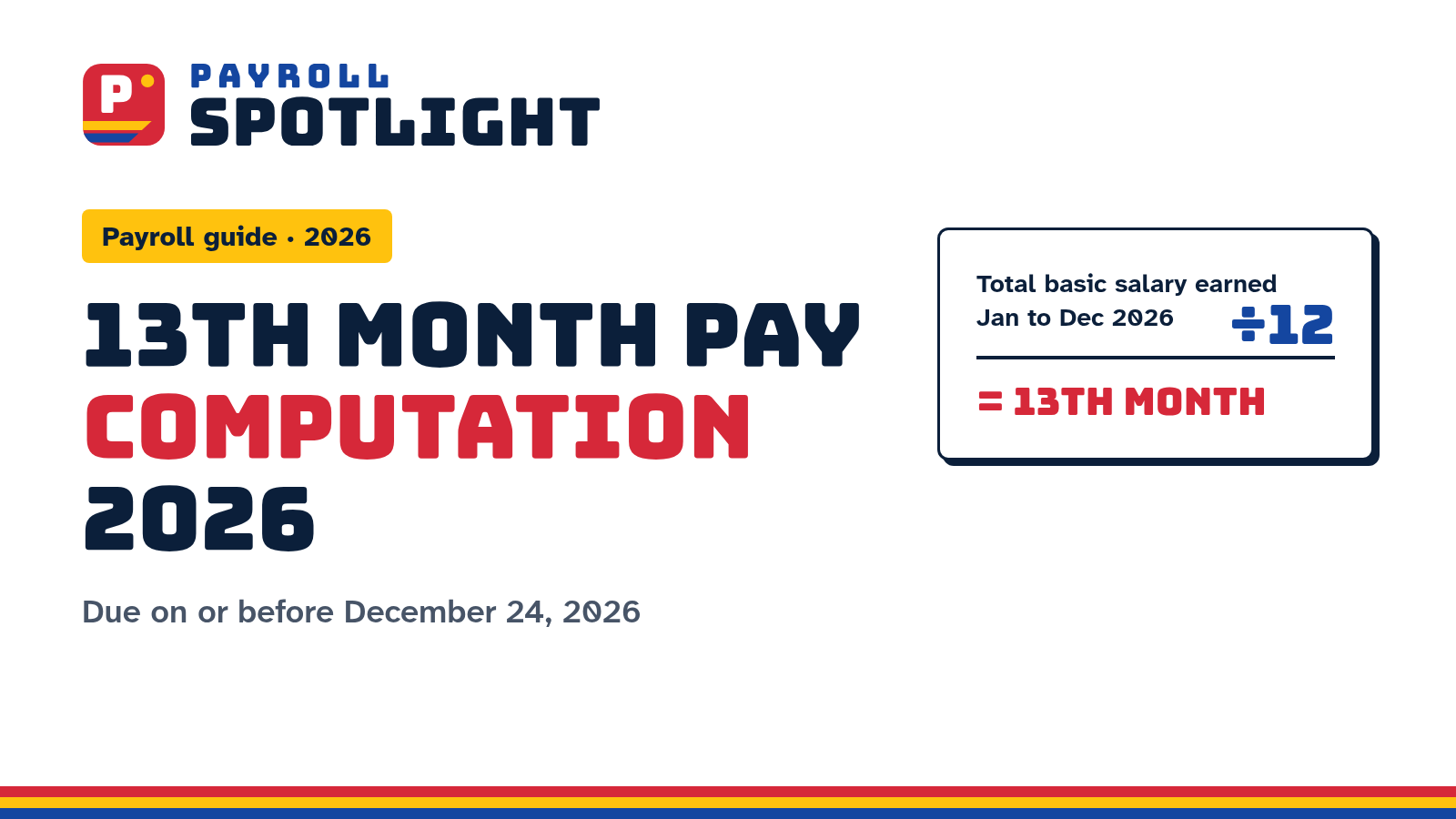
Short answer: add up the basic salary each rank-and-file employee actually earned from January 1 to December 2026, divide by 12, and release it on or before December 24, 2026. Overtime, holiday pay, night differential, COLA, and cash conversion of unused leave are left out unless your policy, contract, or CBA already treats them as part of basic pay. That is the rule in Presidential Decree No. 851 as restated in DOLE’s latest guidelines, Labor Advisory No. 16, Series of 2025.
This guide is for HR and payroll staff, small business owners, campaign and NGO admins who run payroll themselves and want a number they can defend. It walks through the formula, three worked examples (including a mid-year raise and a resigned employee), the tax cap, and the year-end mistakes that cause the most recomputations.
Who is entitled to 13th month pay in 2026
Under the DOLE guidelines, 13th month pay goes to rank-and-file employees in the private sector who worked at least one month during the calendar year, regardless of position, designation, employment status, or how their wages are paid (Labor Advisory No. 16-2025).
The same advisory names groups that payroll teams often skip by mistake:
- employees paid on a piece-rate basis
- employees on a fixed or guaranteed wage plus commission
- employees with multiple employers (each employer pays its share)
- employees who resigned or were terminated during the year
- employees who were on maternity leave and received salary differential
Who this guide is not for: managerial employees are outside the PD 851 mandate, and government workers follow separate rules on year-end and mid-year bonuses. If your organization pays a voluntary bonus to managers, that is a policy decision, not a PD 851 computation.
The 2026 formula, in plain terms
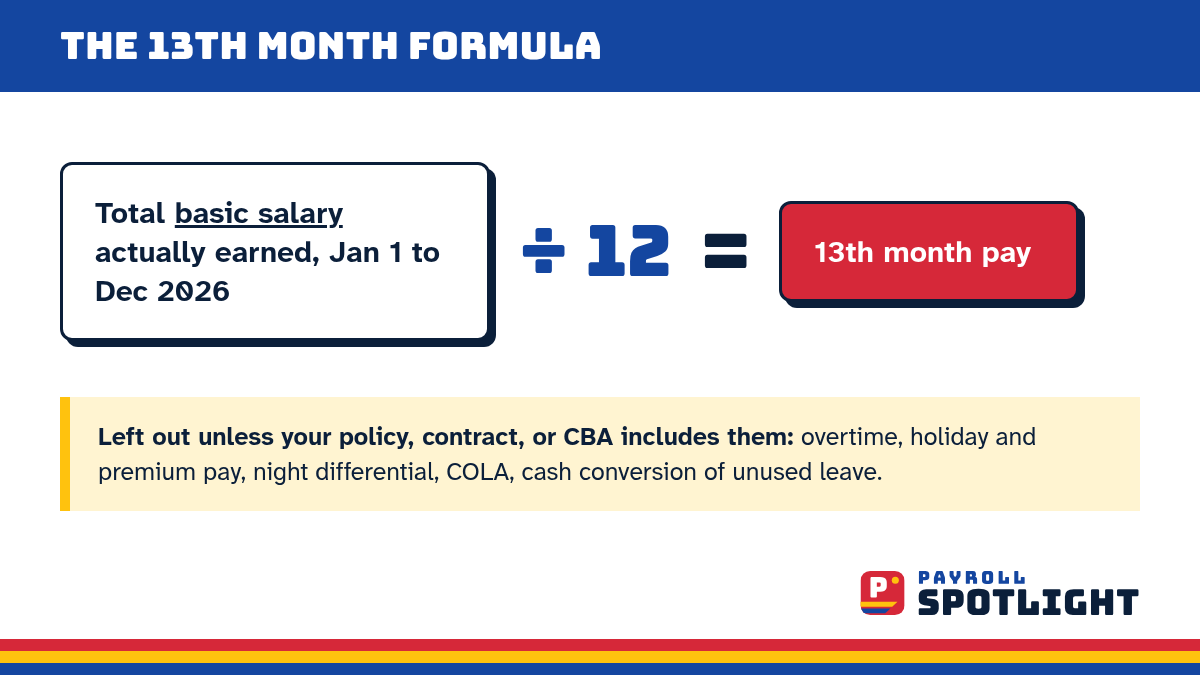
13th month pay = total basic salary actually earned in the calendar year ÷ 12
The phrase that does the work is actually earned. You are not multiplying today’s rate by 12 and dividing by 12. You are adding what the employee was really paid as basic salary, month by month, after unpaid absences and before deductions like SSS, PhilHealth, Pag-IBIG, and withholding tax.
The DOLE advisory says “basic salary” includes all remuneration paid for services rendered, but excludes allowances and monetary benefits not integrated into basic salary, such as:
| Usually excluded from the base | Included only if… |
|---|---|
| Overtime pay | your contract, CBA, policy, or company practice treats it as basic salary |
| Premium pay and holiday pay | same condition |
| Night shift differential | same condition |
| Cost of living allowance (COLA) | same condition |
| Cash conversion of unused vacation and sick leave | same condition |
Source: Labor Advisory No. 16-2025, Part II.
That second column matters. If your company has always included a fixed allowance in the 13th month base, changing it this year can be read as a diminution of benefits. Check past payroll records before you “clean up” the formula.
Worked example 1: a full year, no changes
Demo employee: Ana, Kalye Kape Co. (demo), monthly basic salary ₱20,000, no unpaid absences in 2026.
| Step | Computation | Result |
|---|---|---|
| Total basic salary earned | ₱20,000 × 12 months | ₱240,000.00 |
| Divide by 12 | ₱240,000 ÷ 12 | ₱20,000.00 |
For a full year with no changes, the 13th month equals one month’s basic salary. This is the case most people picture, and it is also the case where mistakes are rare. The next two examples are where payroll teams lose time.
Worked example 2: a mid-year raise plus unpaid absences
2026 brought new wage orders in several regions. The National Wages and Productivity Commission’s summary of regional minimum wage rates (as of October 6, 2026) lists recent increases, and more regional boards were still holding consultations in September (NWPC, September 29, 2026). Whether a raise comes from a wage order or a merit increase, the 13th month follows the salary actually earned in each month, so the raise only counts from its effective date.
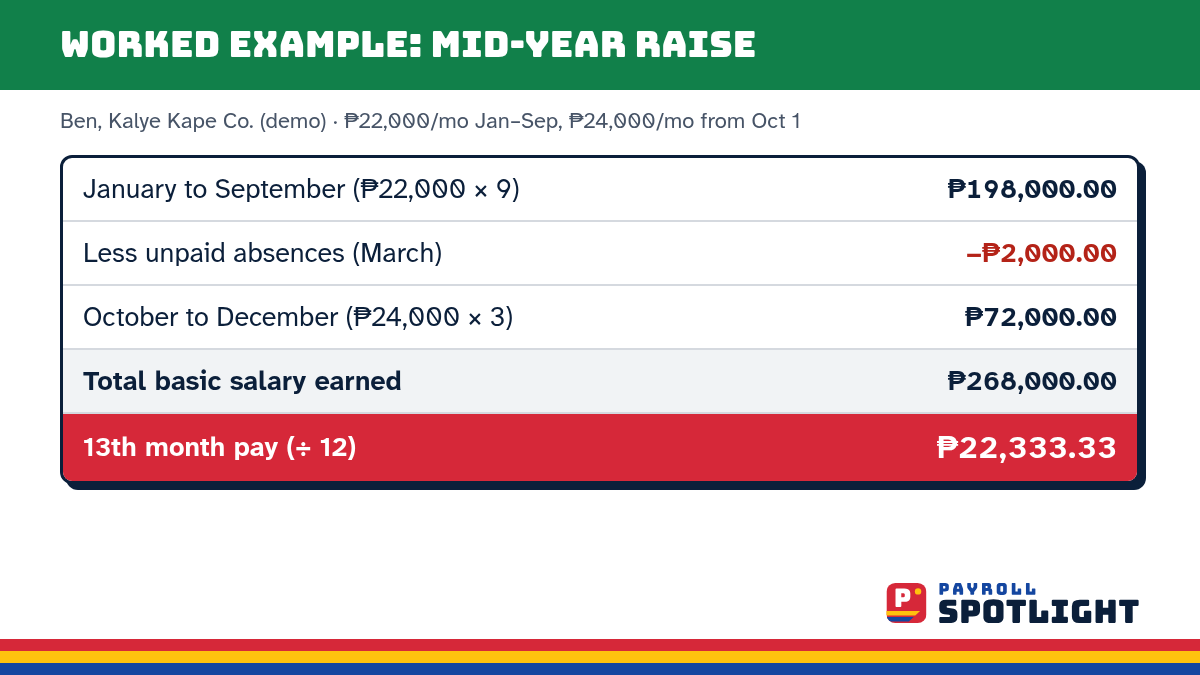
Demo employee: Ben, Kalye Kape Co. (demo). Basic salary ₱22,000/month from January to September, raised to ₱24,000/month from October 1. He had unpaid absences in March that reduced his basic pay that month by ₱2,000.
| Period | Computation | Basic salary earned |
|---|---|---|
| January to September | ₱22,000 × 9 | ₱198,000.00 |
| Less unpaid absences (March) | −₱2,000.00 | |
| October to December | ₱24,000 × 3 | ₱72,000.00 |
| Total basic salary earned | ₱268,000.00 | |
| 13th month pay | ₱268,000 ÷ 12 | ₱22,333.33 |
Two traps here. First, using the new rate for the whole year (₱24,000) overpays by ₱1,666.67. Second, using the old rate for the whole year underpays and invites a complaint. Pull the actual monthly basic pay from your payroll register instead of re-keying rates.
If a wage order takes effect in December, after you have already released the 13th month, the December portion of the increase still has to be reflected. Plan a small adjustment run rather than ignoring it.
Worked example 3: an employee who resigned in 2026
Resigned and terminated employees are entitled to a proportionate 13th month based on basic salary earned up to separation (Labor Advisory No. 16-2025). In practice it is released with final pay. DOLE’s Labor Advisory No. 06, Series of 2020 sets the expectation that final pay is released within 30 days from separation, unless a more favorable company policy or agreement applies.
Demo employee: Carla, Kalye Kape Co. (demo). Basic salary ₱18,000/month. Last day worked: June 30, 2026, no unpaid absences.
| Step | Computation | Result |
|---|---|---|
| Basic salary earned January to June | ₱18,000 × 6 | ₱108,000.00 |
| Proportionate 13th month | ₱108,000 ÷ 12 | ₱9,000.00 |
| Release with | Final pay | within 30 days of separation |
A resignation letter does not waive this amount. If Carla was hired mid-month, count only the days she was actually paid for in her first month.
Is 13th month pay taxable in 2026?
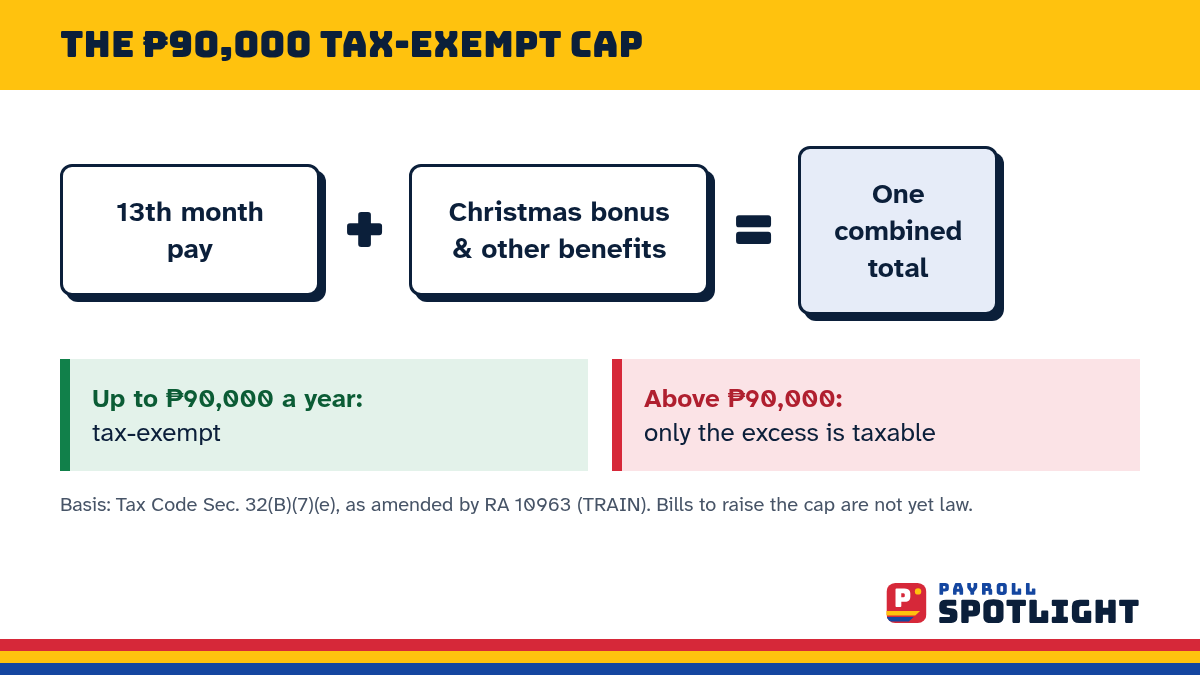
Not up to a limit. Under Section 32(B)(7)(e) of the Tax Code, as amended by the TRAIN Law (Republic Act No. 10963), 13th month pay and other benefits combined are excluded from gross income up to ₱90,000 per year. “Other benefits” includes Christmas bonuses, productivity incentives, and similar year-end payments. Only the amount above ₱90,000 is added to taxable compensation and subjected to withholding.
Quick check using Ben from Example 2:
| Item | Amount |
|---|---|
| 13th month pay | ₱22,333.33 |
| Christmas bonus (company policy, demo) | ₱10,000.00 |
| Combined | ₱32,333.33 |
| Over the ₱90,000 cap? | No, fully exempt |
About the bills you may have read about: proposals to raise the cap have been filed in 2026, including a House bill proposing ₱150,000 (BusinessMirror, February 9, 2026). A bill changes nothing until it is enacted and takes effect. For 2026 payroll, use ₱90,000 unless the BIR issues new rules.
The year-end checklist (with dates)
This is the order we suggest to finish without a rush on December 23.
| # | Task | When | What you need |
|---|---|---|---|
| 1 | Freeze the list of covered employees (including resigned staff and those on maternity leave) | First week of November | HR masterlist, separation dates |
| 2 | Export each employee’s monthly basic pay, January to latest cutoff | Mid-November | Payroll register |
| 3 | Confirm what is “basic salary” under your policy, CBA, or past practice | Mid-November | Last year’s 13th month file |
| 4 | Compute, then spot-check 5 to 10 employees by hand | Late November | Worksheet like the examples above |
| 5 | Check combined benefits against the ₱90,000 cap | Late November | Bonus list |
| 6 | Approve and release | On or before December 24, 2026 | Approval sign-off, bank file |
| 7 | Issue payslips that show the 13th month as its own line | Same day as release | Payslip template |
| 8 | Submit the compliance report through the DOLE Establishment Report System | By the January deadline DOLE sets (last cycle: January 15) | Totals per employee |
The DOLE advisory for the last cycle required the compliance report through the DOLE Establishment Report System by January 15. DOLE also states that no request for exemption or deferment of 13th month payment is accepted (Labor Advisory No. 16-2025).
Common mistakes that trigger recomputation
- Multiplying the current rate by 12. It ignores raises, unpaid leave, and late hires.
- Leaving out resigned employees. Their share belongs in final pay.
- Adding overtime and holiday pay by default. They are excluded unless your policy says otherwise.
- Dropping an allowance that was always included. That can be a diminution of benefits.
- Treating “bonus” and “13th month” as separate tax buckets. They share the one ₱90,000 cap.
- Paying in installments without a record. Paying half earlier in the year is a common practice, but both halves must be documented and the full amount must be complete by December 24.
A simple decision guide
- Employee worked the full year with no changes? Use one month’s basic salary, then confirm against the register.
- Raise, wage order, unpaid leave, or late hire? Sum actual monthly basic pay and divide by 12.
- Separated before December? Compute to the last day worked and include it in final pay.
- Combined year-end benefits above ₱90,000? Withhold tax only on the excess.
- Unsure whether an allowance belongs in the base? Check what you did last year and what the contract or CBA says before changing it.
Frequently asked questions
When is the deadline for 13th month pay in 2026?
On or before December 24, 2026. PD 851 sets December 24 as the deadline, and DOLE does not accept requests to defer it.
Do probationary and part-time employees get 13th month pay?
Yes, if they are rank-and-file and worked at least one month in the calendar year. Employment status does not matter; the amount follows the basic salary they actually earned.
Is 13th month pay included in final pay?
Yes. A resigned or terminated employee gets the proportionate amount based on basic salary earned up to separation, usually released with final pay within 30 days.
Is the 13th month pay taxable?
Only the part of your 13th month and other bonuses, combined, that goes above ₱90,000 in the year. Below that, it is tax-exempt.
Can an employer skip the 13th month because business is slow?
No. DOLE has stated it will not accept requests for exemption or deferment.
What to do next
Pull your 2026 payroll register this week and run Example 2’s method on three employees who had a raise or unpaid leave. If the numbers match your plan, you are ready for the December run. If your team wants the monthly basic pay already summed per employee, with a review step before release, see how Payroll Spotlight covers Philippine payroll compliance.
This article is general information about Philippine payroll rules as of October 2026, not legal or tax advice. For unusual cases, check with DOLE, the BIR, or a qualified adviser.
Leave a Reply