
Short answer (as of October 28, 2026): Year-end annualization is the recomputation every Philippine employer must do before releasing the last payroll of December 2026. You add up each employee’s taxable compensation for January to December, apply the annual graduated tax table in force since 2023, and compare the result with the tax already withheld. If you withheld too little, the shortfall comes out of the December pay. If you withheld too much, you refund it no later than January 25, 2027. The rule is in Section 79(H) of the Tax Code, quoted in BIR RMC 21-2010 and the step-by-step method is in Section 2.79(B)(5)(b) of RR 2-98 as amended by RR 11-2018.
This guide is for payroll officers, accountants and owners who will close December 2026 payroll, and for employees who want to know why their December net pay looks different. Our withholding tax on compensation guide explains the regular per-payday computation. This article is only about the year-end step: the worksheet, three worked cases (refund, extra withholding, and a mid-year job change), the forms that come after, and the traps that lead to BIR findings.
What year-end annualization actually does
Per-payday withholding is an estimate. Each month’s tax comes from the monthly or semi-monthly table in Annex E of RR 11-2018, which assumes the employee earns the same taxable pay every period for twelve months. Real payroll doesn’t behave that way. People get hired in July, take unpaid leave, get raises, receive bonuses that cross the ₱90,000 ceiling, or bring income from a previous employer.
The law closes the gap once a year. Section 79(H) says that before paying compensation for the last payroll period, “the employer shall determine the tax due from each employee on taxable compensation income for the entire taxable year.” The difference between that annual tax and the January to November withholding “shall either be withheld from his salary in December of the current calendar year or refunded to the employee not later than January 25 of the succeeding year.”
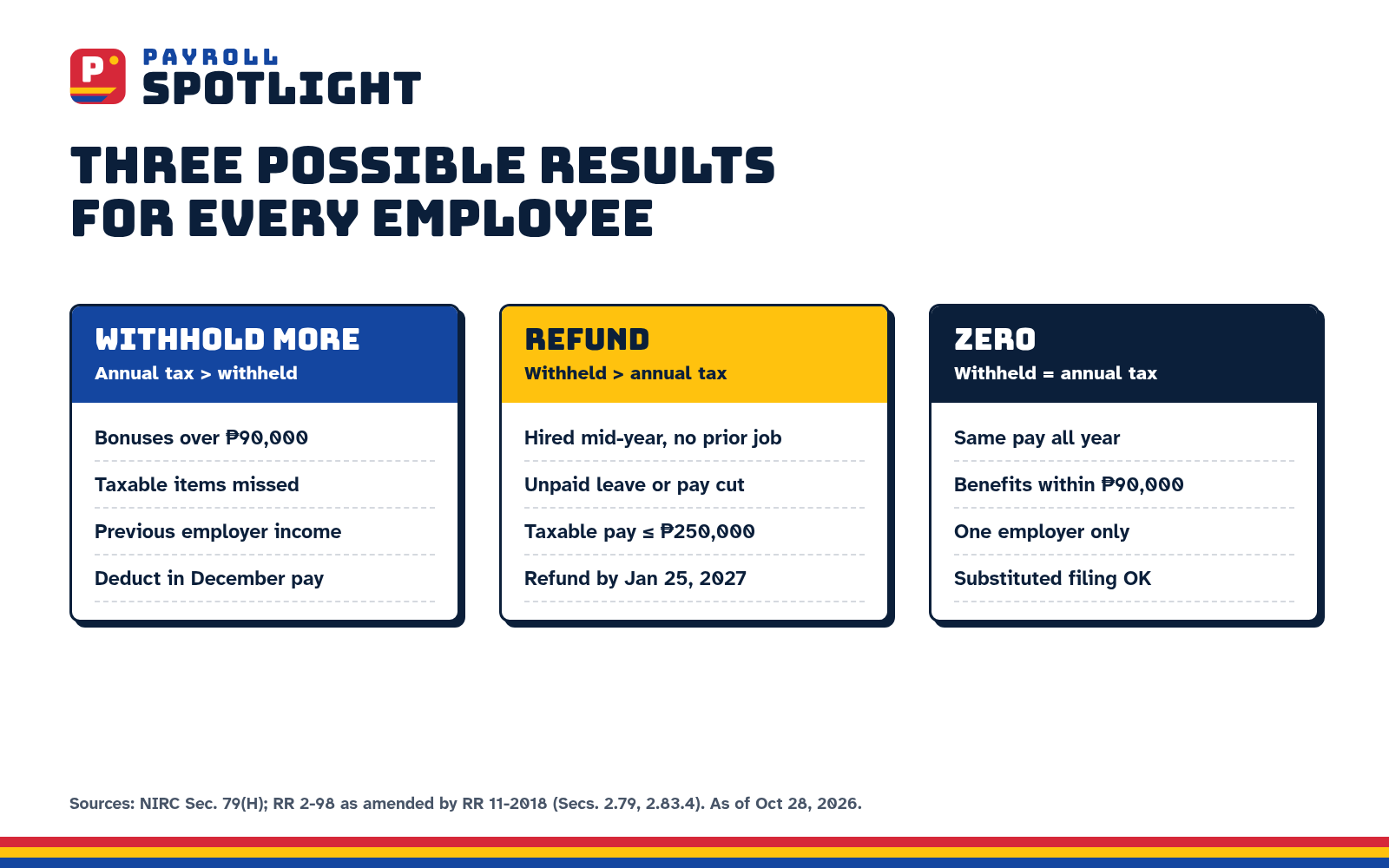
So annualization has only three possible outcomes for each employee:
| Outcome | What happened during the year | What you do in December |
|---|---|---|
| Additional withholding | Too little was withheld (bonus excess over ₱90,000, taxable items missed during the year, uncaptured previous-employer income) | Withhold the shortfall from the last payroll |
| Refund | Too much was withheld (partial-year hire, unpaid leave, pay cut) | Refund the excess by January 25, 2027 |
| Zero difference | Withholding matched the annual tax | Nothing extra; the employee may qualify for substituted filing |
The 2026 annual tax table you annualize against
For compensation paid in 2026 you use the schedule that took effect on January 1, 2023 under RA 10963 (TRAIN), reproduced in RR 11-2018 for “taxable year 2023 and onwards.” No law has replaced it as of October 28, 2026.
| Annual taxable compensation | Tax due |
|---|---|
| ₱250,000 and below | ₱0 |
| Over ₱250,000 to ₱400,000 | 15% of the excess over ₱250,000 |
| Over ₱400,000 to ₱800,000 | ₱22,500 + 20% of the excess over ₱400,000 |
| Over ₱800,000 to ₱2,000,000 | ₱102,500 + 25% of the excess over ₱800,000 |
| Over ₱2,000,000 to ₱8,000,000 | ₱402,500 + 30% of the excess over ₱2,000,000 |
| Over ₱8,000,000 | ₱2,202,500 + 35% of the excess over ₱8,000,000 |
Old spreadsheets often still carry the 2018 to 2022 schedule, whose rates go up to 32% in the ₱2 million to ₱8 million band. Check yours before December.
The December annualization worksheet, step by step
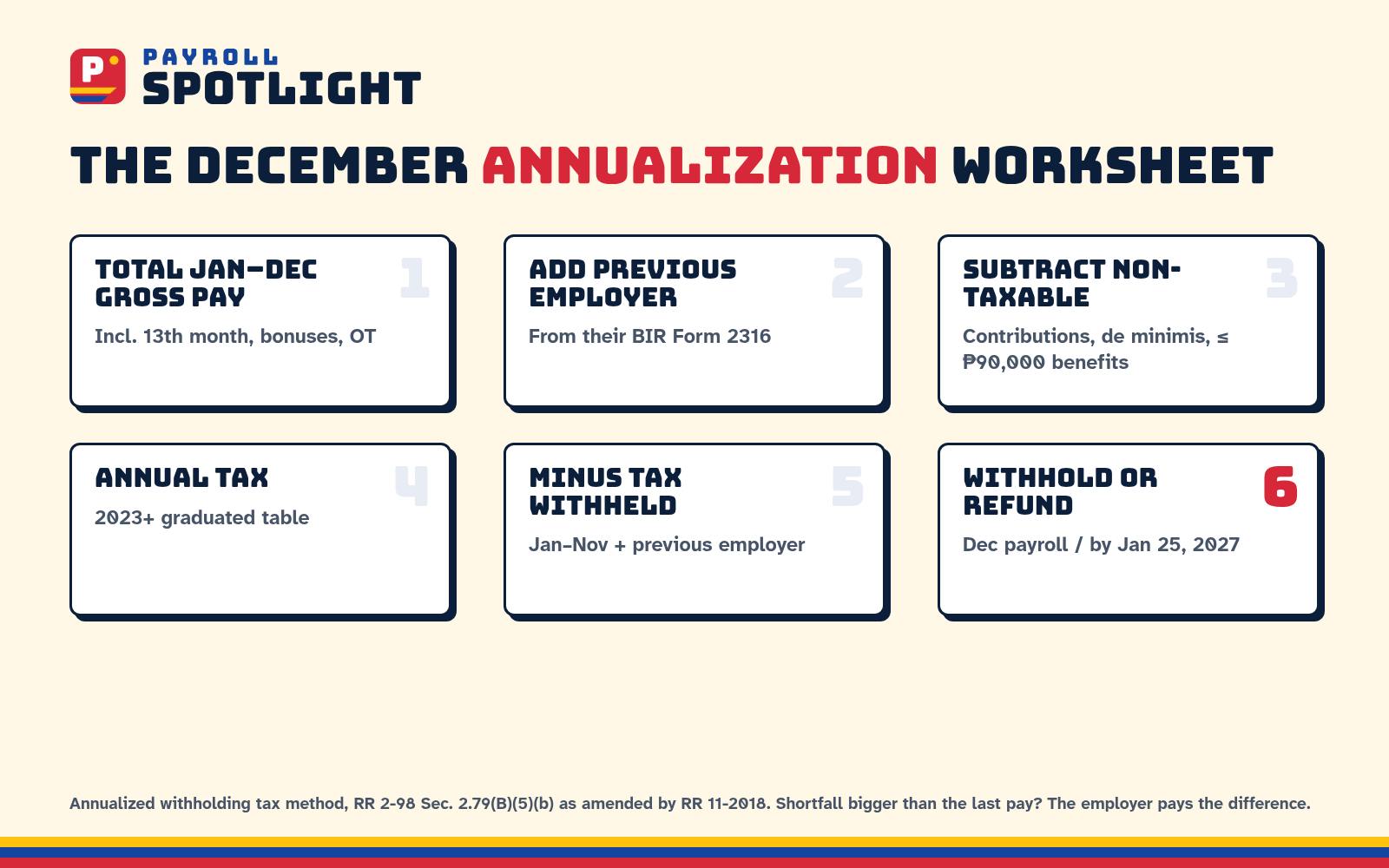
RR 11-2018 calls this the “annualized withholding tax method.” In plain terms, do this for every employee on the last payroll run:
- Total the gross compensation paid January 1 to December 31, 2026, including the December pay you’re about to release: basic pay, overtime, holiday and night differential, taxable allowances, commissions, the 13th month and every bonus.
- Add taxable compensation from previous employers in 2026, taken from the BIR Form 2316 the new hire gave you. RR 11-2018 requires an employee who moved jobs during the year to furnish the new employer a copy of the previous employer’s 2316.
- Subtract non-taxable items: the employee’s share of SSS, PhilHealth and Pag-IBIG (see our 2026 contribution table); de minimis benefits within their ceilings under RR 29-2025; and the 13th month pay and other benefits up to ₱90,000 combined. Only the excess over ₱90,000 stays taxable. Our Christmas bonus and ₱90,000 cap guide shows how to track that bucket.
- Compute the annual tax on what’s left, using the table above.
- Total the tax already withheld from January to November, plus anything withheld by the previous employer that year.
- Take the difference. Positive means withhold it from the December pay. Negative means refund it.
- Show it on the payslip as a separate “year-end tax adjustment” line so employees can see why net pay moved. Our payslip field checklist has the full layout.
One rule most people miss: if the shortfall is bigger than the employee’s last pay, RR 11-2018 says “the employer shall be liable to pay the amount of tax which cannot be withheld,” and recovering it from the employee “is a matter of settlement between the employee and employer.” In other words, BIR collects from you. Run a trial annualization in November so a large gap can be spread over the last two paydays instead of wiping out one.
Worked example 1: a bonus over the ₱90,000 ceiling (extra withholding)
All names and figures are example data. Contributions use 2026 employee shares: SSS 5% of the ₱35,000 maximum salary credit (₱1,750), PhilHealth 2.5% of basic pay, Pag-IBIG ₱200.
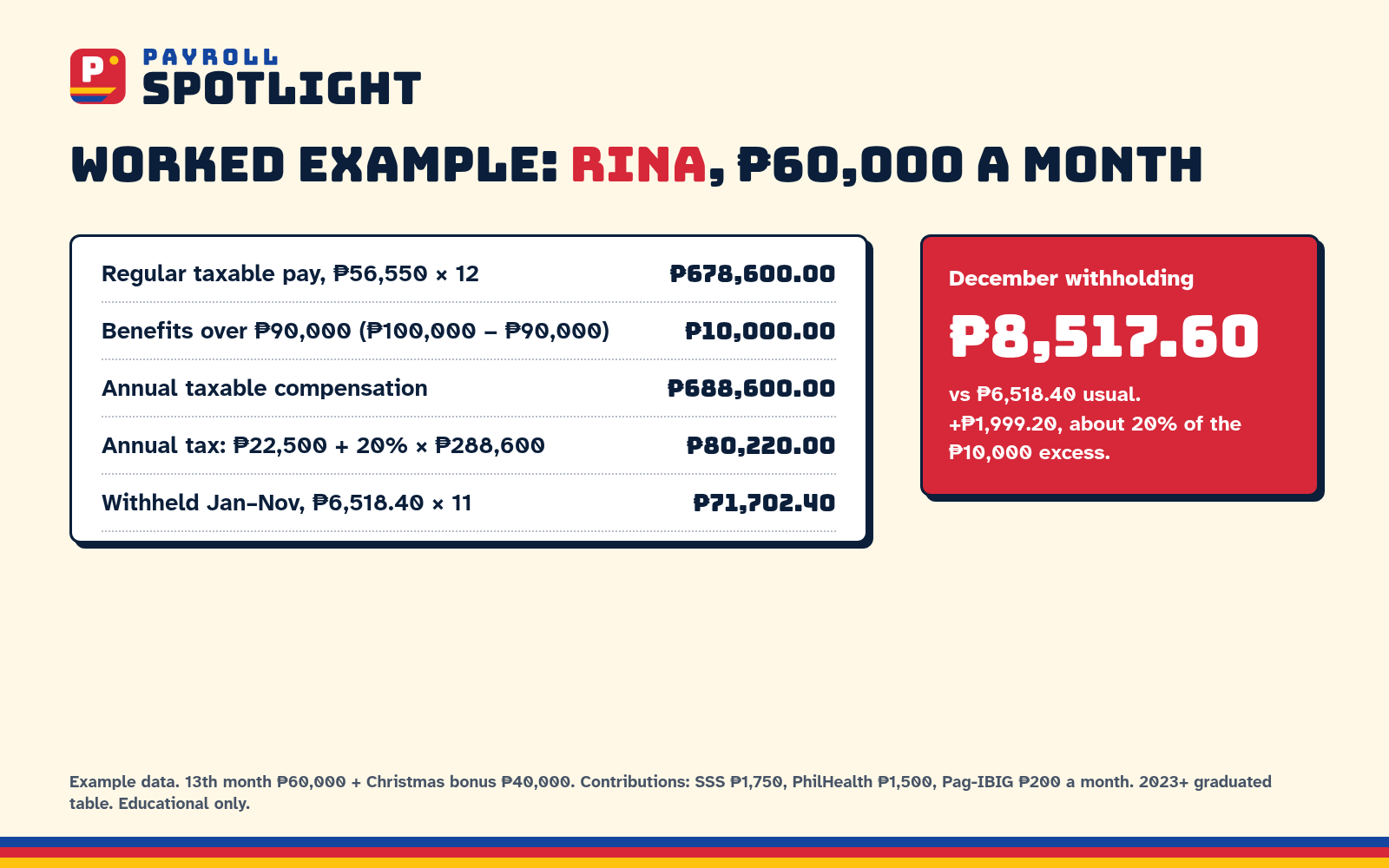
Rina earns ₱60,000 a month all year. Her monthly taxable pay is ₱60,000 − ₱1,750 − ₱1,500 − ₱200 = ₱56,550, so the monthly table withholds ₱1,875 + 20% × (₱56,550 − ₱33,333) = ₱6,518.40. In December she gets a ₱60,000 13th month and a ₱40,000 Christmas bonus, ₱100,000 in all.
| Step | Amount |
|---|---|
| Regular taxable pay, ₱56,550 × 12 | ₱678,600.00 |
| Benefits over the ₱90,000 ceiling (₱100,000 − ₱90,000) | ₱10,000.00 |
| Annual taxable compensation | ₱688,600.00 |
| Annual tax: ₱22,500 + 20% × (₱688,600 − ₱400,000) | ₱80,220.00 |
| Withheld January to November, ₱6,518.40 × 11 | ₱71,702.40 |
| December withholding after annualization | ₱8,517.60 |
That’s ₱1,999.20 more than her usual ₱6,518.40, almost exactly 20% of the ₱10,000 excess. Tell her before payday.
Worked example 2: a July hire with no previous employer (refund)
Ana is a fresh graduate hired on July 1, 2026 at ₱40,000 a month, with no other employer in 2026. Her monthly taxable pay is ₱37,050 and the table withholds ₱2,618.40 a month, as computed in our withholding tax guide.
| Step | Amount |
|---|---|
| Taxable pay July to December, ₱37,050 × 6 | ₱222,300.00 |
| 13th month (₱20,000, pro-rated) | Exempt, under ₱90,000 |
| Annual tax on ₱222,300 | ₱0 |
| Withheld July to November, ₱2,618.40 × 5 | ₱13,092.00 |
| Result | No December tax; refund ₱13,092.00 by January 25, 2027 |
The monthly table assumed she’d earn ₱37,050 for twelve months. She only earned it for six, which keeps her under the ₱250,000 zero bracket. Under RR 11-2018 you may then deduct refunds like this from your own remittances of tax withheld on compensation, starting with the month of the refund, until fully recovered.
Worked example 3: a mid-year job change (why the previous 2316 matters)
Leo worked at Company A from January to June at ₱30,000 a month (₱27,550 taxable, ₱1,007.55 withheld a month). When he resigned, Company A annualized his six months: ₱165,300 taxable, tax due ₱0, so it refunded all ₱6,045.30 in his final pay, as RR 11-2018 requires for employees who leave before December.
Company B hired him on July 1 at ₱45,000 (₱41,925 taxable, ₱3,593.40 withheld a month).
| With Company A’s 2316 | Without it | |
|---|---|---|
| Taxable compensation counted | ₱165,300 + ₱251,550 = ₱416,850 | ₱251,550 only |
| Annual tax | ₱22,500 + 20% × ₱16,850 = ₱25,870.00 | 15% × ₱1,550 = ₱232.50 |
| Withheld July to November by B | ₱17,967.00 | ₱17,967.00 |
| December result | Withhold ₱7,903.00 | Refund ₱17,734.50 |
Same employee, same pay, and a ₱25,637.50 swing. Without the previous 2316, Company B under-withholds and Leo gets a large tax bill when he files his own return. Either way, he isn’t eligible for substituted filing because he had two employers in 2026, so he files BIR Form 1700 by April 15, 2027. RR 11-2018 also tells the new employer to use the cumulative average method, which folds in the previous employer’s pay and tax, when withholding for a new hire who had a previous employer in the same year. Ask for the 2316 on day one, not in December.
Special cases to check before you close the year
- Minimum wage earners. The statutory minimum wage and the holiday, overtime, night differential and hazard pay of MWEs are exempt (NIRC Sec. 24(A)(2), as amended). But RR 11-2018 says “benefits in excess of the allowable statutory amount of ₱90,000.00, taxable allowances, and other taxable income” given to an MWE are still subject to withholding, so an MWE can still have a December adjustment. Check this after any 2026 minimum wage increase too.
- Managerial and supervisory perks. Taxable fringe benefits of managers and supervisors carry the separate final fringe benefit tax, and RR 11-2018 says they are not part of the compensation you annualize.
- Unpaid leave and mid-year pay cuts. Like Ana, these employees often end the year over-withheld. Expect a refund.
- Employees who resigned in 2026. They should already have been annualized in their final pay and given a 2316 on their last payday.
- Concurrent jobs. An employee with two employers at the same time is never eligible for substituted filing, whatever the annualization says.
What comes after December: forms and 2027 dates
| Form or action | Deadline for 2026 compensation | Source |
|---|---|---|
| Refund of over-withheld tax | Not later than January 25, 2027 (Monday) | NIRC Sec. 79(H); RR 11-2018 |
| BIR Form 1601-C for December 2026 | January 15, 2027; eFPS filers get up to 5 more days | BIR 1601-C guidelines |
| BIR Form 2316 to every employee, including MWEs | January 31, 2027 | RR 11-2018, Sec. 2.83.1 |
| BIR Form 1604-C with alphalist | January 31, 2027 | BIR 1604-C guidelines |
| Signed 2316s and certified list for substituted filing | February 28, 2027 | RR 11-2018, Sec. 2.83.1 |
| BIR Form 1700 for employees not qualified for substituted filing | April 15, 2027 | RR 11-2018, Sec. 2.83.1 |
January 31, 2027 falls on a Sunday and February 28, 2027 on a Sunday. When January 31, 2026 fell on a Saturday, BIR’s own deadline notice noted that weekend deadlines move automatically to the next working day. Plan for the earlier date anyway.
The annualization you do in December is what BIR sees later: RR 11-2018 says “the annualized computation done for each employee shall be reflected by the employer at the alphabetical list attached to BIR Form No. 1604C.” Under the Ease of Paying Taxes Act (RA 11976) and its rules on filing (RR 4-2024), you can file and pay electronically through any available BIR platform, and filing at the “wrong” office no longer draws the 25% civil penalty. The deadlines themselves didn’t change.
Substituted filing only works when an employee had purely compensation income from one employer for the whole year and tax due equals tax withheld. That’s exactly what a correct annualization produces. Employees with two employers in the year, other non-final-tax income, or (under RR 11-2018) a spouse who must file, still file their own return.
Mistakes that turn into BIR findings
- Skipping annualization because “the monthly table is close enough.” BIR’s RMC 21-2010 lists under-withholding and failure to refund excess withholding as separate violations. Under NIRC Sec. 252, an employer that fails to refund faces a penalty equal to the amount not refunded.
- Forgetting the previous employer’s 2316. See Leo.
- Treating the whole 13th month as exempt. Only up to ₱90,000, combined with other bonuses and de minimis excesses. Our 13th month pay worksheet covers the computation itself.
- Taxing employee contributions. Subtract SSS, PhilHealth and Pag-IBIG employee shares before computing the annual tax.
- Refunding late or “netting it” into next year’s withholding. The refund date is January 25. Don’t carry over-withheld tax into 2027 payroll.
- Releasing December pay before annualizing. Once the last pay is out, any shortfall is yours to pay.
Who this guide is for, and who should get help
Use it if you run payroll for a small or mid-sized company, NGO, campaign team or cooperative with mostly regular employees. Get a tax adviser involved if you have expatriates or non-resident aliens, employees under special tax regimes, large stock or retirement payouts, or past years that were never annualized.
FAQ
What is year-end annualization in payroll?
It’s the December recomputation of each employee’s tax for the whole calendar year. The employer compares the annual tax due with the tax withheld January to November, then withholds the shortfall in the last payroll or refunds the excess by January 25 of the next year.
When must the employer refund over-withheld tax for 2026?
Not later than January 25, 2027. For employees who left before December, the refund is due with their last pay. The employer can deduct refunds from its own remittances of withholding tax on compensation.
What if the extra tax is bigger than the employee’s December pay?
RR 11-2018 makes the employer liable for the part it can’t withhold from the last pay. Recovering it from the employee is a private settlement between them. A trial annualization in November avoids this.
Do I need my previous employer’s BIR Form 2316?
Yes, if you changed jobs in 2026. Your new employer adds that income and tax in the annualization. Without it, your tax will likely be under-withheld, and you’ll have to file BIR Form 1700 yourself in any case.
Are minimum wage earners included in annualization?
Their statutory minimum wage and related holiday, overtime, night differential and hazard pay are exempt. Other taxable income from the employer, such as benefits above ₱90,000, still goes through annualization, and every MWE still gets a BIR Form 2316.
What to do next
Run a trial annualization for every employee in the first payroll of December, flag anyone with a refund or a shortfall over one pay period, and collect missing previous-employer 2316s now. If you’d rather not rebuild this in spreadsheets each year, Payroll Spotlight tracks the ₱90,000 bucket, annualizes in the last payroll and prepares 2316 data. See plans and the free trial.
This guide is educational and reflects Philippine rules as of October 28, 2026, based on the NIRC as amended by RA 10963, RR 2-98 as amended by RR 11-2018, RR 29-2025 and BIR form guidelines. Names and figures in the examples are illustrative. It isn’t legal or tax advice. For unusual cases, consult a tax adviser.
Leave a Reply