
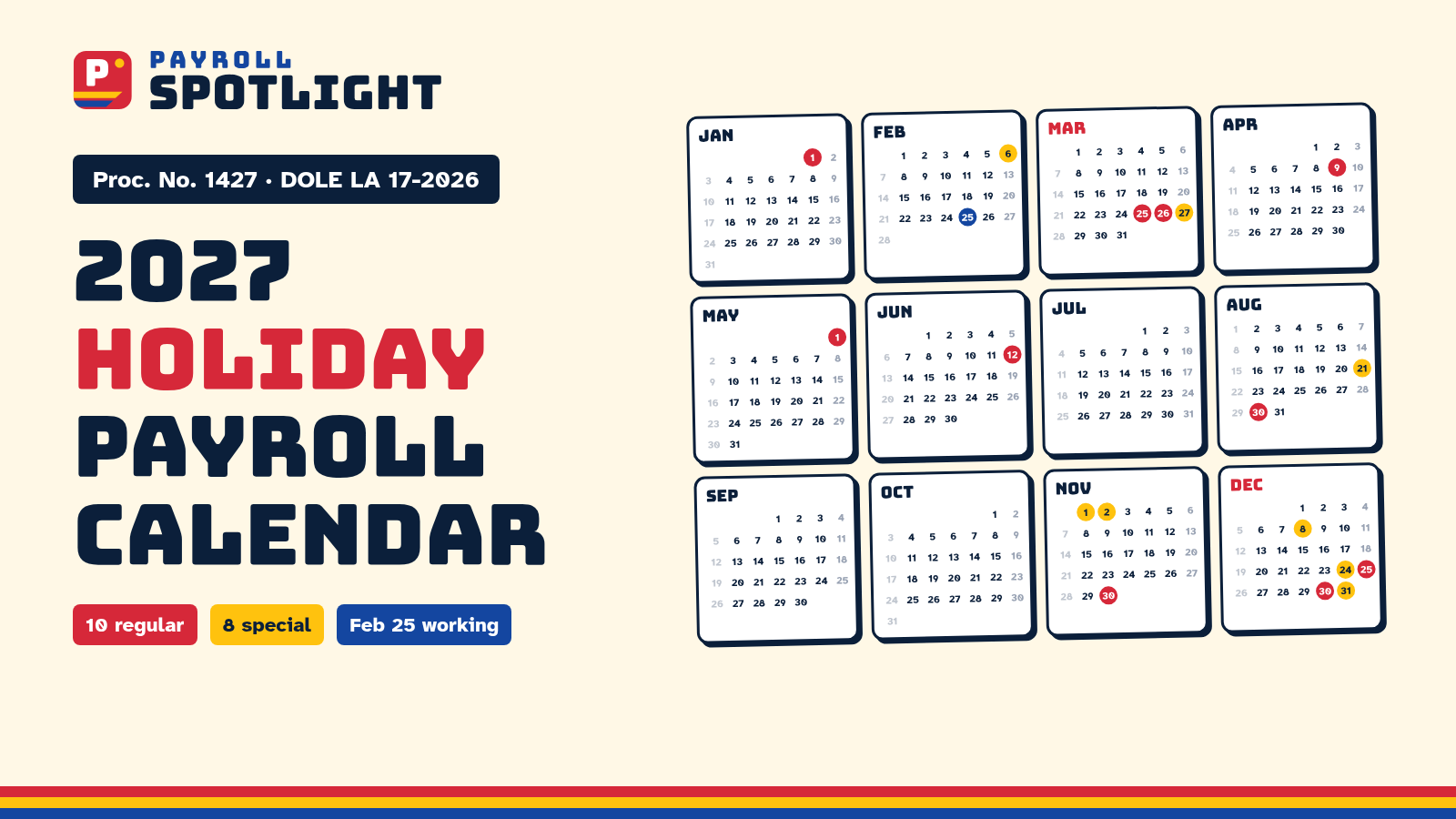
Short answer (as of November 4, 2026): The 2027 holidays in the Philippines are 10 regular holidays, 8 special non-working days and 1 special working day, set by Proclamation No. 1427, s. 2026, signed September 8, 2026. Eid’l Fitr and Eid’l Adha will be added later by separate proclamations. DOLE’s pay rules for these dates are in Labor Advisory No. 17, s. 2026: a regular holiday is paid 100% if unworked (for eligible employees) and 200% if worked; a special day is “no work, no pay” unless your policy says otherwise, and 130% if worked. For payroll, the three things to flag now are the six holidays that fall on a Saturday, the four-date pile-up in the December 16–31 cut-off, and the fact that the 13th month deadline, December 24, 2027, is itself a special non-working day.
This guide is for payroll officers, HR leads, owners and NGO or campaign admins who need to set up 2027 timekeeping, cut-offs and paydays before January. It isn’t another list of long weekends. It maps every 2027 date to a semi-monthly cut-off, shows the DOLE multipliers with peso examples, and lists the paydays that collide with weekends or holidays. If you need this month’s rates, our holiday pay guide for November 2026 covers Undas, the NCR ASEAN Summit days and Bonifacio Day 2026.
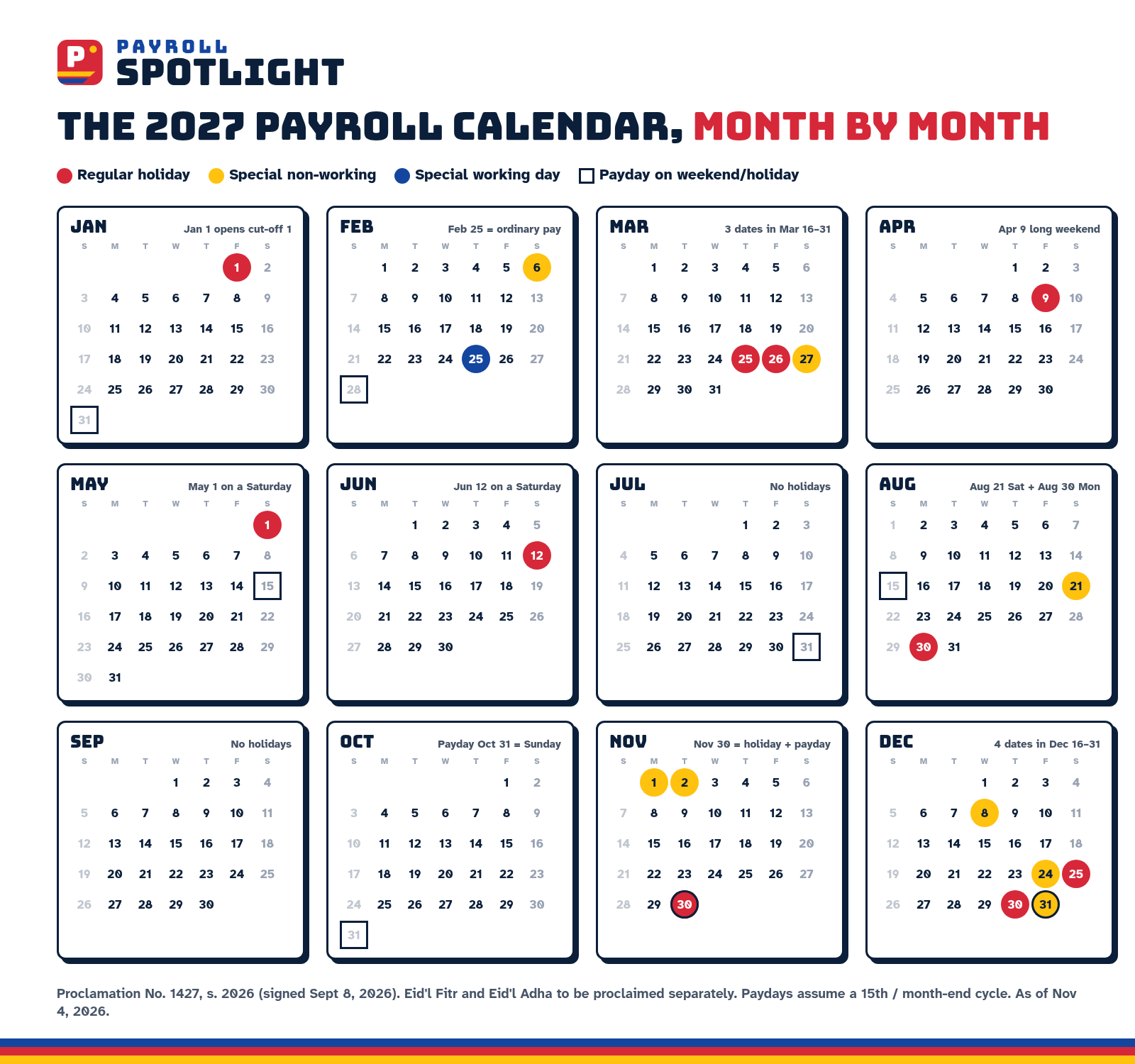
The 2027 holidays, mapped to your payroll cut-offs
The table assumes the common semi-monthly cycle (1st to 15th, 16th to month-end). If you pay weekly or on a 10th/25th cycle, the dates stay the same but the cut-off column shifts.
| Date (2027) | Day | Holiday | Type | Cut-off | Payroll note |
|---|---|---|---|---|---|
| Jan 1 | Fri | New Year’s Day | Regular | Jan 1–15 | Opens the year; the check day falls in 2026 (see below) |
| Feb 6 | Sat | Chinese New Year | Special non-working (additional) | Feb 1–15 | Only affects people who normally work Saturdays |
| Feb 25 | Thu | EDSA People Power Anniversary | Special working day | Feb 16–28 | Ordinary working day: 100%, overtime 125% |
| To be proclaimed | Eid’l Fitr | Regular | Likely March | Leave a placeholder | |
| Mar 25 | Thu | Maundy Thursday | Regular | Mar 16–31 | Two successive regular holidays |
| Mar 26 | Fri | Good Friday | Regular | Mar 16–31 | See the Holy Week attendance rule |
| Mar 27 | Sat | Black Saturday | Special non-working (additional) | Mar 16–31 | Saturday workers only |
| Apr 9 | Fri | Araw ng Kagitingan | Regular | Apr 1–15 | Long weekend |
| May 1 | Sat | Labor Day | Regular | May 1–15 | Saturday regular holiday |
| To be proclaimed | Eid’l Adha | Regular | Likely May | Leave a placeholder | |
| Jun 12 | Sat | Independence Day | Regular | Jun 1–15 | Saturday regular holiday |
| Aug 21 | Sat | Ninoy Aquino Day | Special non-working | Aug 16–31 | Saturday workers only |
| Aug 30 | Mon | National Heroes Day | Regular | Aug 16–31 | Long weekend |
| Nov 1 | Mon | All Saints’ Day | Special non-working | Nov 1–15 | |
| Nov 2 | Tue | All Souls’ Day | Special non-working (additional) | Nov 1–15 | Two special days in a row |
| Nov 30 | Tue | Bonifacio Day | Regular | Nov 16–30 | Also the month-end payday |
| Dec 8 | Wed | Feast of the Immaculate Conception | Special non-working | Dec 1–15 | |
| Dec 24 | Fri | Christmas Eve | Special non-working (additional) | Dec 16–31 | Also the 13th month deadline |
| Dec 25 | Sat | Christmas Day | Regular | Dec 16–31 | Saturday regular holiday |
| Dec 30 | Thu | Rizal Day | Regular | Dec 16–31 | |
| Dec 31 | Fri | Last Day of the Year | Special non-working | Dec 16–31 | Also the month-end payday |
Dates, days and types are from the proclamation’s text on LawPhil and the signed copy on the PCO website. Weekdays are our own check against the 2027 calendar.
What DOLE says you pay on each type of day
Labor Advisory No. 17, s. 2026, announced by DOLE on September 30, 2026, applies the usual formulas to the 2027 dates. The rest-day lines follow the same computations in DOLE’s Handbook on Workers’ Statutory Monetary Benefits (2024 edition).
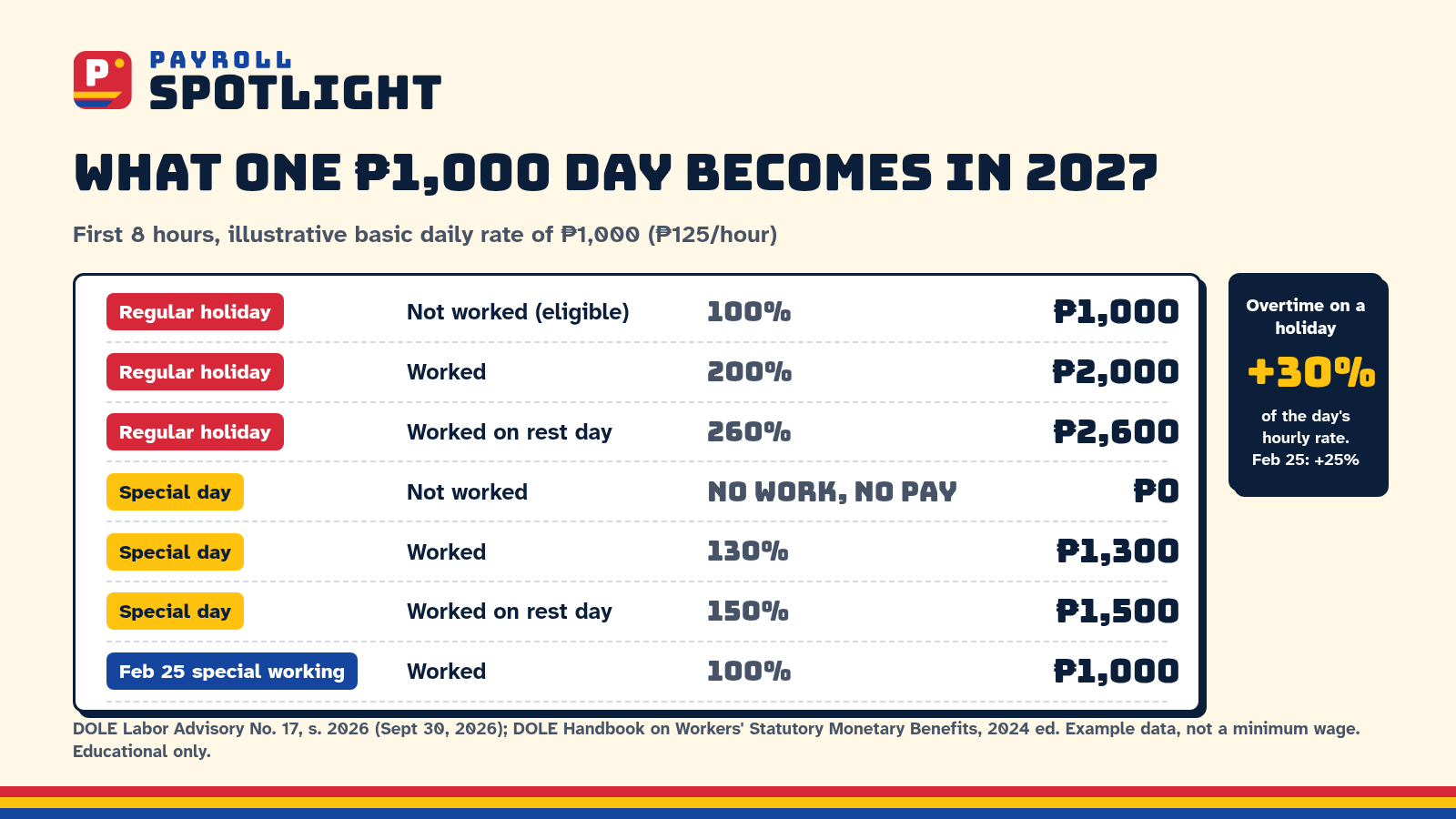
To make the math easy to check, every example uses an illustrative basic daily rate of ₱1,000 (₱125 an hour for 8 hours). That’s example data, not a minimum wage. For your region’s floor, see our minimum wage guide for 2026.
| Situation | DOLE formula | On ₱1,000/day | 2 hours overtime |
|---|---|---|---|
| Regular holiday, not worked (eligible) | Basic wage × 100% | ₱1,000 | – |
| Regular holiday, worked | Basic wage × 200% | ₱2,000 | ₱125 × 200% × 130% × 2 = ₱650 |
| Regular holiday on rest day, worked | Basic wage × 200% × 130% | ₱2,600 | ₱125 × 260% × 130% × 2 = ₱845 |
| Special day, not worked | No work, no pay (unless policy, practice or CBA) | ₱0 | – |
| Special day, worked | Basic wage × 130% | ₱1,300 | ₱125 × 130% × 130% × 2 = ₱422.50 |
| Special day on rest day, worked | Basic wage × 150% | ₱1,500 | ₱125 × 150% × 130% × 2 = ₱487.50 |
| Feb 25 special working day, worked | Basic wage × 100% | ₱1,000 | ₱125 × 125% × 2 = ₱312.50 |
Night shift differential stacks on top. Under Article 86 of the Labor Code, work between 10 p.m. and 6 a.m. gets at least 10% of the regular rate for that time, so on a worked regular holiday each night hour earns at least ₱125 × 200% × 10% = ₱25 extra. Our overtime and night differential guide has the full stacking table.
Monthly-paid staff: the DOLE handbook defines monthly-paid employees as those “paid every day of the month, including unworked rest days, special days, and regular holidays.” Their 2027 pay only changes on days they actually work, when the premium is added.
The six Saturday holidays: who they affect
Six 2027 dates land on a Saturday: Feb 6, Mar 27, May 1, Jun 12, Aug 21 and Dec 25. Three are regular holidays (Labor Day, Independence Day, Christmas) and three are special days (Chinese New Year, Black Saturday, Ninoy Aquino Day). How they hit payroll depends on the schedule:
- Monday to Friday, daily-paid: the three Saturday special days change nothing, since no one works and nothing is paid. The three Saturday regular holidays still earn eligible employees 100% even though nobody works that day. Article 94 of the Labor Code pays the regular daily wage on regular holidays, and the DOLE handbook defines daily-paid employees as those paid “on the days they actually worked and on unworked regular holidays.” Budget three days of holiday pay that produce no work hours.
- Monday to Saturday (retail, food, clinics, logistics): all six are scheduled workdays. Anyone who works is paid 200% on May 1, Jun 12 and Dec 25 and 130% on Feb 6, Mar 27 and Aug 21.
- Saturday is the rest day (for example, Sunday-to-Thursday or rotating shifts): working on those days moves up to the rest-day lines, 260% for a regular holiday and 150% for a special day.
The trap is a shared template that assumes Saturdays are always off. Tag each employee’s actual rest day in your timekeeping before January, not after the first Saturday holiday.
Holy Week and the “day before” rule
An unworked regular holiday is only paid if the employee worked, or was on paid leave, on the workday immediately before it. If that day is the employee’s rest day or a non-working day in the establishment, you look at the workday before that. DOLE restated this in the 2027 advisory.
Holy Week is the classic case: Maundy Thursday (Mar 25) and Good Friday (Mar 26) are back-to-back regular holidays. The DOLE handbook’s section on successive regular holidays (also in DOLE’s FAQs on wage and wage-related benefits) uses this exact pair as its example. An employee absent without pay on the day before the first holiday isn’t paid for either one, unless they work on the first holiday, which then entitles them to holiday pay for the second.
Example (example data, ₱1,000/day, Monday to Friday):
- Ana works Wednesday, Mar 24, and stays home on both holidays: ₱1,000 + ₱1,000 = ₱2,000.
- Ben is absent without pay on Mar 24 and stays home: ₱0 for Mar 25 and 26.
- Carla is absent without pay on Mar 24 but works 8 hours on Maundy Thursday: ₱2,000 for Mar 25, plus ₱1,000 holiday pay for Good Friday = ₱3,000.
New Year’s Day needs the same care. For a Monday-to-Friday team, the days just before Friday, Jan 1, 2027 are Thursday, Dec 31, 2026 (a special non-working day under the 2026 proclamation) and Wednesday, Dec 30, 2026 (Rizal Day). Decide in writing which day your system treats as the check day, and if the rule leaves you unsure, pay it.
Christmas week 2027: the busiest cut-off of the year
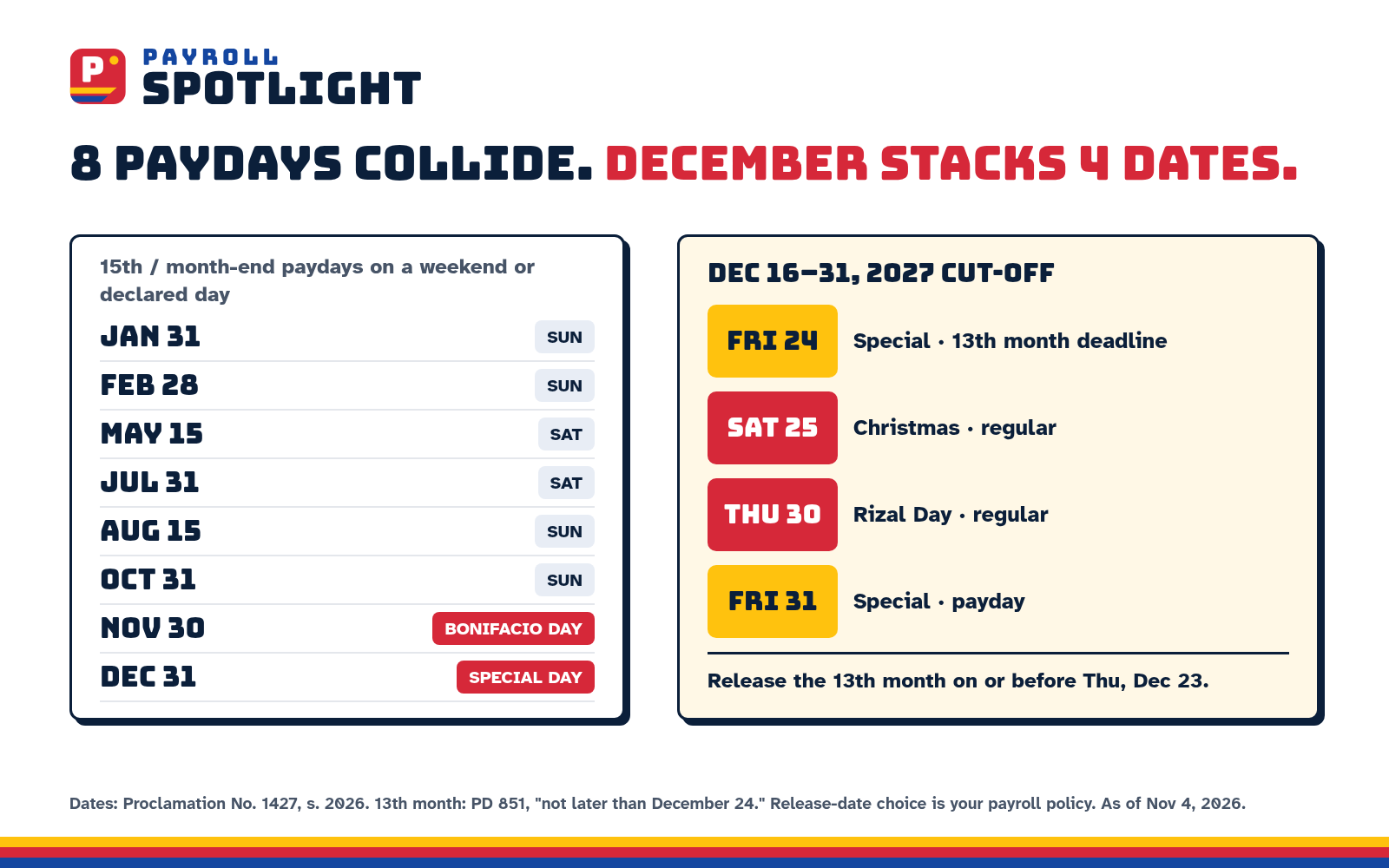
The December 16–31 cut-off has four dates: Dec 24 (special), Dec 25 (regular, Saturday), Dec 30 (regular) and Dec 31 (special). It also ends on a payday that’s a special non-working day.
Worked example (example data): Dina is a daily-paid store supervisor at ₱1,000 a day, Monday to Saturday, rest day Sunday. She works 8 hours on Dec 24, Dec 25 and Dec 31 and is off on Rizal Day after working Dec 29.
| Date | What happened | Pay |
|---|---|---|
| Fri, Dec 24 | Worked, special day | ₱1,000 × 130% = ₱1,300 |
| Sat, Dec 25 | Worked, regular holiday (not her rest day) | ₱1,000 × 200% = ₱2,000 |
| Thu, Dec 30 | Not worked, eligible | ₱1,000 × 100% = ₱1,000 |
| Fri, Dec 31 | Worked, special day | ₱1,000 × 130% = ₱1,300 |
| Total for the four dates | ₱5,600 |
That’s ₱1,600 more than four ordinary days (₱4,000), from three worked holiday shifts. Multiply by your holiday roster and you have December’s premium budget.
Paydays that collide with weekends or holidays
This is the part most 2027 lists skip. On a 15th/end-of-month schedule, eight 2027 paydays fall on a weekend or a declared day:
| Payday | Day | Why it matters |
|---|---|---|
| Jan 31 | Sunday | Weekend |
| Feb 28 | Sunday | Weekend |
| May 15 | Saturday | Weekend for Monday-to-Friday offices and banks |
| Jul 31 | Saturday | Weekend |
| Aug 15 | Sunday | Weekend |
| Oct 31 | Sunday | Weekend; the Nov 1–2 special days follow |
| Nov 30 | Tuesday | Bonifacio Day, regular holiday |
| Dec 31 | Friday | Last Day of the Year, special non-working day |
Most employers release pay on the last banking day before. Whatever you choose, put it in your payroll policy and calendar, and move the cut-off and approval dates back with it. Our payroll cut-off and timekeeping guide shows how to build the lag between cut-off and payday.
13th month in 2027: Presidential Decree No. 851 requires payment “not later than December 24 of every year.” In 2027 that’s a Friday and a special non-working day, so plan to release on or before Thursday, Dec 23. The 13th month worksheet covers the computation.
Eid’l Fitr and Eid’l Adha: plan with placeholders
Section 2 of Proclamation No. 1427 says the Eid holidays will be proclaimed separately once their dates are set by the Islamic calendar or astronomical calculation, on the recommendation of the National Commission on Muslim Filipinos. As of November 4, 2026, neither 2027 date has been proclaimed. Published astronomical estimates point to roughly mid-March (Eid’l Fitr) and mid-May (Eid’l Adha), but those are not official.
What to do now: add two “regular holiday, date to follow” lines to your March and May calendars, keep the regular-holiday pay rules ready for them, and watch the Official Gazette and PCO for the proclamations. Proclamations usually come only weeks ahead, sometimes days.
Mistakes that cost money in a holiday year
- Treating Feb 25 as a special non-working day. In 2027 it’s a special working day. Work is paid at ordinary rates, and an employee who doesn’t work isn’t paid unless your policy says otherwise.
- Paying 130% on a special day that is the employee’s rest day. The rate is 150%.
- Skipping holiday pay on Saturday regular holidays for Monday-to-Friday daily-paid staff. May 1, Jun 12 and Dec 25 are still paid at 100% to eligible employees.
- Overtime at +25% on holidays. Holiday and special-day overtime is +30% of the holiday hourly rate. Only the Feb 25 special working day uses +25%.
- Forgetting the check day around successive holidays, like Mar 25–26 and Nov 1–2.
- Missing later proclamations. Eid dates, local special days and one-off national days (like the NCR ASEAN Summit days in November 2026) are declared during the year.
Who this is for, and who can skim
Read closely if you pay daily-rated staff, run Monday-to-Saturday or 24/7 operations, or have sites in several regions on one payroll. Skim if everyone is monthly-paid and nobody works on holidays. Get labor counsel if you have a CBA with holiday terms better than the law, or you’re changing a long-standing practice of paying special days. Stopping a benefit you’ve always given can raise a non-diminution issue.
2027 holiday payroll checklist
- Load all 18 dates and the Feb 25 special working day into your timekeeping and payroll system, with two Eid placeholders.
- Record each employee’s actual rest day and work week (Monday to Friday, Monday to Saturday, rotating).
- Map each date to its cut-off and flag Mar 16–31 and Dec 16–31 as heavy periods.
- Set the release rule and date for the eight colliding paydays.
- Schedule the 13th month release on or before Dec 23, 2027.
- Brief supervisors on the check-day rule before Holy Week and New Year.
- Budget holiday premiums from your roster (as in the Christmas week example).
- Subscribe to proclamation updates and re-check the calendar each quarter.
FAQ
How many holidays are there in the Philippines in 2027?
Proclamation No. 1427, s. 2026 lists 10 regular holidays and 8 special non-working days, plus February 25 as a special working day. Eid’l Fitr and Eid’l Adha will be added as regular holidays by separate proclamations, which would bring regular holidays to 12.
Is February 25, 2027 a holiday?
No. The EDSA People Power anniversary is a special working day in 2027. DOLE treats it as an ordinary working day: 100% of the basic wage for the first 8 hours and an extra 25% of the hourly rate for overtime.
What is the holiday pay if a 2027 regular holiday falls on a Saturday?
If the employee works and Saturday is a regular workday, 200% of the daily wage. If Saturday is their rest day and they work, 260%. Eligible employees who don’t work still get 100%, even if Saturday is a non-working day for them.
When will the 2027 Eid’l Fitr and Eid’l Adha dates be announced?
They are proclaimed separately once the Islamic calendar dates are determined, on the National Commission on Muslim Filipinos’ recommendation. As of November 4, 2026, neither has been proclaimed. Keep placeholders in March and May.
Do monthly-paid employees get extra pay on 2027 holidays?
Only if they work. Under the DOLE handbook, monthly-paid employees on a factor that covers every day of the month are already paid for unworked regular holidays and special days. Working on one adds the premium.
What to do next
Put the 2027 dates, your employees’ real rest days and the eight colliding paydays into your system this month, before the first cut-off of January opens. If you’d rather not rebuild holiday rules in spreadsheets, Payroll Spotlight applies DOLE holiday, rest-day and overtime multipliers per employee schedule. See plans and the free trial.
This guide is educational and reflects Philippine rules as of November 4, 2026, based on Proclamation No. 1427, s. 2026, DOLE Labor Advisory No. 17, s. 2026, the Labor Code and the DOLE Handbook on Workers’ Statutory Monetary Benefits (2024 edition). Names and figures in the examples are illustrative. It isn’t legal advice. Later proclamations can add or move dates, so check the Official Gazette before each cut-off.
Leave a Reply