
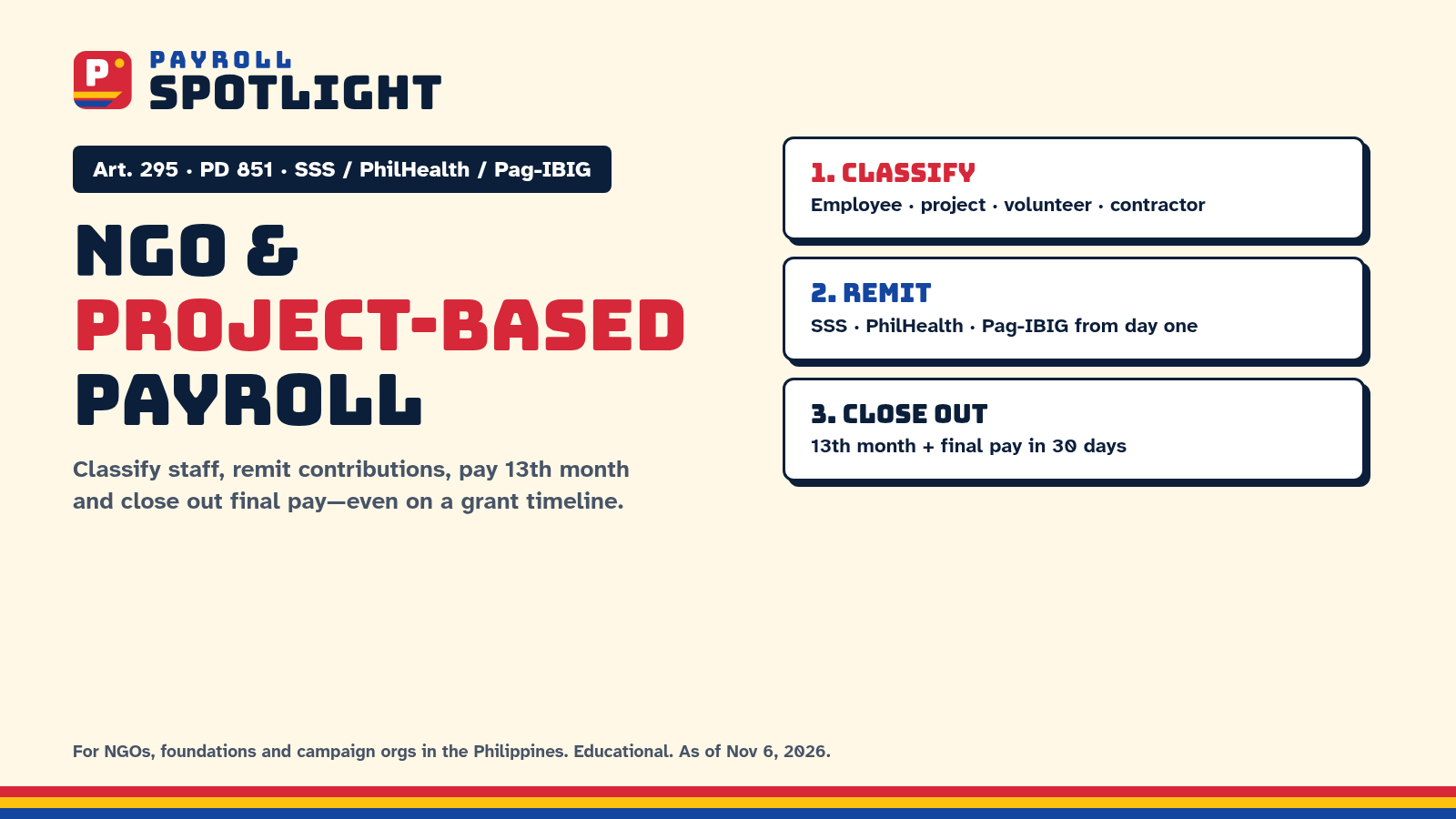
Short answer (as of November 6, 2026): In the Philippines, NGOs, foundations, campaign organizations and other project-driven employers are covered by the Labor Code whether or not they operate for profit (Article 293). Staff hired for a specific project whose completion was fixed at hiring may be project employees under Article 295 (formerly Art. 280)—but the label on the contract is not enough. If the work continues after the “project” ends, or the person was never told a clear end date at engagement, labor tribunals often treat them as regular. Project employees who are employees still get SSS, PhilHealth and Pag-IBIG, proportionate 13th-month pay if they worked at least one month in the calendar year, a payslip, and final pay within 30 days of separation under DOLE Labor Advisory No. 06, s. 2020. Unpaid “volunteers” who are directed like staff and paid like staff are a common misclassification risk for campaigns and NGOs.
This guide is for finance officers, HR leads, executive directors and campaign admins who hire field organizers, MEL officers, trainers, enumerators, creatives and project coordinators on donor or grant timelines. It is educational, not legal advice. For your facts, read the linked statutes and ask counsel or DOLE when a case is borderline.
Who this is for (and who should skip)
Use this if you:
- Run an NGO, foundation, people’s organization, church social arm, or campaign HQ that hires people for funded projects
- Use fixed end dates, “project-based,” “contractual,” or “volunteer stipend” language in engagement letters
- Charge salaries across multiple donors or grants and need clean payroll + remittance trails
- Need a payroll checklist when a six-month project ends mid-year
Skip or skim if you: only hire one regular admin, never use project contracts, and already run full statutory payroll the same way as a private company. The classification traps below still matter if anyone is labeled a volunteer or freelancer.
The classification checklist: five boxes, one real status
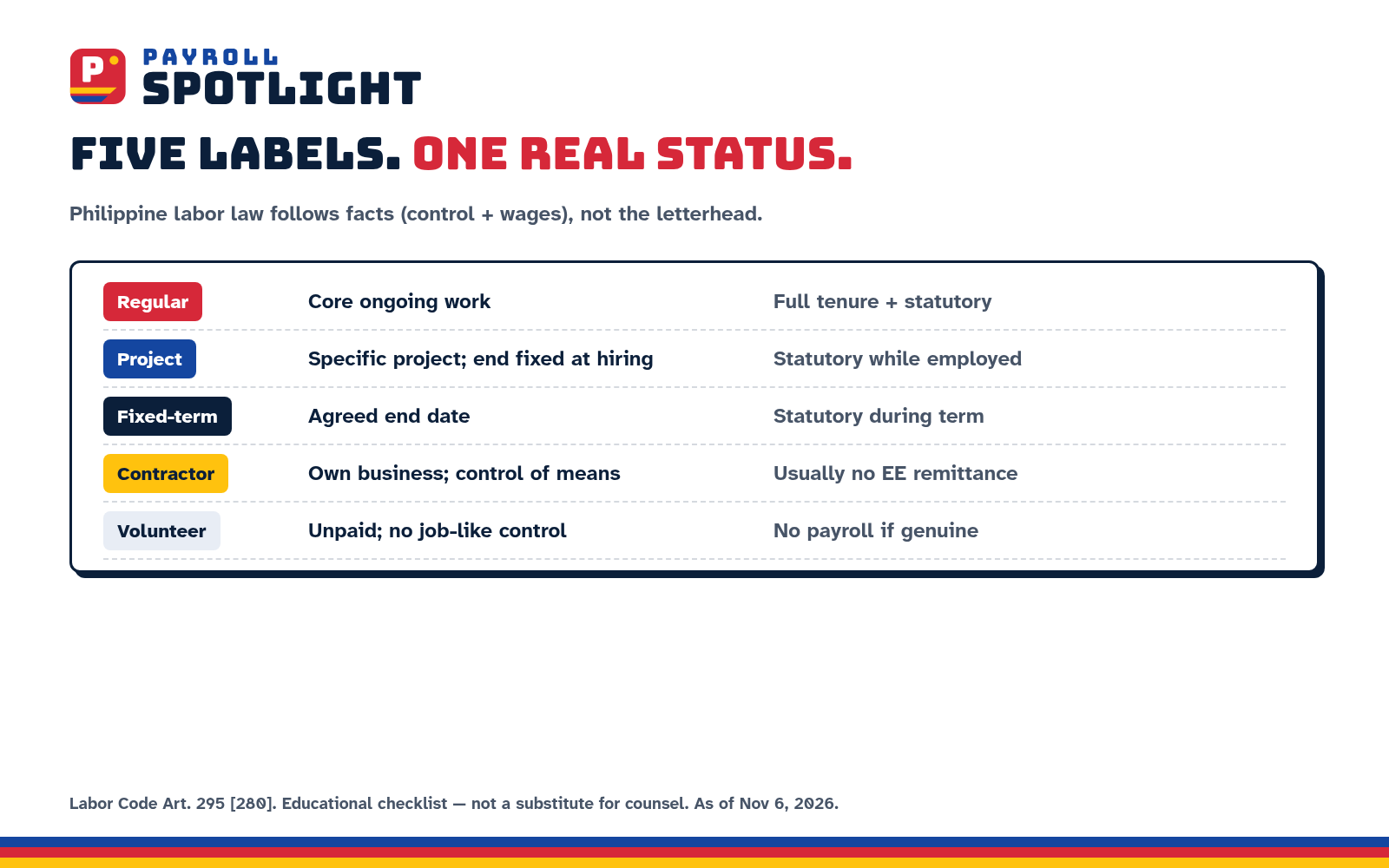
Philippine labor law cares about facts, not stationery. Use this table before you issue an ID, a stipend, or a DOLE RKS Form 5-style project report pattern your counsel recommends.
| Label people use | Usual legal idea | Still an “employee”? | Typical payroll duties if yes |
|---|---|---|---|
| Regular / permanent staff | Activities usually necessary or desirable in your usual work (Art. 295) | Yes | Full wages, SIL (if eligible), holiday pay rules, contributions, 13th month, security of tenure |
| Project employee | Hired for a specific project or undertaking whose completion/termination was determined at engagement (Art. 295 exception) | Yes, for the project period | Same statutory money benefits while employed; employment ends when the real project ends |
| Fixed-term / “contractual” | Period fixed by agreement; often used for grants | Often yes | Same statutory benefits during the term; repeated short terms for ongoing core work are a regularization risk |
| Independent contractor / freelancer | Own business, tools, control over means; paid for a result (invoice), not wages under your control | Usually no (if genuine) | No SSS EE/ER remittance as employer; may still have BIR expanded withholding on purchases of services—see your tax rules |
| Unpaid volunteer | Genuine volunteerism without wages; no employer control like a job | Usually no | No payroll; document role carefully. Paid “volunteer stipends” + set hours + supervisors often look like employment |
Four practical tests when you are unsure (drawn from long-standing jurisprudence on employer-employee relationship; not a statute checklist):
- Selection and engagement — Did your NGO pick and place the person?
- Payment of wages — Do you pay a wage, stipend, or allowance on a schedule you set?
- Power of dismissal — Can you end the engagement for cause or convenience under your rules?
- Control — Do you control how the work is done (hours, tools, scripts, attendance), not only the result?
If most answers are yes, budget for employee payroll even if the memo says “volunteer” or “consultant.”
What Article 295 actually allows for project employment
Under Article 295 of the Labor Code (old Art. 280), employment is generally regular when the person performs activities usually necessary or desirable in the employer’s usual business—except where:
- Employment was fixed for a specific project or undertaking, and
- The completion or termination of that project was determined at the time of engagement, or
- The work is seasonal and employment is only for the season.
So a six-month “Community Health Mapping Project — Grant ABC” with a written scope, a start date, an end date tied to the grant, and a clear statement at hiring that employment ends when the mapping deliverable is accepted, can be genuine project employment. A forever-renewed “Project Assistant — Operations” who does the same core admin work every year is the classic trap.
Security-of-tenure trap: When the “project” ends on paper but the person keeps doing the same work for the next donor, under a new contract with a new title, tribunals often find regular employment. Article 294 protects regular employees from termination except for just or authorized causes with due process. Ending a fake project is treated as dismissal.
Contracting note: Hiring through a manpower agency or “job contractor” is a separate track under Articles 106–109 and DOLE’s contracting rules (Department Order No. 174, s. 2017 on contracting and subcontracting). Labor-only contracting is prohibited; in those cases the principal can be treated as the direct employer. Genuine project employment of your own staff is not the same thing as labor-only contracting—but using an intermediary to supply people for your core program without a legitimate contracting setup is a different risk. Have counsel map which box you are in before you scale a field team.
Volunteers, stipends and campaign orgs
Campaign seasons and disaster responses lean hard on volunteers. That is fine when people truly volunteer. Trouble starts when:
- “Volunteers” have fixed shifts, KPIs, and a team lead who disciplines attendance
- You pay a daily stipend, meal allowance, or “honorarium” that looks like a wage
- You issue IDs, NDAs, and performance evaluations like employees
- The same people roll from one campaign to the next under the NGO’s control
There is no Labor Code free pass that says “NGO + stipend = not an employee.” Article 293 applies to establishments whether for profit or not. If a dispute lands in DOLE or the NLRC, the four-fold / control analysis above usually decides it. Safer patterns:
- Keep genuine volunteers unpaid (or limited to documented reimbursements of actual expenses)
- Put paid organizers on project employment contracts with clear end dates, remittances, and 13th-month accrual
- Do not mix “volunteer” branding with employee-level control
Mandatory contributions: project length is not an exemption
If the person is your employee, SSS compulsory coverage for private-sector employees under Republic Act No. 11199 starts on the first day of employment. PhilHealth and Pag-IBIG membership duties for employed persons likewise follow the employee relationship—not the project label. Short contracts do not create a holiday from remittance.
For 2026 private-employee rates (same schedule as our contribution table guide):
| Agency | 2026 headline rate (private employees) | Notes |
|---|---|---|
| SSS | 15% of Monthly Salary Credit (employee 5%, employer 10%) + employer EC | MSC brackets up to ₱35,000 |
| PhilHealth | 5% of monthly basic salary, split 2.5% / 2.5% | Floor ₱10,000; ceiling ₱100,000 |
| Pag-IBIG | 2% employee + 2% employer on Monthly Fund Salary | MFS capped at ₱10,000 → ₱200 each mandatory max |
Register the worker, deduct the employee share, add the employer share, and remit on the agency deadlines for every month wages are paid. Our payslip requirements guide covers what must appear on each pay document.
13th-month pay for project-based staff
Under Presidential Decree No. 851 and DOLE’s handbook summary, covered employers must pay rank-and-file employees a 13th-month benefit regardless of the nature of their employment, provided they worked at least one (1) month during the calendar year. The amount is 1/12 of total basic salary earned in the calendar year, due not later than December 24. An employee who resigns or whose project ends mid-year still gets the proportionate amount for months worked (see also our 13th-month worksheet).
NGOs sometimes assume non-profits are exempt. The original implementing rules listed a narrow path for certain distressed non-profit institutions, historically subject to prior authorization—not a blanket NGO waiver. Do not skip 13th month on “we’re an NGO” alone.
Worked example: six-month project staffer (example data)
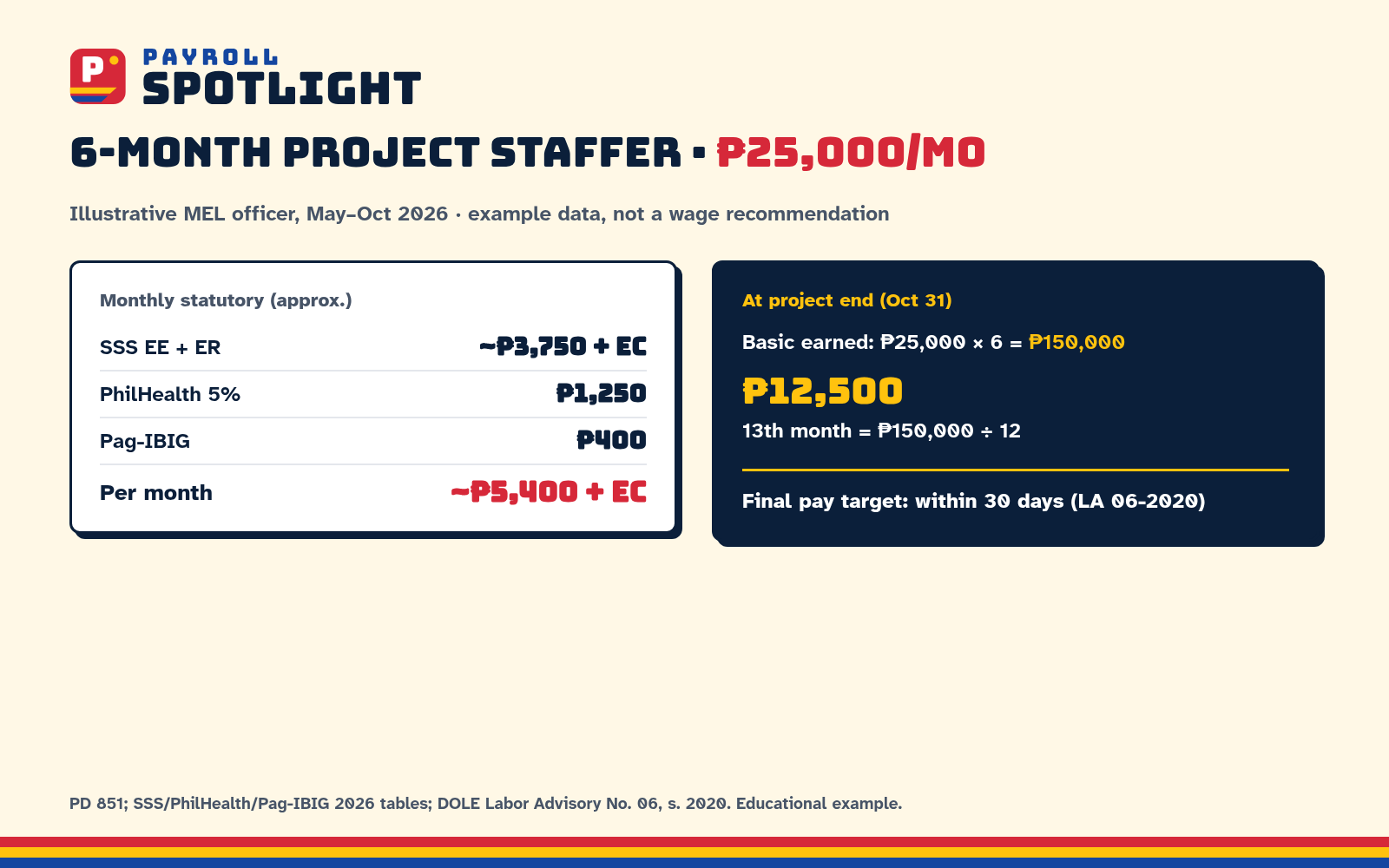
Facts (illustrative only): Maya is hired by a Metro Manila NGO as MEL Officer for Grant DEF — Water Access Mapping, May 1 to October 31, 2026. Monthly basic salary ₱25,000. Written project contract states the engagement ends on grant close-out. No overtime in this simplified example. Region wage floors are met (see minimum wage 2026).
Monthly statutory snapshot (approximate, using 2026 tables):
| Item | Employee share | Employer share | Monthly total |
|---|---|---|---|
| SSS (MSC ₱25,000 bracket) | ₱1,250 | ₱2,500 + EC | ~₱3,750 + EC |
| PhilHealth (5% of ₱25,000) | ₱625 | ₱625 | ₱1,250 |
| Pag-IBIG (capped) | ₱200 | ₱200 | ₱400 |
| Approx. monthly statutory | ₱2,075 | ~₱3,325 + EC | ~₱5,400 + EC |
Over six months (May–Oct): about ₱12,450 employee deductions and ~₱19,950 + EC employer cost for contributions alone, before wages.
13th-month pay at project end (Oct 31, 2026):
- Total basic salary earned = ₱25,000 × 6 = ₱150,000
- Proportionate 13th month = ₱150,000 ÷ 12 = ₱12,500
- Pay with final pay (or by Dec 24 if she were still employed then)
Final pay package (conceptually): unpaid wages through last day, proportionate 13th month (₱12,500), cash conversion of unused SIL if she became entitled and your policy/law requires it, tax documents, and any authorized deductions only. Under DOLE Labor Advisory No. 06, s. 2020, aim to release final pay within 30 days from separation and a Certificate of Employment within 3 days of request—details and a worksheet are in our final pay guide.
NGO multi-donor / multi-project cost-charging pitfalls
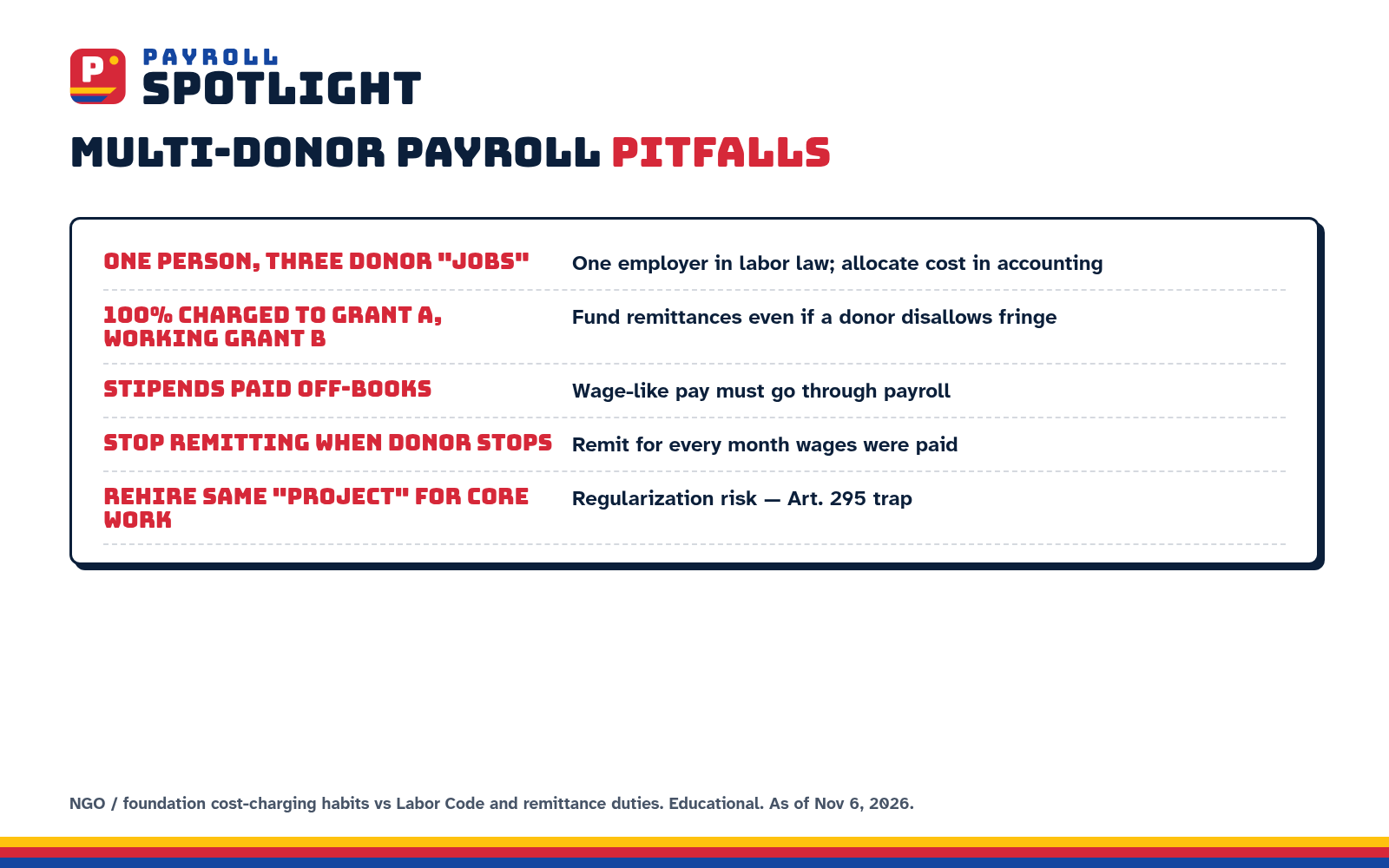
| Pitfall | Why payroll breaks | Safer habit |
|---|---|---|
| One person, three donor codes, three “jobs” | Overtime, rest day and holiday rules still see one employer; splitting codes does not create three employment relationships | One employment file; allocate salary cost in accounting, not three conflicting contracts |
| Charging 100% of salary to Grant A while the person also runs Grant B field work | Audit finding + under-funded remittances if Grant A ends early | Timesheets aligned to effort; remittances funded even if a donor disallows “fringe” |
| Paying “stipends” from unrestricted funds off-books | Missing SSS/PhilHealth/Pag-IBIG and 13th month | All wage-like payments go through payroll |
| Ending remittances the month the donor stops reimbursing | Coverage gap and penalties; employee still worked | Remit for every month wages were paid, then recover from the right cost center |
| Rehiring the same “project” person every quarter for core programs | Regularization / illegal dismissal exposure | Either genuine new projects with proof, or regularize |
Cut-offs, payslips and leave while the project runs
Project staff still need a clear cut-off and timekeeping rule. If they cross one year of service, service incentive leave and other tenure-linked benefits under the Labor Code and special laws may kick in—see our leave benefits 2026 guide. Do not wait until grant close-out to discover missing time records.
A practical hiring-to-close checklist for NGOs
- Define the project in writing before the offer: scope, deliverable, start, end or completion trigger.
- Classify honestly with the table above; if it fails the project test, hire as regular or fixed-term with eyes open.
- Register and enroll for SSS, PhilHealth and Pag-IBIG on or before first payroll.
- Run payroll with payslips, remittances and a cut-off calendar.
- Accrue 13th month every month (basic ÷ 12) so October close-outs are not a surprise.
- On project end: compute final pay, release within 30 days, issue COE, file the right BIR forms, and stop remittances only after the last wage month.
- Do not silently roll the person into the next grant under a new title without a real new project—or accept that you may have created regular employment.
FAQ
Are project-based employees entitled to 13th-month pay?
Yes, if they are rank-and-file employees who worked at least one month in the calendar year. PD 851 and DOLE guidance apply regardless of the nature of employment. Pay 1/12 of basic salary earned in the year, including a proportionate amount when the project ends mid-year.
Do NGOs have to remit SSS, PhilHealth and Pag-IBIG for short project hires?
If an employer-employee relationship exists, yes. SSS compulsory coverage for private-sector employees begins on the first day of employment. Project length is not a statutory exemption.
When does a “project employee” become regular?
When the legal tests for project employment fail—for example, no specific project fixed at hiring, or the person continues performing necessary/desirable work after the supposed project ends. Article 295 states the rule; disputes turn on evidence. Repeated contracts for ongoing core work are a common red flag.
Is a paid campaign “volunteer” really a volunteer?
Often not. Control, scheduled hours, and wage-like stipends point to employment. Unpaid genuine volunteers are different. When in doubt, treat paid roles as employment and run payroll.
How fast must final pay be released when a project ends?
DOLE Labor Advisory No. 06, s. 2020 expects final pay within 30 days from separation unless a more favorable company policy or agreement applies, and a Certificate of Employment within three days of the employee’s request. See the final pay worksheet.
What to do next
Pick one active engagement letter this week and run it through the classification table. If it is a true project hire, confirm remittances and 13th-month accrual are live; if it is ongoing program work wearing a project costume, talk to counsel about regularization before the next grant renewal. For day-to-day statutory payroll, see how Payroll Spotlight works or compare plans.
Educational only (YMYL). Philippine statutes, DOLE issuances and agency tables change. This page is not legal, tax or accounting advice and does not guarantee outcomes in DOLE, NLRC, SSS, PhilHealth, Pag-IBIG or BIR proceedings. Confirm figures against the linked official sources and your counsel. As of November 6, 2026.
Leave a Reply