
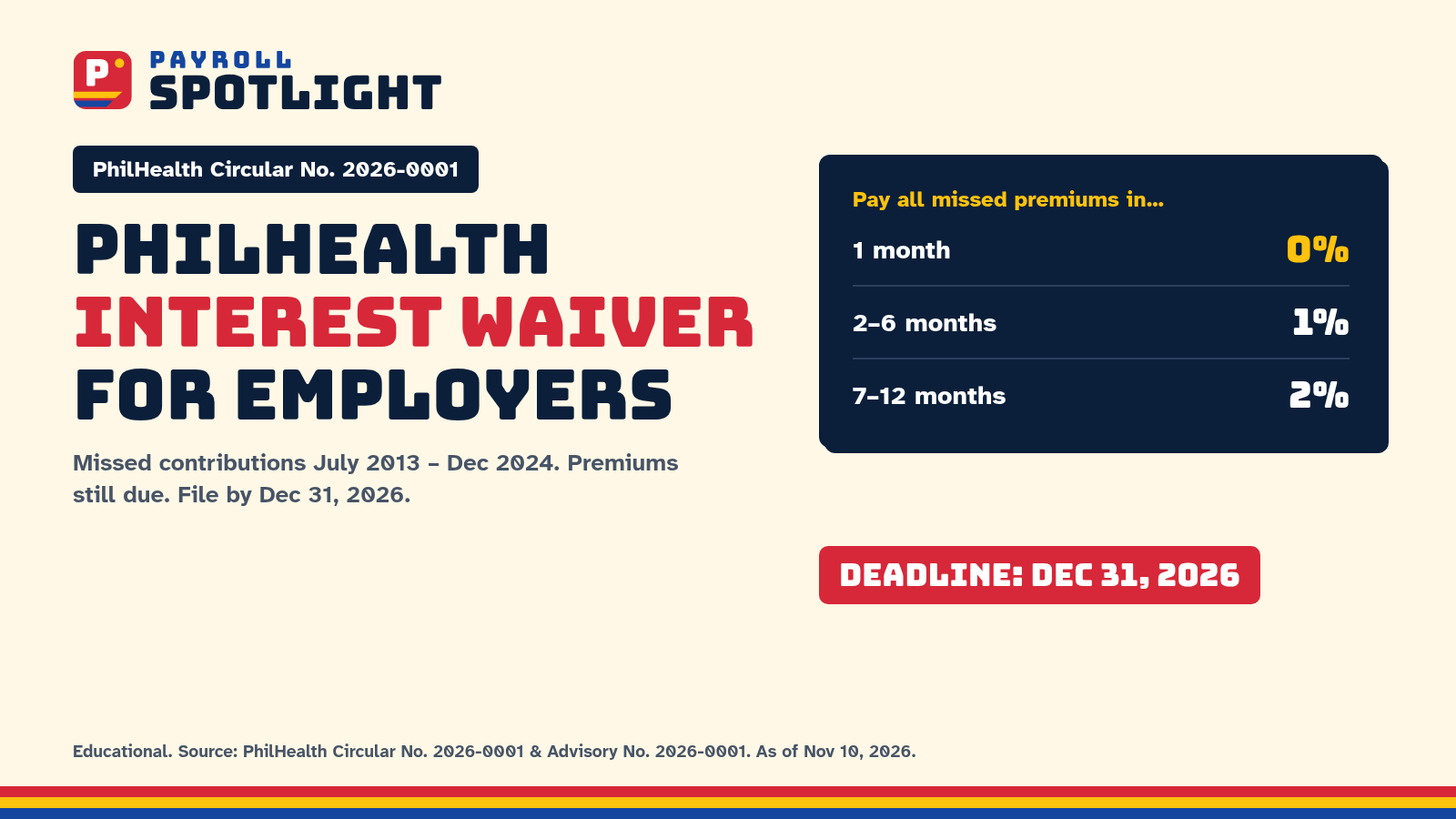
Short answer (as of November 10, 2026): Yes. PhilHealth is running a one-time waiver of interest for employers under PhilHealth Circular No. 2026-0001, announced in PhilHealth Advisory No. 2026-0001. It covers missed employer contributions for July 2013 to December 2024, for government and private employers. Pay all missed premiums within one month and the interest is fully waived. Take 2 to 6 months and a 1% simple interest applies; take 7 to 12 months and it is 2%. The premiums themselves are not waived. To qualify you must update your employer and employee records, enroll every employee in YAKAP (Yaman ng Kalusugan Program) and complete the First Patient Encounter (FPE). Requests are accepted only until December 31, 2026, which is 51 days from today.
This guide is for owners, HR and finance officers, and bookkeepers who know (or suspect) there are unpaid PhilHealth months in the company’s history: a lapse during the pandemic, a branch that never remitted, a payroll vendor that dropped a month, or a new owner who inherited an old account. It explains what the circular actually says, what it does not cover, and how to decide on a payment term before the deadline. It is educational, not legal advice.
What PhilHealth Circular 2026-0001 actually says
The circular, titled Recovery of Missed Employer Contributions Through a One-Time Waiver of Interest, was authorized by PhilHealth Board Resolution No. 3065, s. 2025. PhilHealth announced the program on January 6, 2026 after a directive from the President, and the guidelines followed in January. The key rules, in plain language:
| Rule | What the circular says |
|---|---|
| Who | All employers, government and private sector |
| Which months | Missed contributions for July 2013 to December 2024 |
| Filing deadline | Within one year of effectivity, but in no case beyond December 31, 2026 |
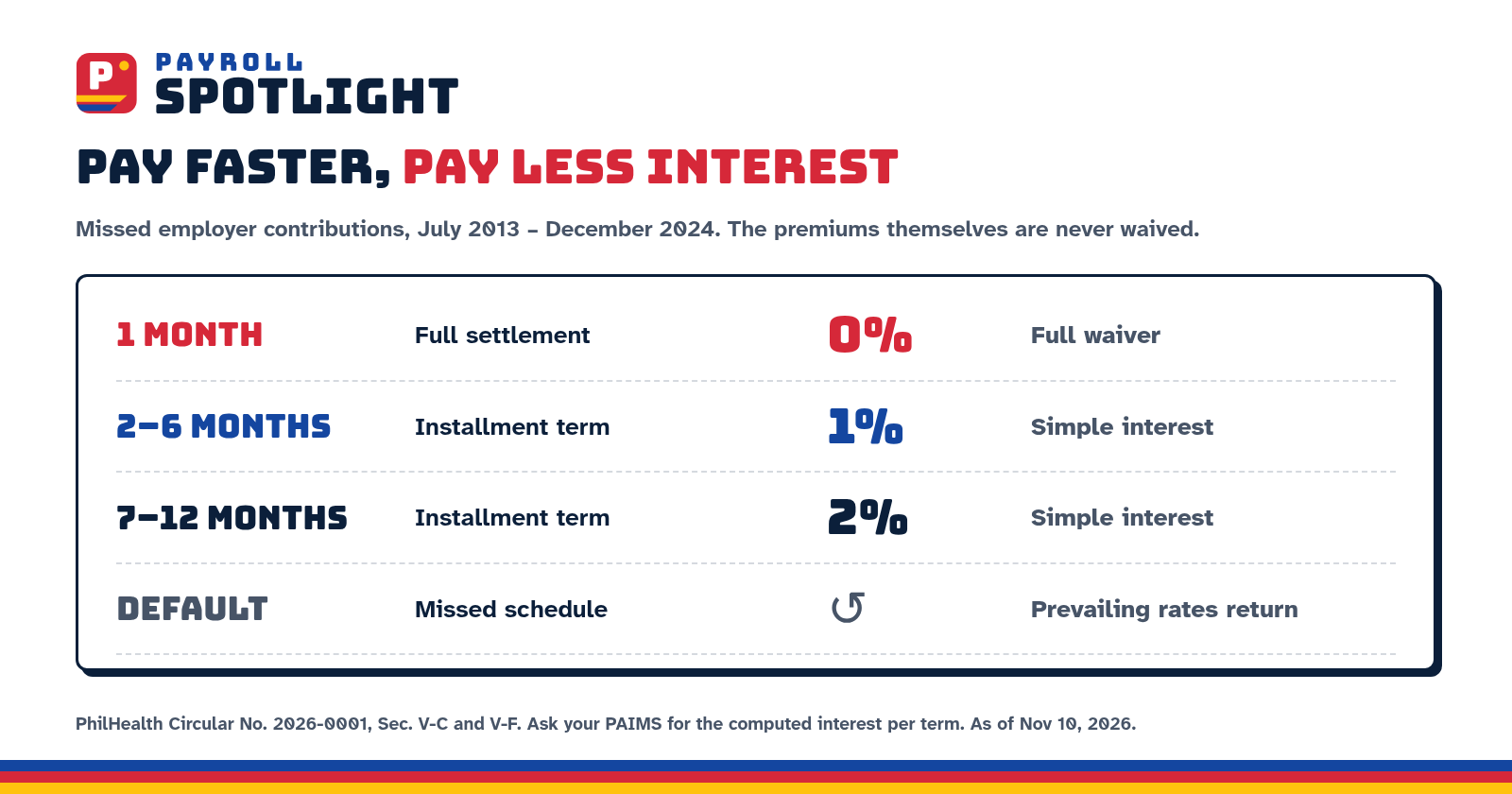
| Payment term | Settle all missed contributions within one year, using simple (not compounded) interest |
| 1-month settlement | Full waiver of interest |
| 2 to 6 months | 1% interest |
| 7 to 12 months | 2% interest |
| Requirements | Documentary requirements, updated employer and employee records, all employees assigned in YAKAP, First Patient Encounter completed |
| How to pay | Premiums online through EPRS using the SPA; interest over the counter at PhilHealth offices |
| Refunds | None for interest or surcharges you already paid |
| If you default | Prevailing interest rates under existing circulars apply again |
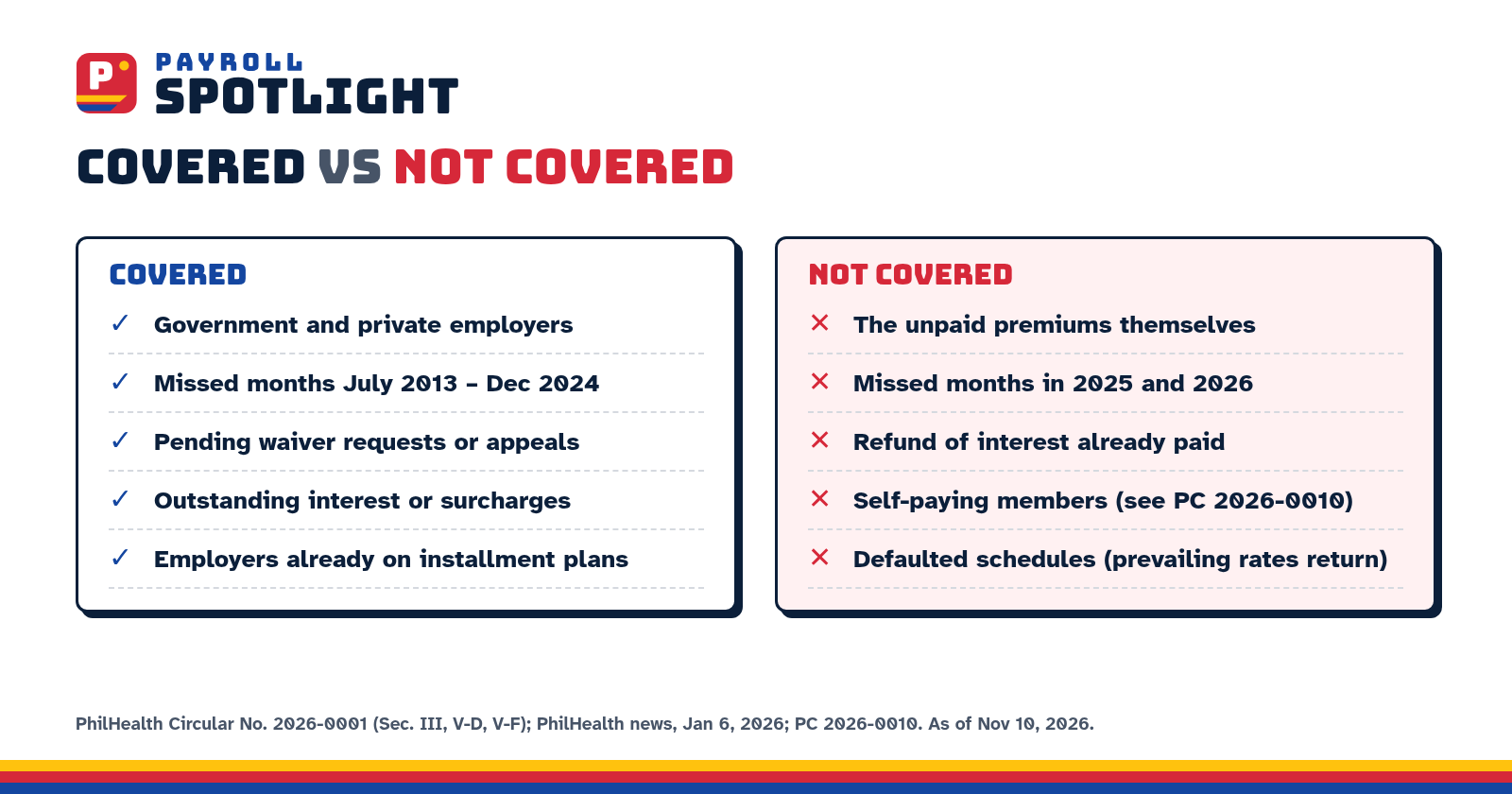
Two more details matter. Employers with pending waiver requests or appeals, with outstanding interest or surcharges, or already on an installment arrangement can still join, as long as they meet all requirements. And PhilHealth keeps the right to determine and collect the true contributions due even after you pay, so a waiver does not close the door on an audit of what you declared.
PhilHealth’s own Tamang Sagot Q&A on the circular repeats these points and tells employers to start with their assigned PhilHealth Accounts Information Management Specialist (PAIMS) or the nearest Local Health Insurance Office (LHIO).
Why this waiver is worth real money
Normal PhilHealth interest is steep. The circular itself restates that under the Universal Health Care Act and its IRR (Section 9.2), employers must pay missed contributions with at least 3% interest, compounded monthly. It also notes that an older rule of “2% interest or ₱200, whichever is higher” produced huge balances for employers with fewer than ten employees and for those with six or more missed months.
To see why compounding hurts, take ₱1,000 of missed premium (illustration only):
| Months unpaid | Balance at 3% compounded monthly | Interest alone |
|---|---|---|
| 12 | ₱1,425.76 | ₱425.76 |
| 24 | ₱2,032.79 | ₱1,032.79 |
| 36 | ₱2,898.28 | ₱1,898.28 |
After two years the interest is larger than the premium. Your actual Statement of Account may use different rules for different periods, so treat this as a sense of scale, not your number. The point is simple: an old arrear left alone keeps growing, while under the waiver a one-month settlement brings the interest to zero.
Also keep in mind that interest is not the only exposure. Section 38 of the UHC Act sets a fine of ₱50,000 per violation per affected employee (or imprisonment, or both) for employers who deliberately or through inexcusable negligence fail to deduct or remit contributions. Employee shares that were deducted from pay but not remitted within 30 days of the due date are presumed, under the same section, to have been misappropriated. The waiver changes the interest, not these rules, so fix deducted-but-unremitted months first. Your people saw those deductions on their payslips.
What the waiver does not cover
Read this part before you tell your boss “PhilHealth forgave our debt.” It didn’t.
- Premiums are not waived. PhilHealth’s announcement says the waiver “applies strictly to interest charges, and does not cover unpaid premium contributions.” You still pay every missed peso of employer and employee share.
- 2025 and 2026 months are outside the program. The window is July 2013 to December 2024 only. A missed month in 2025 is charged under the regular rules.
- No refunds. Interest you already paid on settled arrears stays paid.
- Ordinary negligence still isn’t excused. PhilHealth’s standing rule in Circular No. 2021-0010 is that interest on late remittance is not waived when the delay is due to the employer’s negligence. That circular lists narrow cases (mostly government budget delays and force majeure) where a waiver or installment plan can be considered. The 2026 program is a one-time exception, not a new normal.
- System-outage relief is separate. PhilHealth has issued narrow advisories for its own system problems, such as Advisory No. 2025-0051, which let employers request a waiver of interest for May to July 2025 when EPRS login and OTP issues caused late payment. That relief needed screenshots and a request letter, and it is not part of this program.
- Self-paying members have their own program. Freelancers, professionals, OFWs and other self-paying members are covered by a different circular, PhilHealth Circular No. 2026-0010, which covers November 2019 to December 2025, offers installment terms of up to 60 months, and accepts applications until December 31, 2027. Don’t mix the two up when you read news posts.
Worked example: a 12-person bakery with old gaps (example data)
Say a family bakery in Laguna changed bookkeepers in 2021 and discovers that PhilHealth was never remitted for several months between 2020 and 2022. The LHIO’s Statement of Account shows ₱96,000 in missed premiums (employer plus employee shares) and a much larger interest balance computed under the regular rules. All figures here are example data.
| Option | What the bakery pays | Interest under the program |
|---|---|---|
| Settle within 1 month | ₱96,000 in one go | ₱0 (full waiver) |
| 6-month term | about ₱16,000 a month in premiums | 1% simple interest, as computed by PhilHealth |
| 12-month term | about ₱8,000 a month in premiums | 2% simple interest, as computed by PhilHealth |
| Do nothing | The full arrear later | Regular compounded interest keeps running |
The circular does not spell out the interest base, so ask your PAIMS to show the computed interest for each term in writing before you choose. If the bakery can borrow or reallocate ₱96,000 for one month, the full waiver is almost always the cheapest path. If not, the shortest term it can actually keep wins, because missing a scheduled payment brings back the prevailing interest rates.
Step by step: how to avail before December 31, 2026
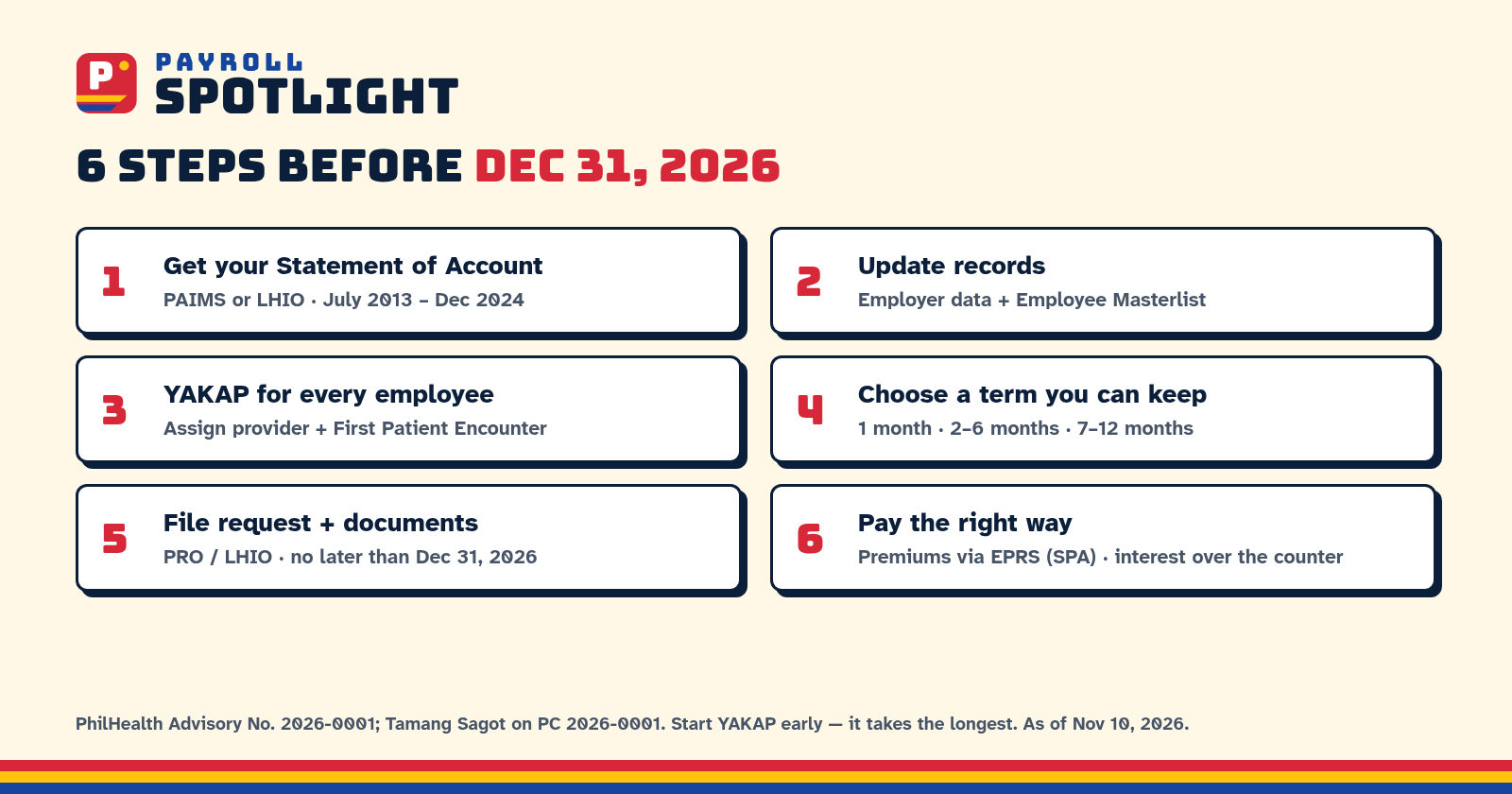
- Get the numbers. Ask your PAIMS or LHIO for a Statement of Account showing missed months from July 2013 to December 2024. Match it against your payroll registers and old remittance receipts. Some “missed” months may already be paid under another employer number or folder.
- Update your records. The advisory requires an updated Employee Masterlist and employer data in the PhilHealth system. Separated employees, wrong PINs and missing hires are the usual cleanup work.
- Do YAKAP for every employee. Each employee must be registered and assigned in YAKAP, and the First Patient Encounter must be completed. This is the step that takes the longest, because it involves your people visiting or connecting with a YAKAP provider. Start it this week.
- Choose a term you can fund. Use the decision rule below.
- File the request and documents with your PRO or LHIO before December 31, 2026. Don’t wait for the last week of December, when offices are busy and many staff are on leave.
- Pay correctly. Premiums go through EPRS using the SPA. Interest, if any, is paid over the counter at a PhilHealth office.
- Stay current. Keep remitting 2026 contributions on your assigned schedule while you settle the old months. Our SSS, PhilHealth and Pag-IBIG contribution table for 2026 covers the current 5% premium and the remittance schedule.
A simple decision rule
- Cash on hand covers the whole arrear? Pay within one month and take the full waiver.
- Covers half or more? Look at the 2 to 6 month option and ask for the 1% computation.
- Tight cash? The 7 to 12 month option at 2% still beats compounded interest, but only if you can pay every installment on time.
- Not sure the arrear is real? Reconcile first, but file before the deadline. A request in the system is better than a perfect spreadsheet on January 2.
Mistakes we see employers make
- Treating it as an amnesty on premiums. It isn’t. Budget the full principal.
- Starting YAKAP enrollment in late December. With a whole team to enroll and a First Patient Encounter to complete, two weeks may not be enough.
- Paying the interest through EPRS. The circular says interest is paid over the counter. Keep premiums and interest receipts separate.
- Signing a 12-month plan the business can’t carry. One missed installment and the prevailing interest comes back.
- Forgetting the employee side. If shares were deducted and not remitted, settle those months first and tell affected employees their records are being fixed.
- Letting the arrear collide with year-end. December already has 13th month pay and year-end annualization. Put the PhilHealth filing on the same calendar now.
Who this is for, and who can skip it
Use it if you are a private or government employer with any unremitted PhilHealth month between July 2013 and December 2024. That includes businesses that paused during lockdowns, new owners of an acquired company, and grant-funded organizations whose remittances stopped when a donor did (see our NGO and project-based payroll guide).
Skip it if your remittances are complete for every month since July 2013. Your only job is to keep paying on time. If you are a self-paying member, read Circular 2026-0010 instead.
FAQ
Is there a PhilHealth interest waiver for employers in 2026?
Yes. PhilHealth Circular No. 2026-0001 grants a one-time waiver of interest on missed employer contributions for July 2013 to December 2024. Requests are accepted until December 31, 2026.
Does the PhilHealth waiver erase unpaid premiums?
No. Only the interest is reduced or waived. All missed premium contributions, both employer and employee shares, must still be paid in full.
How much interest do I pay under the program?
None if you settle all missed contributions within one month. A 1% simple interest applies to a 2 to 6 month payment term, and 2% to a 7 to 12 month term. Ask your PAIMS for the computed amount before you choose.
Are missed 2025 PhilHealth contributions covered?
No. The program covers July 2013 to December 2024 only. Late or missed 2025 and 2026 remittances follow the regular interest rules, unless a specific PhilHealth advisory covers a system problem for that period.
What happens if I miss an installment?
The circular says any delay or default brings back the prevailing interest rates under existing circulars. Choose a term you can actually pay.
What to do next
Today, ask your PAIMS or LHIO for a Statement of Account covering July 2013 to December 2024, and start YAKAP registration for your whole team. If the arrear is real, pick the shortest payment term your cash flow can keep and file before December 31, 2026. To stop new gaps from forming, run every month’s contributions from one system. See how Payroll Spotlight handles remittance reports or compare plans.
Educational only (YMYL). Based on PhilHealth Circular No. 2026-0001, PhilHealth Advisory No. 2026-0001, PhilHealth’s Tamang Sagot on the circular, PhilHealth Circulars No. 2021-0010 and 2026-0010, PhilHealth Advisory No. 2025-0051 and RA 11223 (UHC Act), all retrieved November 10, 2026. The bakery and all peso figures are example data. This is not legal, tax or accounting advice, and it does not guarantee approval of any request. Confirm your figures and requirements with your PhilHealth Accounts Information Management Specialist or LHIO.
Leave a Reply