
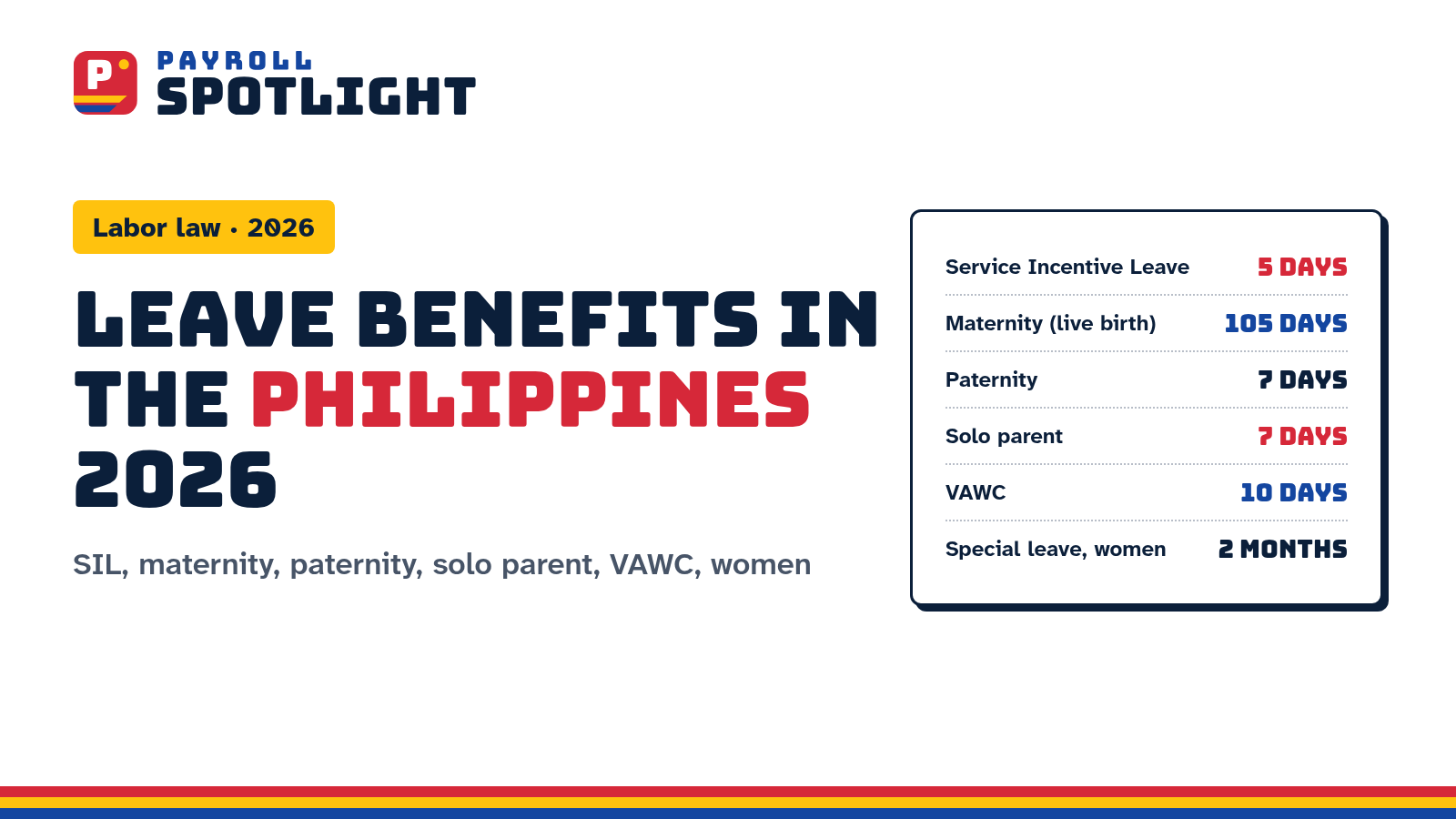
Short answer (as of October 23, 2026): Private-sector employees in the Philippines have six main statutory leaves. Service Incentive Leave (SIL): 5 days with pay a year after one year of service (Labor Code Art. 95). Maternity leave: 105 days with full pay for live birth, 60 days for miscarriage or emergency termination of pregnancy, plus 15 days for solo mothers (RA 11210). Paternity leave: 7 days (RA 8187). Solo parent leave: 7 working days a year (RA 11861). VAWC leave: 10 days (RA 9262). Special leave for women: up to 2 months after gynecological surgery (RA 9710). None of these changed in 2026; the bill to lengthen paternity leave is still pending.
This guide to leave benefits in the Philippines for 2026 is for HR and payroll teams writing or checking a leave policy, and for employees who want to know what they can claim. It covers who qualifies for each leave, how each one is paid, worked examples and the policy mistakes that turn into complaints.
All six leaves in one table
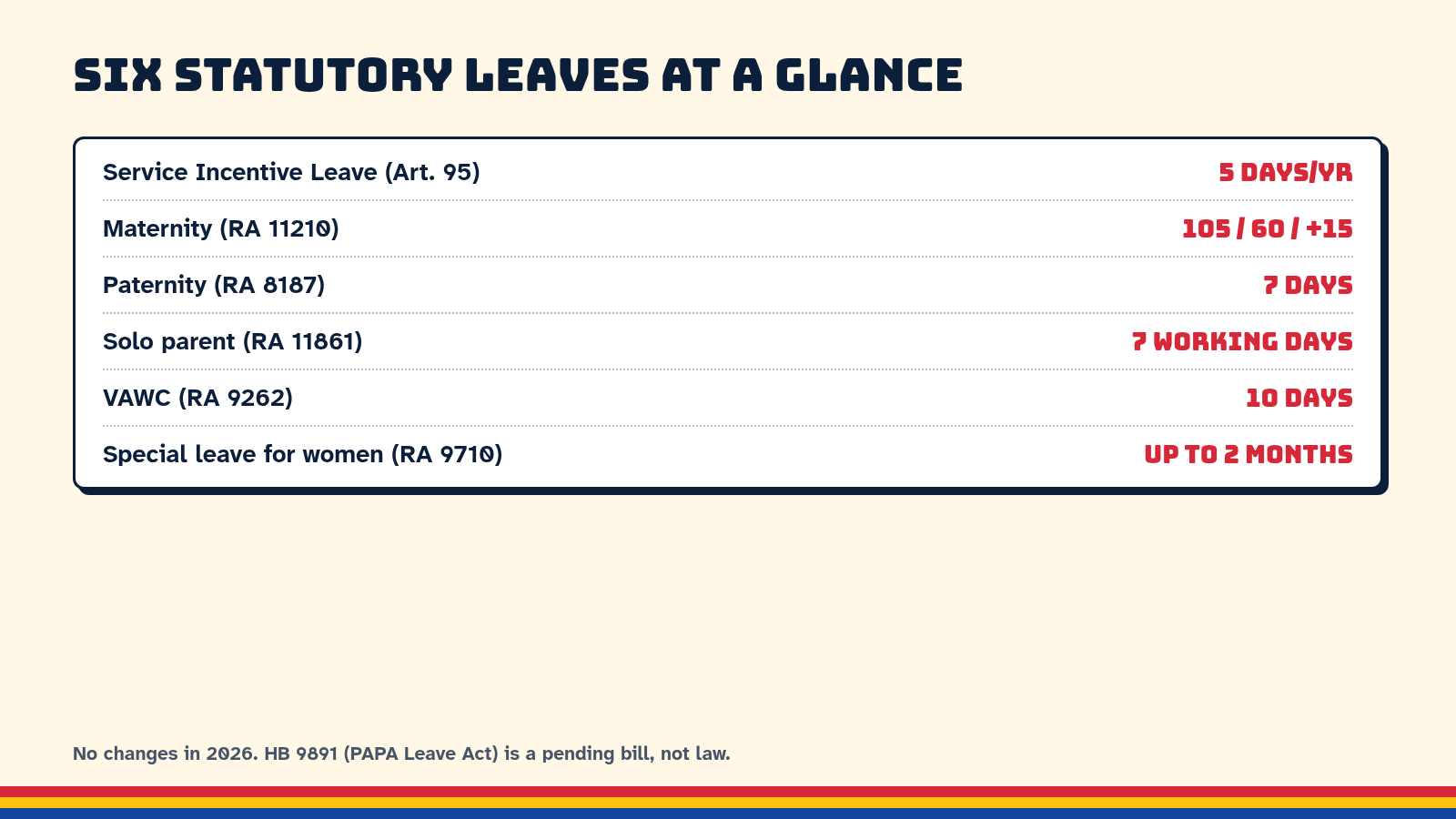
| Leave | Length | Who qualifies | Who pays | Converts to cash? |
|---|---|---|---|---|
| Service Incentive Leave | 5 days a year | At least 1 year of service; not in an exempt category | Employer | Yes, unused SIL is commutable at year-end or on separation |
| Maternity leave | 105 days (live birth); 60 days (miscarriage or emergency termination); +15 days for solo mothers; optional 30 more days unpaid | Every pregnant female employee, regardless of civil status | SSS maternity benefit, plus employer salary differential | No |
| Paternity leave | 7 days with full pay | Married male employee, for the first 4 deliveries of his lawful wife with whom he lives | Employer | No |
| Solo parent leave | 7 working days a year | Solo parent with at least 6 months of service and a Solo Parent ID | Employer | No, unless policy says so |
| VAWC leave | 10 days with pay, extendable when necessary | Woman employee who is a victim of violence under RA 9262, or whose child is | Employer | No |
| Special leave for women | Up to 2 months with full pay | At least 6 months of continuous aggregate service in the last 12 months; surgery for a gynecological disorder | Employer | No |
Service Incentive Leave
Every employee who has rendered at least one year of service gets five days of SIL with pay each year. “One year of service” means 12 months, whether continuous or broken, counted from the start of employment.
Exempt from SIL: establishments regularly employing fewer than ten workers; employees already enjoying vacation leave with pay of at least five days; managerial employees and field personnel whose hours can’t be determined; and others listed in the implementing rules. Most companies with a 5-day vacation leave policy meet SIL through that policy.
Cash conversion: Unused SIL is converted to cash at the end of the year or on separation, using the salary rate at that time. For a minimum wage employee in NCR at ₱755 a day, five unused SIL days convert to ₱3,775. Our final pay worksheet shows how this goes into last pay.
Domestic workers have their own 5-day SIL under the Batas Kasambahay (RA 10361, Sec. 29), but unused days there are not convertible to cash.
Maternity leave (RA 11210)
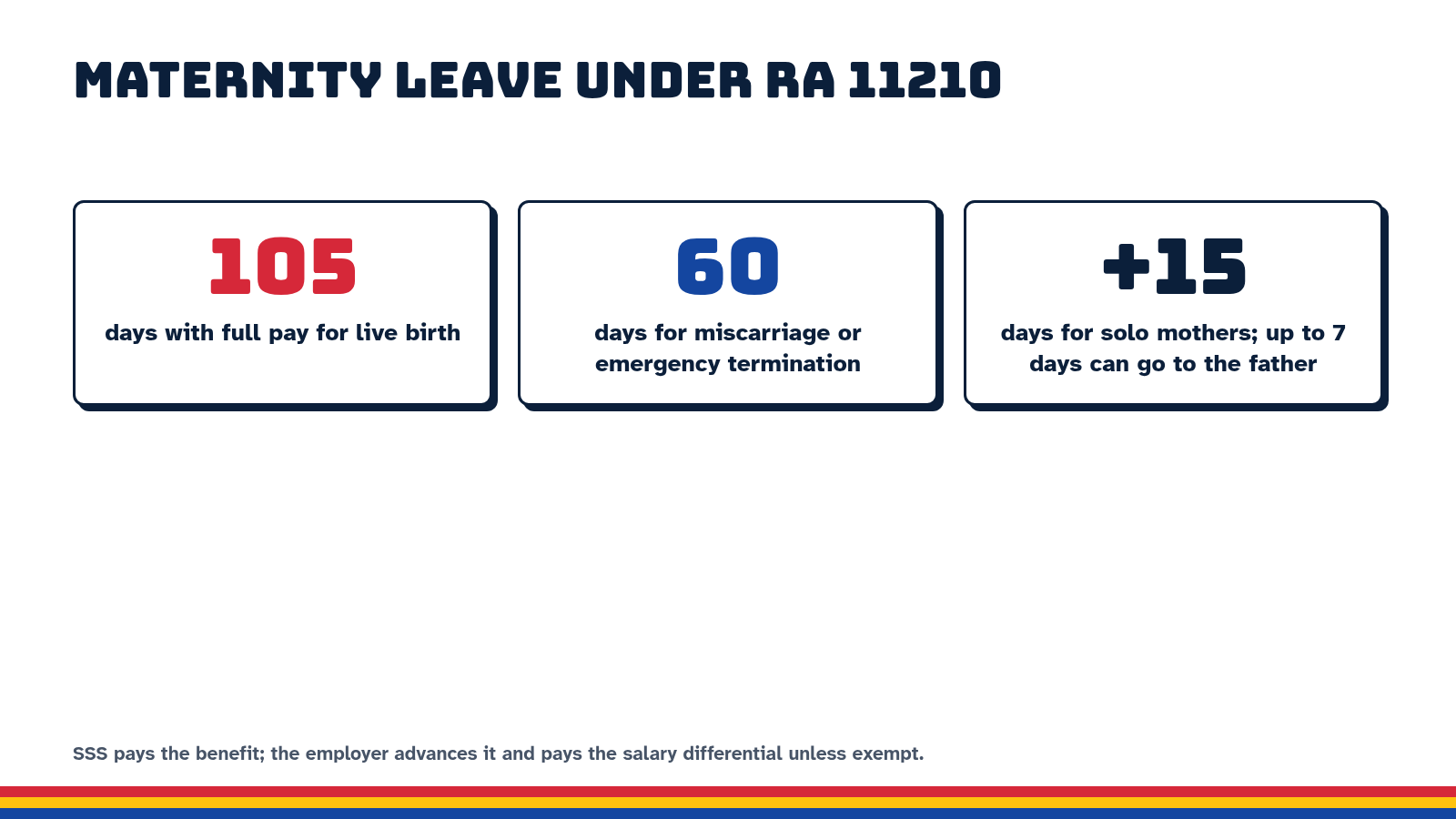
The 105-Day Expanded Maternity Leave Law covers every pregnant woman employee in the private sector, whether married or not, and applies to every pregnancy.
- 105 days with full pay for live childbirth, whether normal or caesarean.
- 60 days for miscarriage or emergency termination of pregnancy.
- +15 days if the mother is a qualified solo parent.
- +30 days without pay, at the mother’s option, with notice to the employer.
- Up to 7 days of the 105 can be allocated to the child’s father (married or not) or, if he’s absent, to an alternate caregiver.
How it’s paid: SSS pays a maternity benefit based on the member’s average daily salary credit, provided she has at least three monthly contributions in the 12 months before the semester of childbirth or miscarriage. The employer advances the benefit and pays the salary differential: the difference between her full pay and the SSS benefit. Some employers are exempt from the differential (for example, distressed establishments, certain small retail and service businesses, and micro-enterprises), under the law’s implementing rules.
Worked example (example data)
Bea earns ₱30,000 a month and gives birth after paying SSS contributions at the ₱30,000 MSC. For benefit computation, SSS uses a maximum MSC of ₱20,000 (SSS), so her average daily salary credit is ₱20,000 × 6 ÷ 180 = ₱666.67, and her SSS maternity benefit for 105 days is about ₱70,000. Her full pay for 105 days is about ₱30,000 ÷ 30 × 105 = ₱105,000. The employer advances the ₱70,000 SSS benefit, which SSS reimburses, and pays the salary differential of about ₱35,000 from its own funds. Confirm the actual benefit in the employer’s My.SSS account; this illustration only shows the logic.
Paternity leave (RA 8187)
A married male employee gets seven days with full pay for each of the first four deliveries (including miscarriage) of his lawful wife with whom he’s cohabiting. He must notify the employer of the pregnancy and expected date of delivery. The leave is used within 60 days after delivery under the implementing rules, and it isn’t convertible to cash.
He may also get up to seven more days if the mother allocates part of her maternity leave to him under RA 11210. These are separate entitlements, so a married father could have up to 14 days for one birth.
What’s pending: House Bill No. 9891, the proposed PAPA Leave Act filed in June 2026, would raise paternity leave to 90 days plus 15 days of parental leave, as reported by the Philippine News Agency through the Inquirer. It’s a bill, not a law. Don’t change your policy until it’s enacted and its rules are out.
Solo parent leave (RA 11861)
The Expanded Solo Parents Welfare Act gives solo parents seven working days of leave with pay each year, on top of other leaves, once they’ve rendered at least six months of service. The employee shows a valid Solo Parent ID issued by the local social welfare office. Solo parents also get flexible work schedules where possible, and protection against discrimination because of their status.
VAWC leave (RA 9262)
Under Sec. 43 of the Anti-Violence Against Women and Their Children Act, a woman employee who is a victim of violence (or whose child is) gets ten days of paid leave, extendable when necessary. It covers time needed for medical and legal matters. The employee presents a certification from the barangay, the prosecutor, or the court that a case or application for a protection order is pending. Treat the documents and the reason as confidential.
Special leave for women (RA 9710)
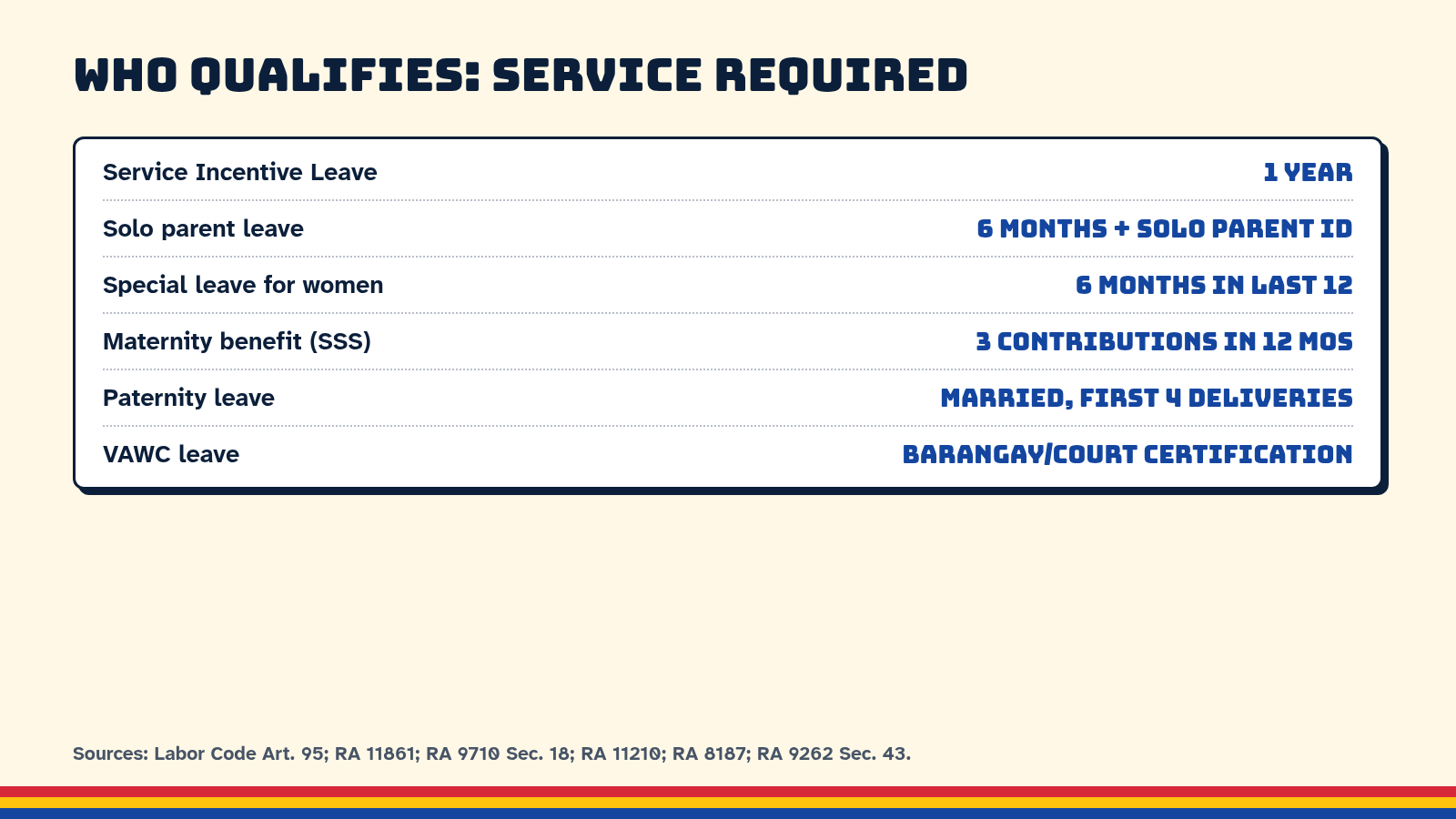
The Magna Carta of Women grants up to two months of leave with full pay, based on gross monthly compensation, to a woman employee who undergoes surgery caused by a gynecological disorder. She needs at least six months of continuous aggregate employment in the last 12 months. This is separate from SIL and from maternity leave.
Building a compliant leave policy
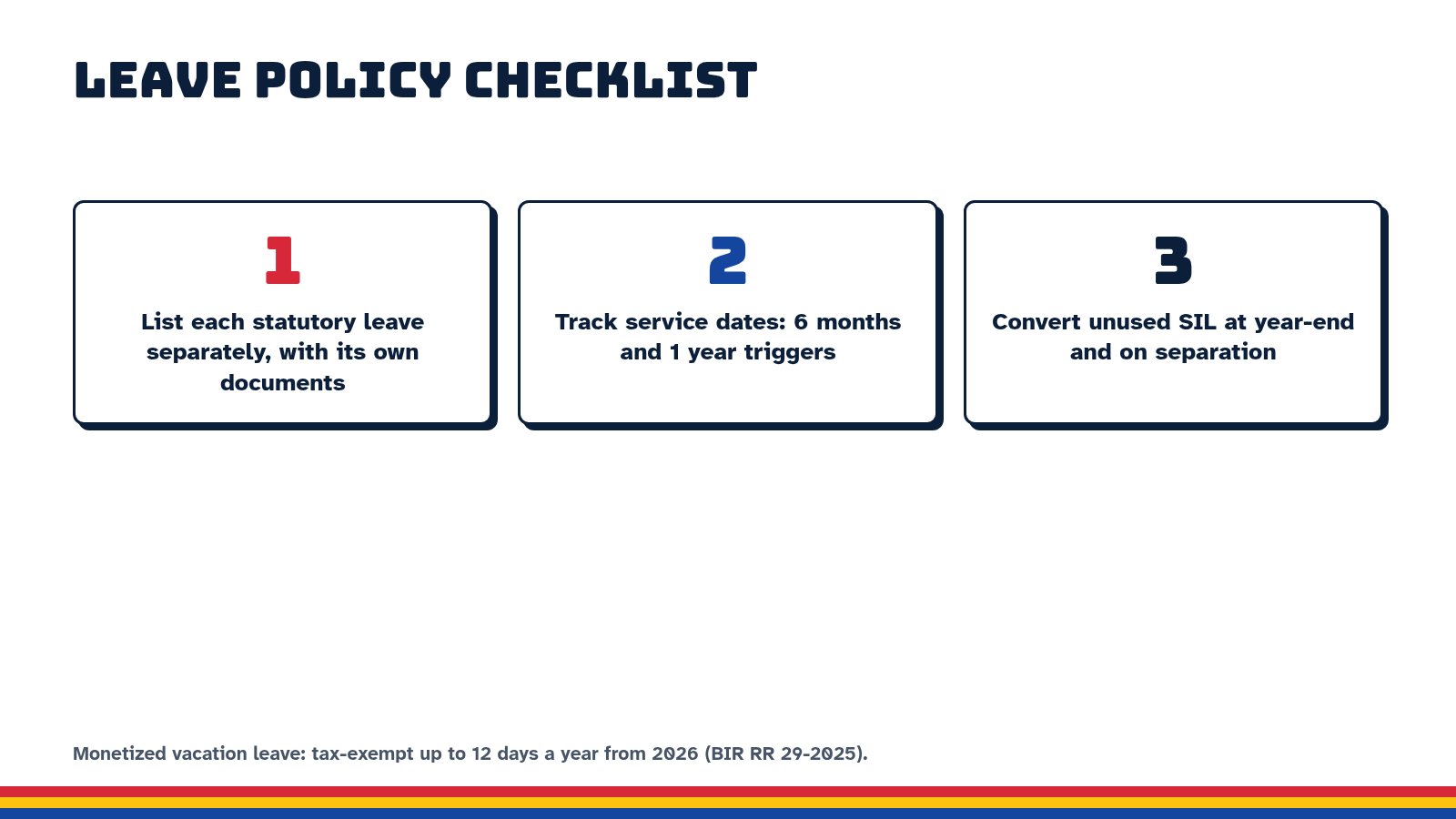
- List each statutory leave separately in your handbook, with its own eligibility and documents. Don’t fold them into “vacation leave”.
- Track service dates so SIL starts at 12 months and solo parent and special leave start at six months.
- Set a cash-conversion rule for unused SIL and any convertible vacation leave. Under BIR RR 29-2025, monetized unused vacation leave of private employees is a tax-exempt de minimis benefit up to 12 days a year from 2026.
- Prepare the maternity process with SSS: notification, benefit advance and reimbursement, salary differential.
- Show leave days and leave pay on the payslip, so the employee can check them. See what a payslip should show.
- Keep leave records with payroll records for at least three years.
Mistakes that become complaints
- Denying SIL because the employee “already used sick leave”. If your policy’s leave totals at least five paid days, it can count; if it doesn’t, SIL is still owed.
- Asking for a marriage certificate for maternity leave. RA 11210 covers every woman employee regardless of civil status.
- Forgetting the salary differential. Paying only the SSS benefit is a common violation if the employer isn’t exempt.
- Refusing solo parent leave for lack of a company form. The Solo Parent ID is the requirement.
- Recording the reason for VAWC leave in shared systems. Limit access to people who need it.
- Not converting unused SIL on separation. It’s part of final pay.
FAQ
How many days is service incentive leave in the Philippines?
Five days with pay a year for employees with at least one year of service, under Labor Code Art. 95. Unused SIL is converted to cash.
Is maternity leave still 105 days in 2026?
Yes. RA 11210 grants 105 days with full pay for live birth, 60 days for miscarriage or emergency termination, and 15 more days for solo mothers. Nothing changed in 2026.
Has paternity leave been increased in 2026?
No. It’s still seven days under RA 8187. House Bill No. 9891, filed in June 2026, would raise it, but it hasn’t been passed.
Who qualifies for solo parent leave?
A solo parent employee with at least six months of service and a valid Solo Parent ID gets seven working days of paid leave each year under RA 11861.
What is the special leave for women?
Up to two months with full pay under RA 9710 for a woman employee who has surgery for a gynecological disorder, after at least six months of continuous aggregate employment in the last 12 months.
What to do next
Compare your handbook with the table above and fix any leave that’s missing or merged. Then make sure payroll converts unused SIL at year-end. If you’d like leave balances, conversions and payslip lines handled in one place, see what Payroll Spotlight does and start a free trial.
Educational overview only, based on Labor Code Art. 95 (as renumbered), RA 11210, RA 8187, RA 11861, RA 9262 Sec. 43, RA 9710 Sec. 18, RA 10361 Sec. 29 and BIR RR 29-2025, all retrieved October 23, 2026. “Bea” and her figures are example data. Policies or CBAs may grant more. Not legal advice.
Leave a Reply