
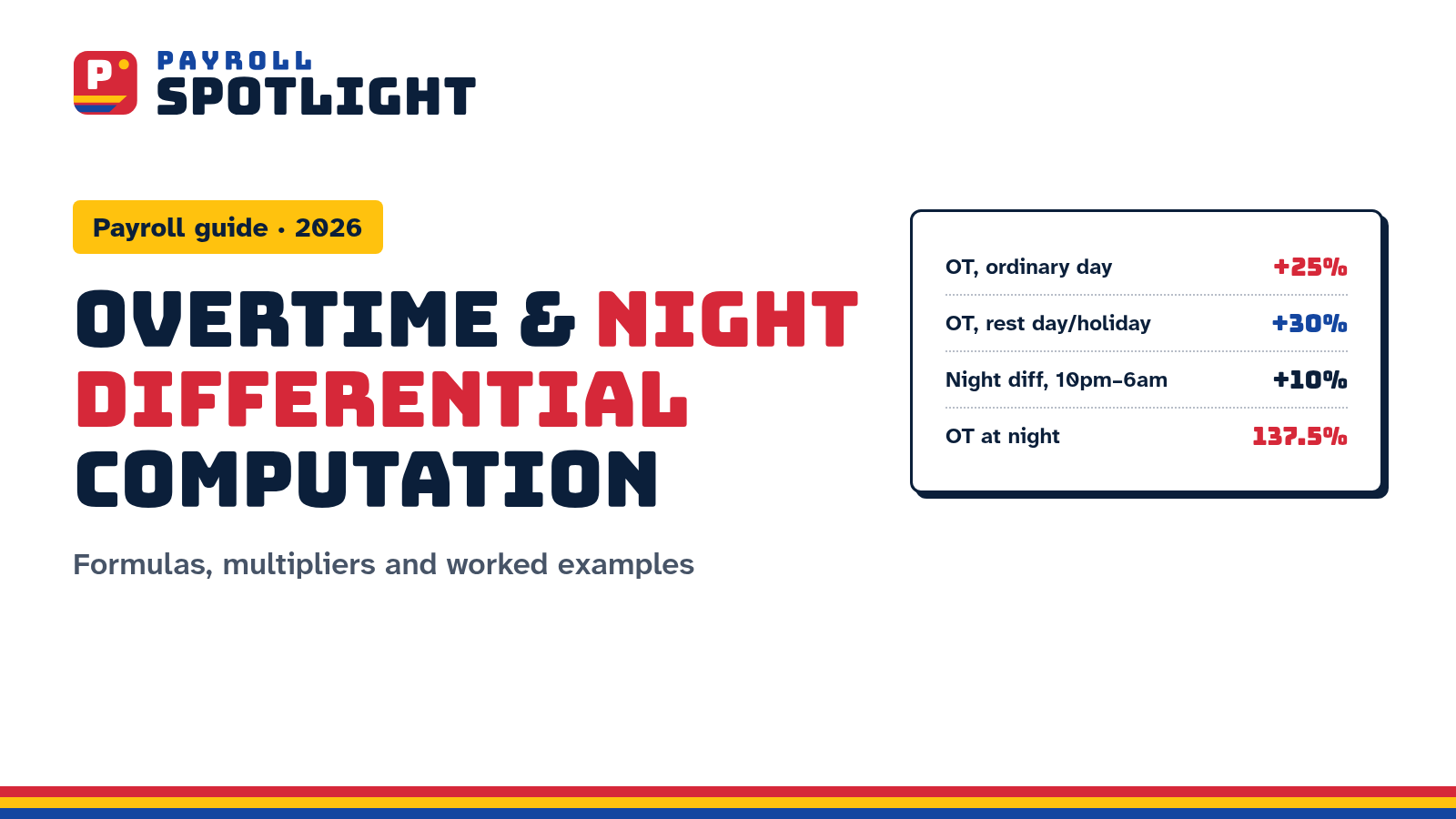
Short answer (as of October 23, 2026): Overtime pay in the Philippines is the hourly rate plus 25% for work beyond 8 hours on an ordinary working day, and the day’s rate plus 30% for overtime on a rest day, special day or regular holiday (Labor Code Art. 87). Night shift differential is at least 10% of the regular wage for each hour worked between 10:00 p.m. and 6:00 a.m. (Art. 86). The premiums stack: an overtime hour at night on an ordinary day is paid at 125% × 110% = 137.5% of the hourly rate. The full multipliers are in the DOLE-BWC Handbook on Workers’ Statutory Monetary Benefits, 2024 edition.
This overtime and night differential computation guide is for payroll officers, team leads approving overtime, and workers on shifts who want to check their pay. You’ll get the formulas, a multiplier table for every day type, worked examples at the NCR minimum wage, and the mistakes DOLE inspectors find most often.
Who is entitled, and who isn’t
Overtime and night differential are labor standards under Book III of the Labor Code. They cover most rank-and-file employees in the private sector, but Art. 82 excludes:
- managerial employees, and officers or members of the managerial staff who meet the exemption criteria;
- field personnel whose hours can’t be determined with reasonable certainty;
- members of the employer’s family who depend on the employer;
- domestic workers (who have their own rules under the Batas Kasambahay); and
- workers paid by results, as defined in DOLE rules.
Night differential also doesn’t apply to retail and service establishments regularly employing not more than five workers, under the implementing rules. Everyone else on a night schedule gets it, including regular, probationary and project staff.
The two formulas
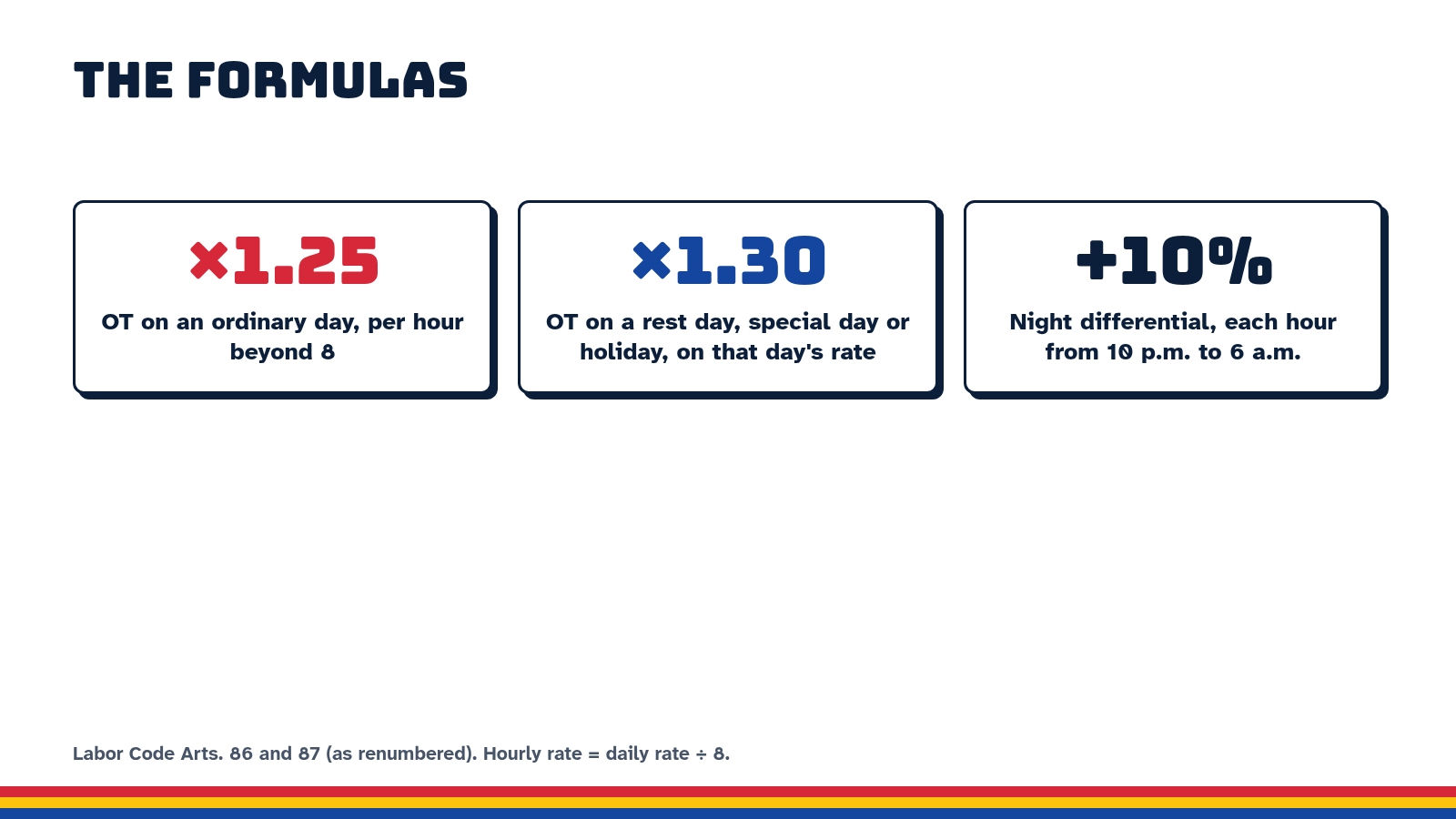
Start from the hourly rate: daily rate ÷ 8. For monthly-paid employees, convert to a daily rate first using the factor your company applies (for example 261, 313 or 365 days, depending on paid rest days), then divide by 8.
Overtime on an ordinary day = hourly rate × 125% × overtime hours.
Overtime on a rest day, special day or holiday = hourly rate × (that day’s premium rate) × 130% × overtime hours.
Night shift differential = hourly rate (or the day’s applicable hourly rate) × 10% × night hours worked. When the night hour is also an overtime hour, apply it to the overtime rate: hourly rate × 125% × 110%.
Multiplier table for every day type
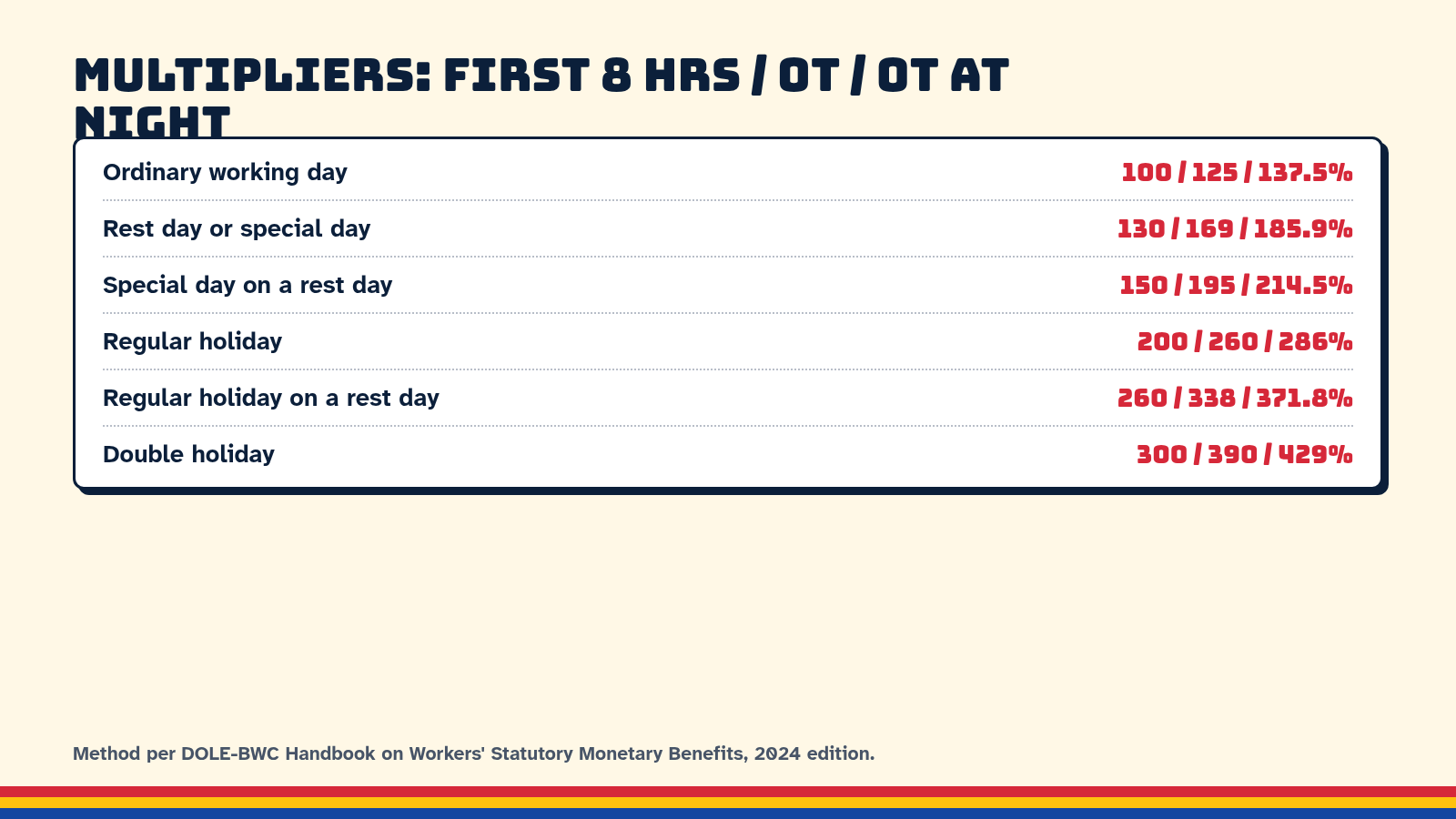
Each figure is a multiple of the ordinary hourly rate. “First 8 hours” applies per hour worked within the normal 8; “OT” is per hour beyond 8; “OT + night” applies to overtime hours between 10:00 p.m. and 6:00 a.m.
| Day type | First 8 hours | OT | Night (within 8) | OT + night |
|---|---|---|---|---|
| Ordinary working day | 100% | 125% | 110% | 137.5% |
| Rest day, or special (non-working) day | 130% | 169% | 143% | 185.9% |
| Special day falling on a rest day | 150% | 195% | 165% | 214.5% |
| Regular holiday | 200% | 260% | 220% | 286% |
| Regular holiday falling on a rest day | 260% | 338% | 286% | 371.8% |
| Double holiday (two regular holidays on one day) | 300% | 390% | 330% | 429% |
| Double holiday on a rest day | 390% | 507% | 429% | 557.7% |
The multipliers follow the DOLE-BWC handbook’s method: start from the day’s premium, add 30% for overtime, then add 10% for night hours on top of the applicable rate. Special working days are paid like ordinary days.
Worked examples at the NCR minimum wage
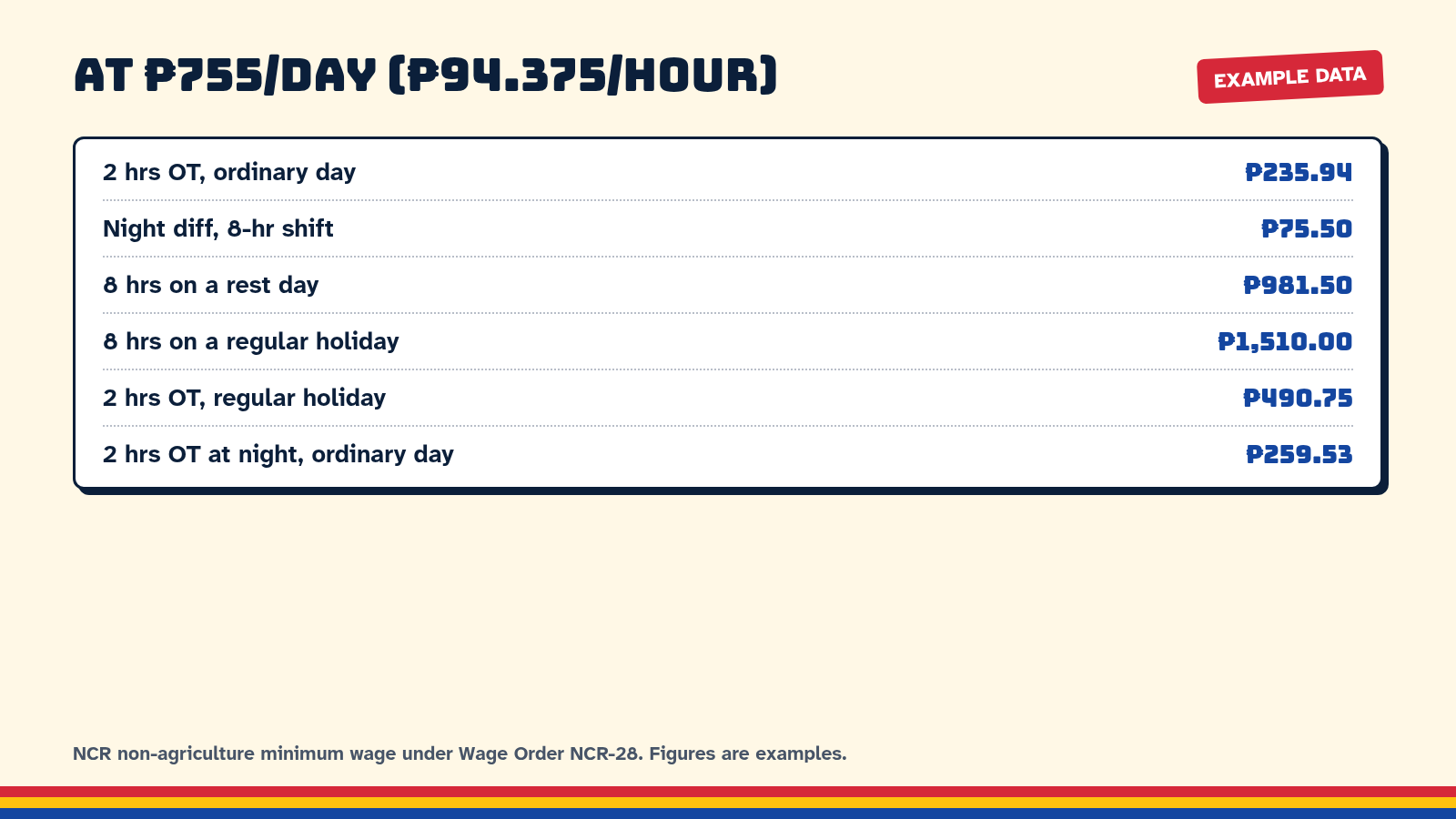
These use the NCR non-agriculture minimum wage of ₱755 a day under Wage Order NCR-28, which we covered in our minimum wage 2026 guide. Hourly rate = ₱755 ÷ 8 = ₱94.375. The worker is example data.
| Scenario | Computation | Pay for those hours |
|---|---|---|
| 2 hours OT on an ordinary day | ₱94.375 × 1.25 × 2 | ₱235.94 |
| 8-hour night shift, 10 p.m. to 6 a.m., ordinary day (ND only) | ₱94.375 × 0.10 × 8 | ₱75.50 on top of the ₱755 daily wage |
| 8 hours on a rest day | ₱755 × 1.30 | ₱981.50 |
| 2 hours OT on a rest day | ₱94.375 × 1.69 × 2 | ₱318.99 |
| 8 hours on a regular holiday | ₱755 × 2.00 | ₱1,510.00 |
| 2 hours OT on a regular holiday | ₱94.375 × 2.60 × 2 | ₱490.75 |
| 2 hours OT between 10 p.m. and midnight, ordinary day | ₱94.375 × 1.25 × 1.10 × 2 | ₱259.53 |
A full shift worked through
Jun (example data) works from 2:00 p.m. to 1:00 a.m. on a Tuesday that’s an ordinary working day, with a one-hour unpaid meal break at 6:00 p.m. That’s 10 hours of work: 8 regular hours (2 p.m. to 11 p.m., minus the break) and 2 overtime hours (11 p.m. to 1 a.m.).
- Regular 8 hours: ₱755.00.
- Night differential for the regular hours from 10 p.m. to 11 p.m. (1 hour): ₱94.375 × 0.10 = ₱9.44.
- Overtime from 11 p.m. to 1 a.m. (2 hours, all at night): ₱94.375 × 1.375 × 2 = ₱259.53.
- Total for the day: ₱755.00 + ₱9.44 + ₱259.53 = ₱1,023.97.
On November 30, 2026 (Bonifacio Day, a regular holiday), the same shift would be: ₱1,510.00 for the first 8 hours, ₱94.375 × 2.00 × 0.10 = ₱18.88 night differential for the 10 to 11 p.m. hour, and ₱94.375 × 2.86 × 2 = ₱539.83 for the overtime, totaling ₱2,068.71. Our November 2026 holiday pay guide covers the other days this month.
Rules that change the math
- Undertime can’t offset overtime. Art. 88 says an employee who works less than 8 hours one day can’t have that undertime cancelled out by overtime on another day. Pay the overtime and deduct the undertime separately.
- Overtime must be worked, not just scheduled. Pay for hours actually worked. A written approval process is fine, but if a supervisor knowingly lets someone work past 8 hours, the hours count.
- Compressed workweeks are different. Under a valid compressed workweek arrangement (for example, 4 days of 10 hours), hours within the agreed daily schedule aren’t overtime. Hours beyond it are.
- Meal breaks of at least 60 minutes are unpaid; shorter breaks (coffee breaks of 5 to 20 minutes) count as hours worked.
- Emergency overtime can be required in the situations Art. 89 lists, such as urgent work to prevent loss or damage, but it’s still paid.
- Taxes: For minimum wage earners, overtime, holiday and night differential pay are exempt from income tax. For others, they’re taxable. See the withholding tax guide.
Mistakes DOLE inspectors find
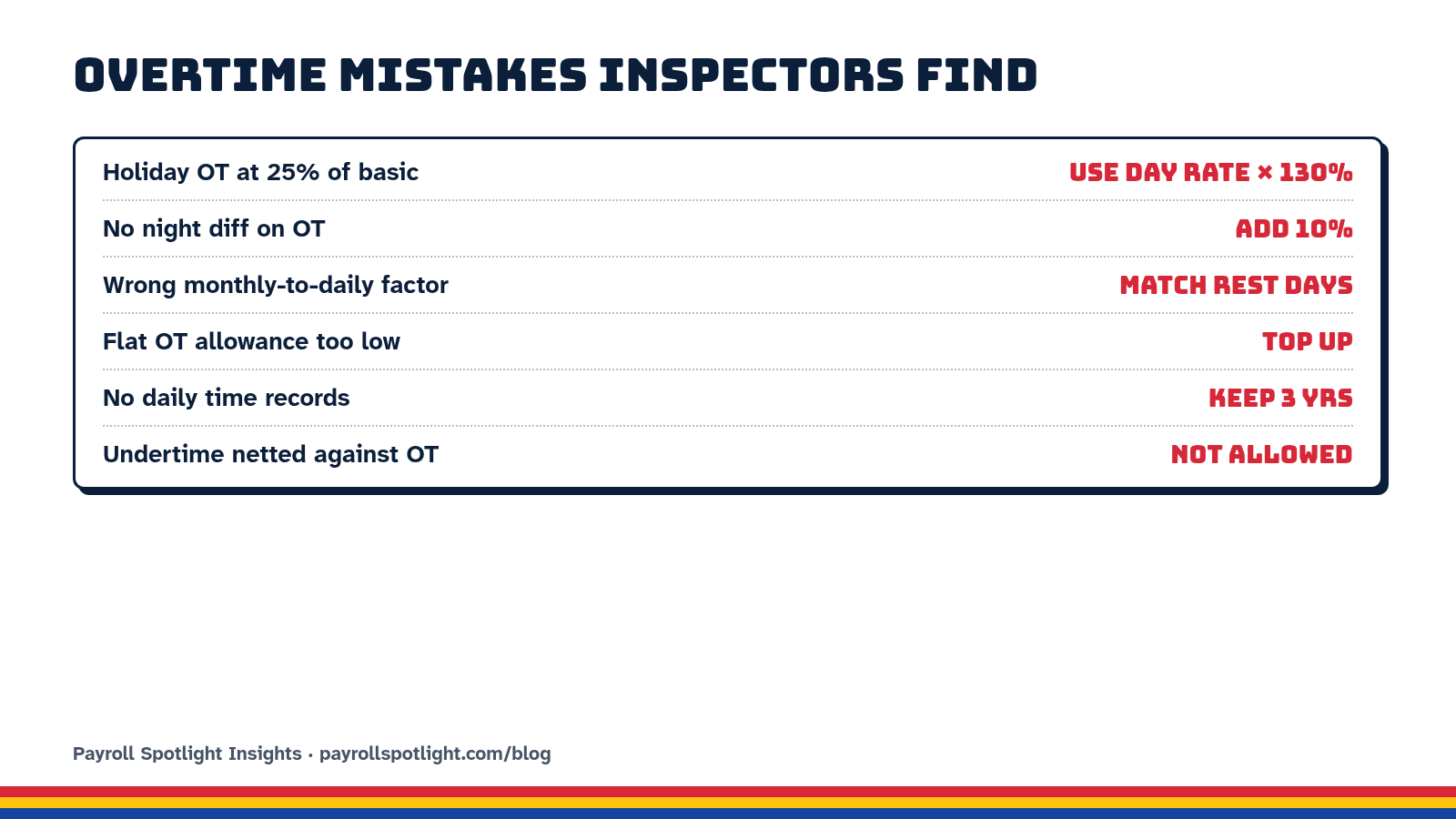
- Computing OT from the basic hourly rate on a rest day or holiday. Overtime on those days is 30% of the day’s rate, not 25% of the basic rate.
- Skipping night differential for overtime. If the overtime hour falls between 10 p.m. and 6 a.m., add the 10% on the overtime rate.
- Using a monthly-to-daily factor that doesn’t match your rest-day practice, which shortchanges every premium.
- Paying “fixed OT allowances” that don’t cover the hours actually worked. A flat amount is fine only if it’s at least what the formula gives.
- Missing time records. Without daily time records, the employer can’t prove what it paid. Our guide to payroll cut-off and timekeeping covers what to keep.
- Not showing OT and ND separately on the payslip. Employees should be able to see the hours and amounts; see what a payslip should show.
A quick decision checklist for every overtime claim
- Is the employee covered by Art. 82 (not managerial or field personnel)?
- What type of day is it: ordinary, rest day, special, regular holiday or double holiday?
- How many hours fall within the first 8, and how many beyond?
- Which of those hours fall between 10 p.m. and 6 a.m.?
- Apply the multiplier from the table to each block and add them up.
- Record the hours and amounts on the payroll register and payslip.
FAQ
How is overtime computed in the Philippines?
Divide the daily rate by 8 to get the hourly rate. On an ordinary working day, multiply by 125% for each overtime hour. On a rest day, special day or holiday, multiply the day’s hourly rate by 130% for each overtime hour.
What is the night shift differential rate?
At least 10% of the regular wage for each hour worked between 10:00 p.m. and 6:00 a.m., under Labor Code Art. 86. Company policy or a CBA can give more.
Is night differential added to overtime pay?
Yes. For an overtime hour worked at night on an ordinary day, the rate is 125% × 110%, or 137.5% of the hourly rate.
Are managers entitled to overtime pay?
Generally no. Managerial employees and qualifying managerial staff are excluded from the hours-of-work rules under Art. 82, unless their contract or company policy grants overtime.
Can an employer offset undertime against overtime?
No. Art. 88 prohibits using overtime on one day to cancel undertime on another. Each is handled separately.
What to do next
Check one recent payroll against the multiplier table, especially rest-day and holiday overtime and anyone on a night shift. If your figures don’t match, fix the formula before the November 30 and December holidays. If you want day types, overtime and night hours computed from time logs automatically, see what Payroll Spotlight does and start a free trial.
Educational overview only, based on the Labor Code Arts. 82 to 89 (as renumbered), its implementing rules, the DOLE-BWC Handbook on Workers’ Statutory Monetary Benefits (2024 edition), and Wage Order NCR-28, all retrieved October 23, 2026. “Jun” and all worked figures are example data. Company policy or a CBA may grant more. Not legal advice.
Leave a Reply