
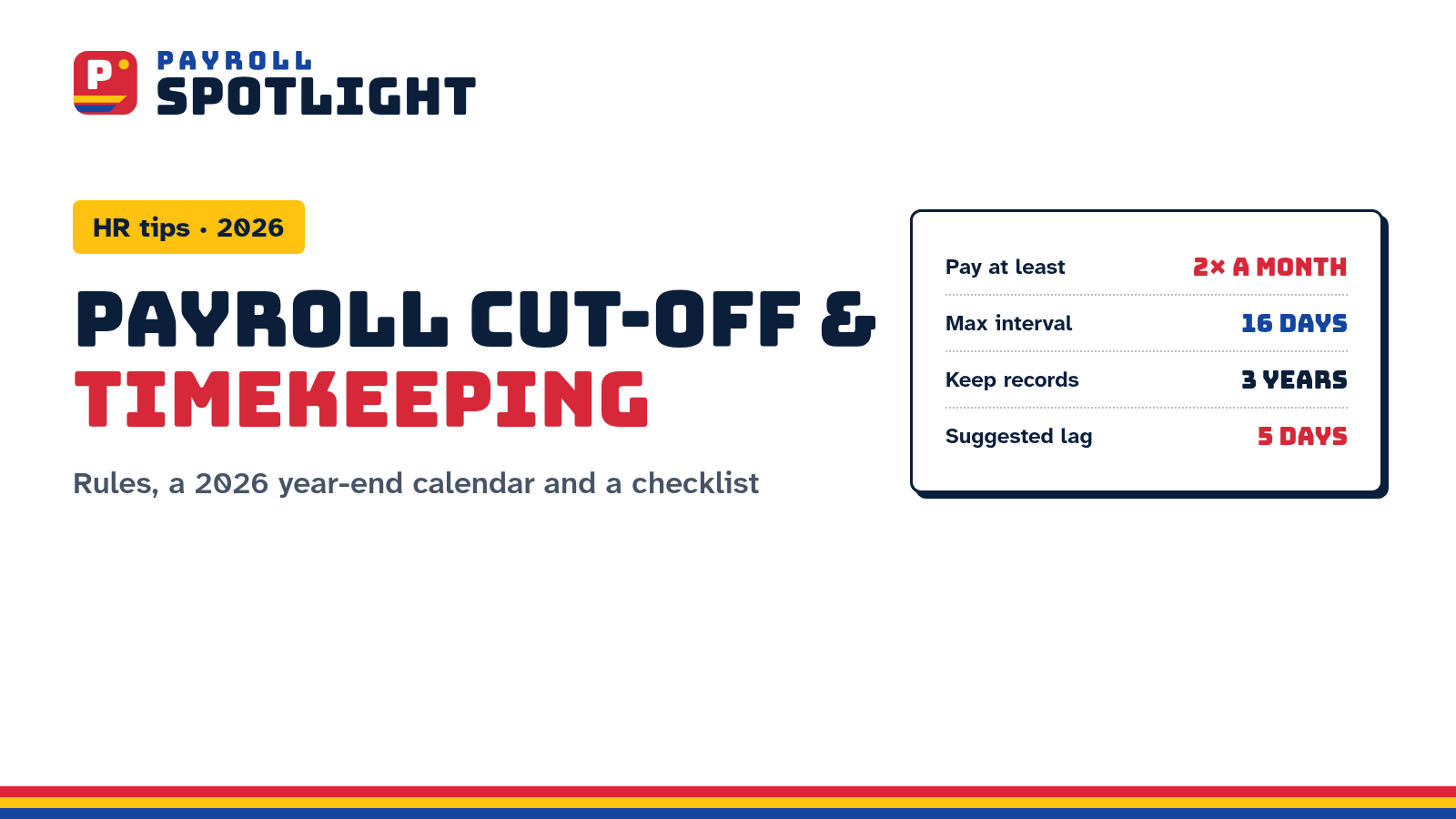
Short answer (as of October 23, 2026): A good payroll cut-off in the Philippines does three things: it pays wages at least twice a month at intervals of no more than 16 days, as the Labor Code’s Art. 103 and its implementing rules require; it leaves enough days between cut-off and payday to check time records; and it keeps daily time records for every employee for at least three years. The most common setup is two cut-offs (for example, the 26th to the 10th paid on the 15th, and the 11th to the 25th paid on the last day of the month), with paydays moved earlier when they fall on a weekend or holiday.
This guide is for owners, HR and payroll staff at small and mid-sized employers who want fewer payroll corrections and fewer disputes. It covers what the rules actually require, how to pick a cut-off, a ready-made November and December 2026 calendar, timekeeping methods, and a cut-off checklist.
What the law requires
The rules are older than biometrics and apps, but they’re still the standard DOLE inspectors apply. From the Labor Code and Book III of its implementing rules (text via Labor Law PH library):
| Rule | What it says | Source |
|---|---|---|
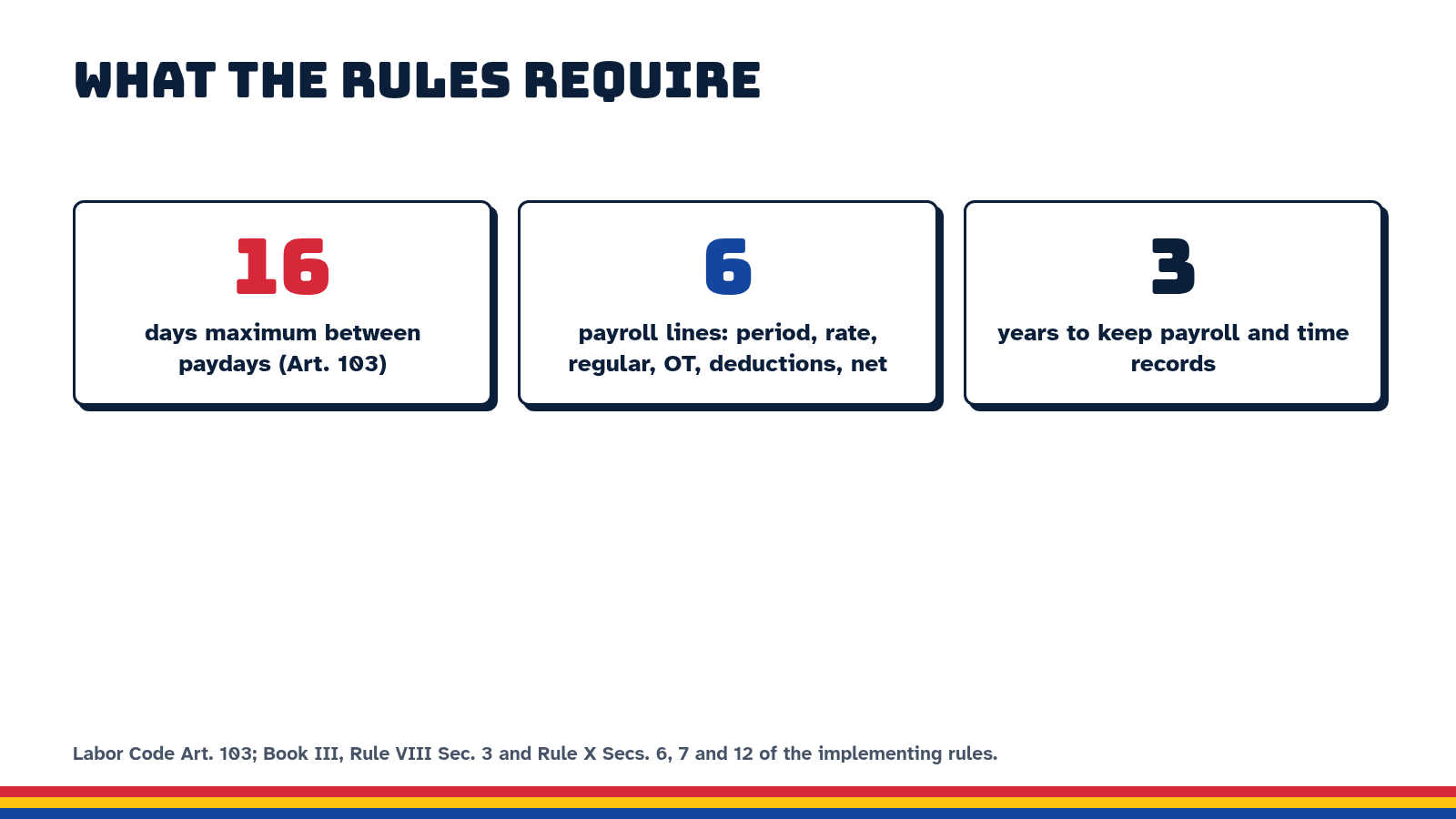
| Frequency | Wages are paid not less than once every two weeks or twice a month, at intervals not exceeding 16 days | Art. 103; Book III, Rule VIII, Sec. 3 |
| Payroll contents | The payroll shows, per employee: period covered, rate of pay, amount for regular work, amount for overtime, deductions, and amount actually paid | Book III, Rule X, Sec. 6 |
| Time records | Every employer keeps an individual time record for each employee: by bundy clock, a timekeeper’s book, or daily time record forms | Book III, Rule X, Sec. 7 |
| Filing | Time records are kept in chronological order at or near the workplace, open to DOLE inspection | Book III, Rule X, Sec. 8 |
| Retention | All employment records are kept for at least three years from the last entry | Book III, Rule X, Sec. 12 |
| Deductions | Only deductions authorized by law or by the employee in writing | Art. 113; Book III, Rule VIII, Sec. 13 |
Two things the rules don’t say: they don’t fix a specific cut-off date, and they don’t require a lag between cut-off and payday. Those are your choices, as long as paydays stay within 16 days of each other.
Choosing a cut-off
Most Philippine employers use one of three setups.
| Setup | Cut-off periods | Payday | Good for | Watch out for |
|---|---|---|---|---|
| Lagged semi-monthly | 26th to 10th; 11th to 25th | 15th and last day of the month | Most employers with overtime, night shifts or variable pay | The first payroll after hiring covers a partial period; explain it to new hires |
| Current semi-monthly | 1st to 15th; 16th to end of month | 15th and last day, with some days estimated | Fixed-salary office staff with little overtime | Absences and overtime after the estimate need adjustment next payroll |
| Weekly | Monday to Sunday | Following Friday or Saturday | Daily-paid, construction, retail | More payroll runs and more remittance work |
The lagged option is the most forgiving. Five days between cut-off and payday gives supervisors time to approve overtime, HR time to fix missing logs, and payroll time to compute holiday and night differential correctly.
November and December 2026 cut-off calendar
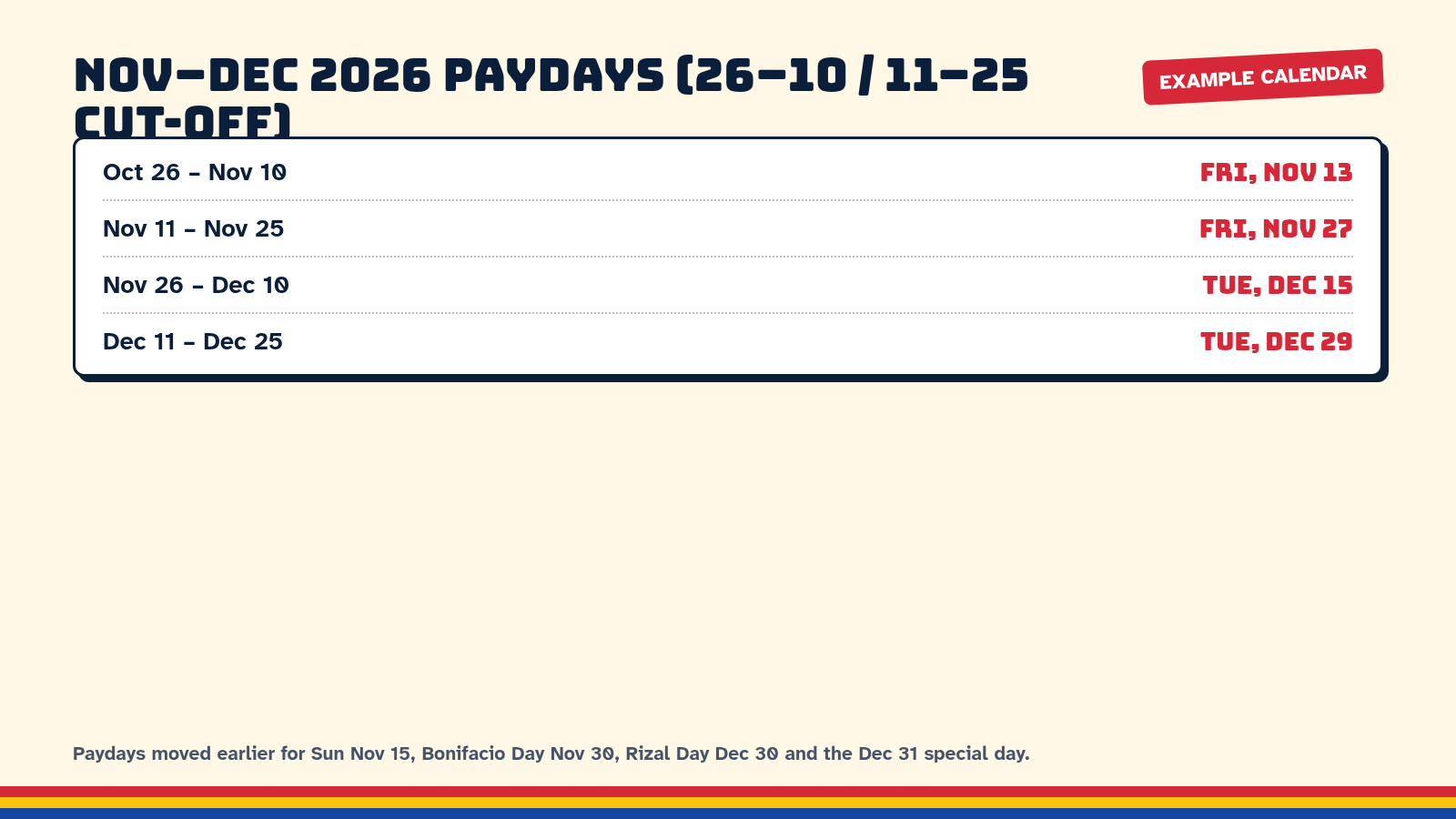
This calendar uses the lagged semi-monthly setup and moves any payday that falls on a weekend or holiday to the working day before. Holiday dates are from our November 2026 holiday pay guide and the 2026 holiday proclamation.
| Cut-off period | Normal payday | Actual payday | Why |
|---|---|---|---|
| Oct 26 to Nov 10 | Sun, Nov 15 | Fri, Nov 13 | Nov 15 is a Sunday |
| Nov 11 to Nov 25 | Mon, Nov 30 | Fri, Nov 27 | Nov 30 is Bonifacio Day, a regular holiday |
| Nov 26 to Dec 10 | Tue, Dec 15 | Tue, Dec 15 | Working day |
| Dec 11 to Dec 25 | Thu, Dec 31 | Tue, Dec 29 | Dec 30 is Rizal Day (regular holiday) and Dec 31 is a special non-working day |
Also note for Metro Manila employers: November 16 to 18, 2026 are special non-working days in the NCR for the ASEAN Summit, so plan approvals for the November 11 to 25 period around them. Moving paydays earlier shortens processing time, so lock the period’s time records a day sooner. December also carries the 13th month pay, due on or before December 24, and year-end tax annualization.
Timekeeping methods that hold up
| Method | Strengths | Risks | Make it defensible |
|---|---|---|---|
| Biometric terminal | Hard to buddy-punch | Personal data under the Data Privacy Act; device downtime | Privacy notice, access limits, a paper or app fallback, regular exports |
| Mobile app with GPS | Works for field and remote staff | Location data; spoofing | Collect location only at clock-in/out; tell employees what’s collected |
| Web or kiosk clock-in | Cheap, simple | Shared devices; forgotten logs | Unique logins; daily exception report |
| Paper DTR or logbook | Allowed by the rules | Errors; late filling; storage | Sign daily in ink; file by date; scan monthly |
Whatever you use, the time record should show each day’s time in and out, and each employee should be able to see and confirm their own records. Electronic systems should keep an edit history so you can show who changed what and why. Biometric and location data are personal information, and fingerprints count as sensitive personal information, under the Data Privacy Act (RA 10173), so collect only what you need and secure it.
The cut-off checklist, day by day
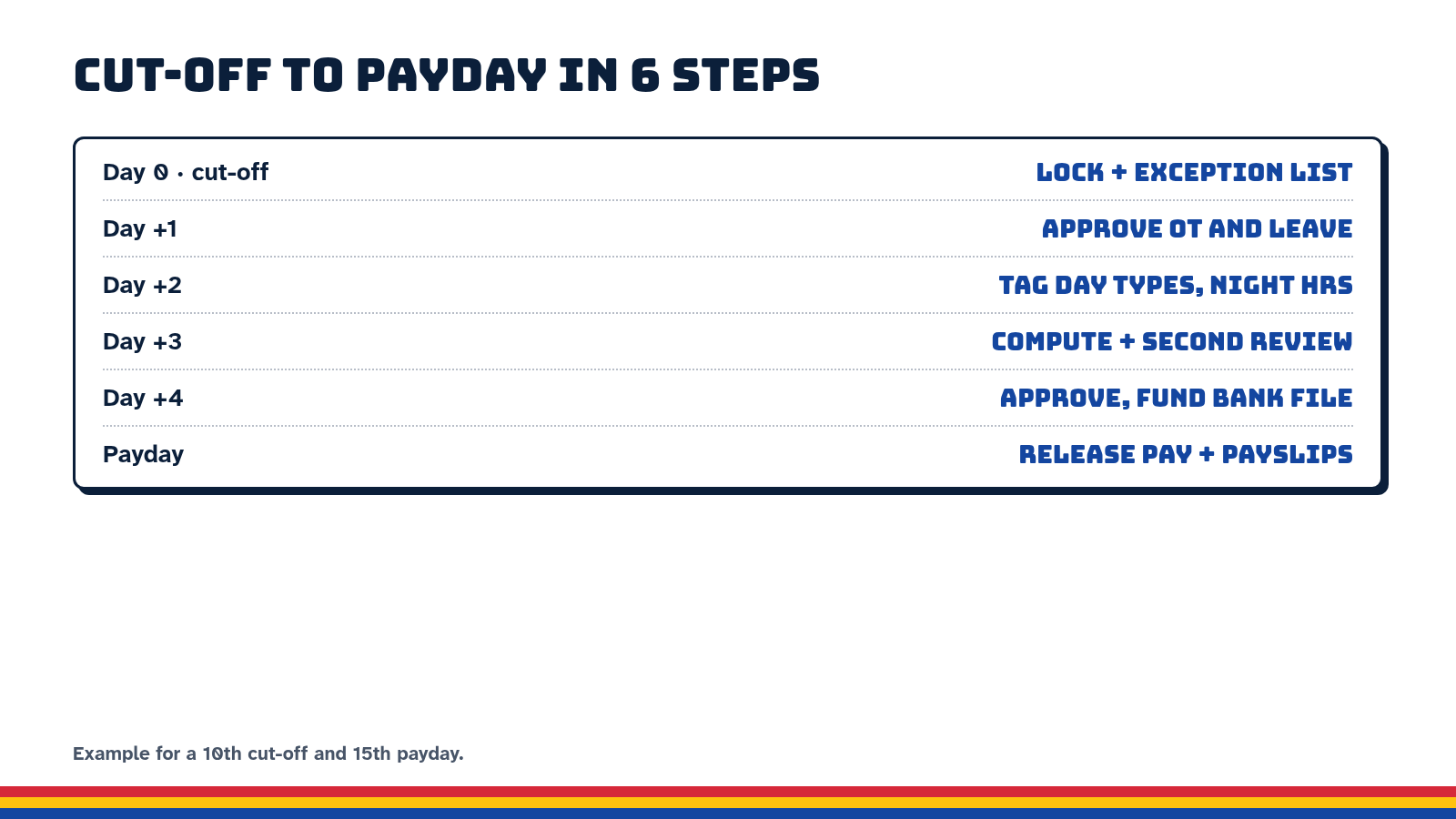
For a 15th payday with a 10th cut-off:
- Cut-off day (10th): Lock the period. Send each supervisor an exception list: missing logs, late in/out, unapproved overtime, leaves without approval.
- Day +1 (11th): Supervisors approve or reject overtime and leaves. Employees fix missing logs with a short reason.
- Day +2 (12th): HR tags day types (rest day, special day, regular holiday) and night hours, then applies leave balances.
- Day +3 (13th): Payroll computes gross pay, overtime, night differential, holiday pay, contributions and tax. A second person reviews totals against last period.
- Day +4 (14th): Approve payroll, fund the bank file, and generate payslips.
- Payday (15th): Release pay and payslips. Log any disputes for the next period.
Rules that affect cut-off decisions
- Undertime and overtime are handled separately (Art. 88). You can’t net them across days.
- Meal breaks of at least 60 minutes are unpaid; short coffee breaks are paid (Art. 85 and its rules).
- No withholding of wages (Art. 116). A late timesheet isn’t a reason to hold pay for hours worked. Pay what you can verify and adjust the rest next cut-off.
- Deductions for losses or damages need due process and the employee’s chance to explain, under the rules on wage deductions.
- Payslip details matter: the hours, rates and deductions should be visible. See what a PH payslip should show.
- Overtime and night differential formulas are in our overtime and night differential guide.
Common problems and fixes
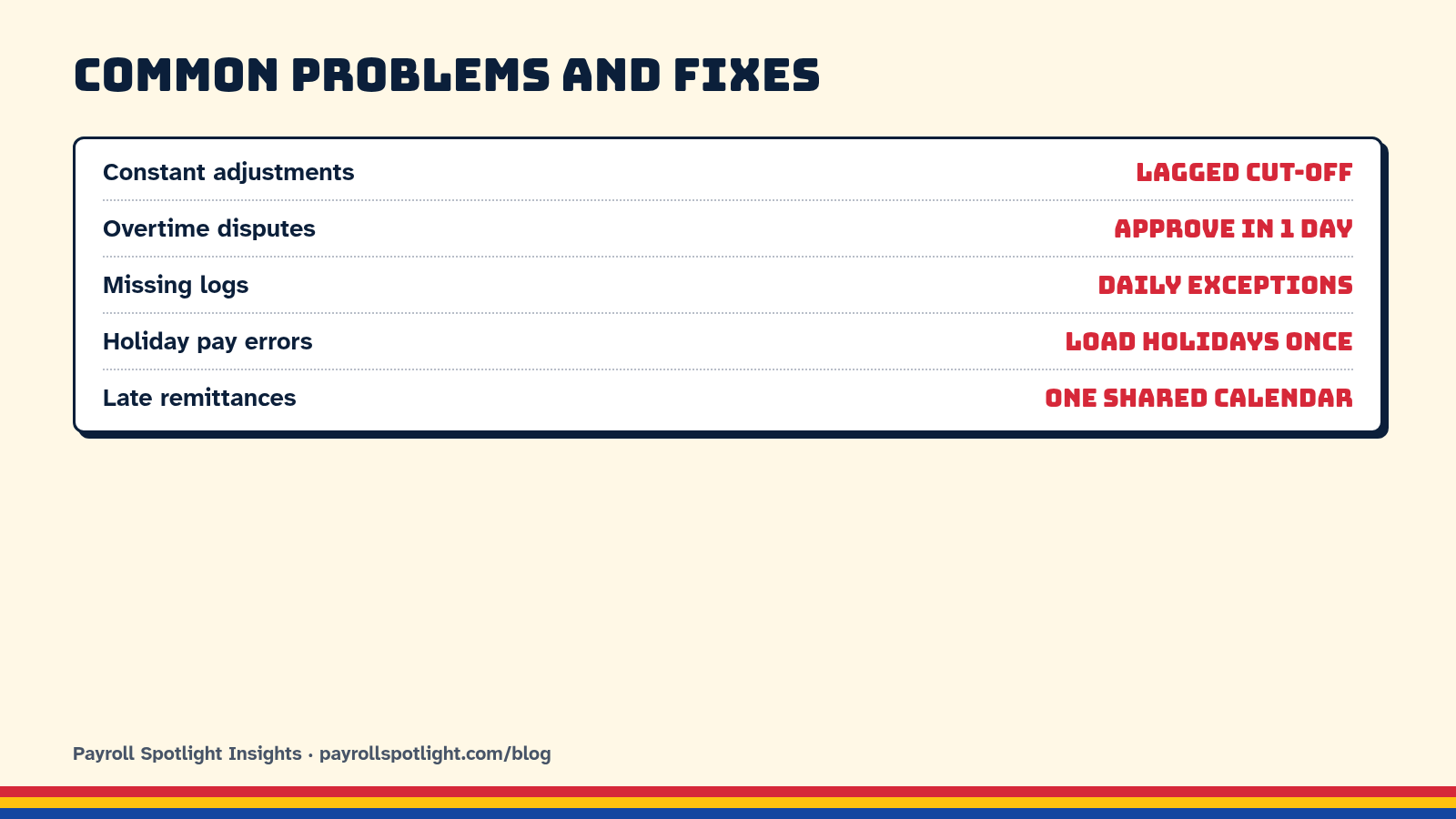
| Problem | Likely cause | Fix |
|---|---|---|
| Lots of “adjustments” every payroll | No lag between cut-off and payday | Move to a lagged cut-off |
| Overtime disputes | Approvals after payday | Require approval within one day of cut-off |
| Missing time logs | No daily exception report | Send exceptions daily, not only at cut-off |
| Holiday pay errors | Day types tagged by hand | Load the year’s holidays into the system once |
| Late remittances | Payroll and remittance on separate calendars | Put SSS, PhilHealth, Pag-IBIG and BIR dates in the same calendar |
FAQ
How often must employers pay wages in the Philippines?
At least twice a month, or once every two weeks, at intervals not exceeding 16 days, under Labor Code Art. 103 and its implementing rules.
Is there a required payroll cut-off date?
No. The law sets payment frequency, not the cut-off date. Employers choose cut-off periods, such as the 26th to 10th and 11th to 25th, as long as paydays stay within 16 days of each other.
What if payday falls on a holiday?
Pay on the working day before. Paying late isn’t allowed unless force majeure prevents payment, and in that case wages are paid as soon as it ends.
How long should employers keep time records?
At least three years from the date of the last entry, under Book III, Rule X, Sec. 12 of the Labor Code’s implementing rules.
Can an employer use biometrics for timekeeping?
Yes, but biometric data is sensitive personal information under the Data Privacy Act. Give employees a privacy notice, limit access, secure the data, and keep a fallback method.
What to do next
Pick one cut-off setup, publish the November and December 2026 calendar above to your team, and start sending daily exception reports. If you’d like time logs, day types and pay computed in one flow from clock-in to payslip, see what Payroll Spotlight does and start a free trial.
Educational overview only, based on the Labor Code Arts. 85, 88, 103, 113 and 116 (as renumbered), Book III of its implementing rules (Rules VIII and X), and RA 10173, all retrieved October 23, 2026. The cut-off calendar is an example. Not legal advice.
Leave a Reply