
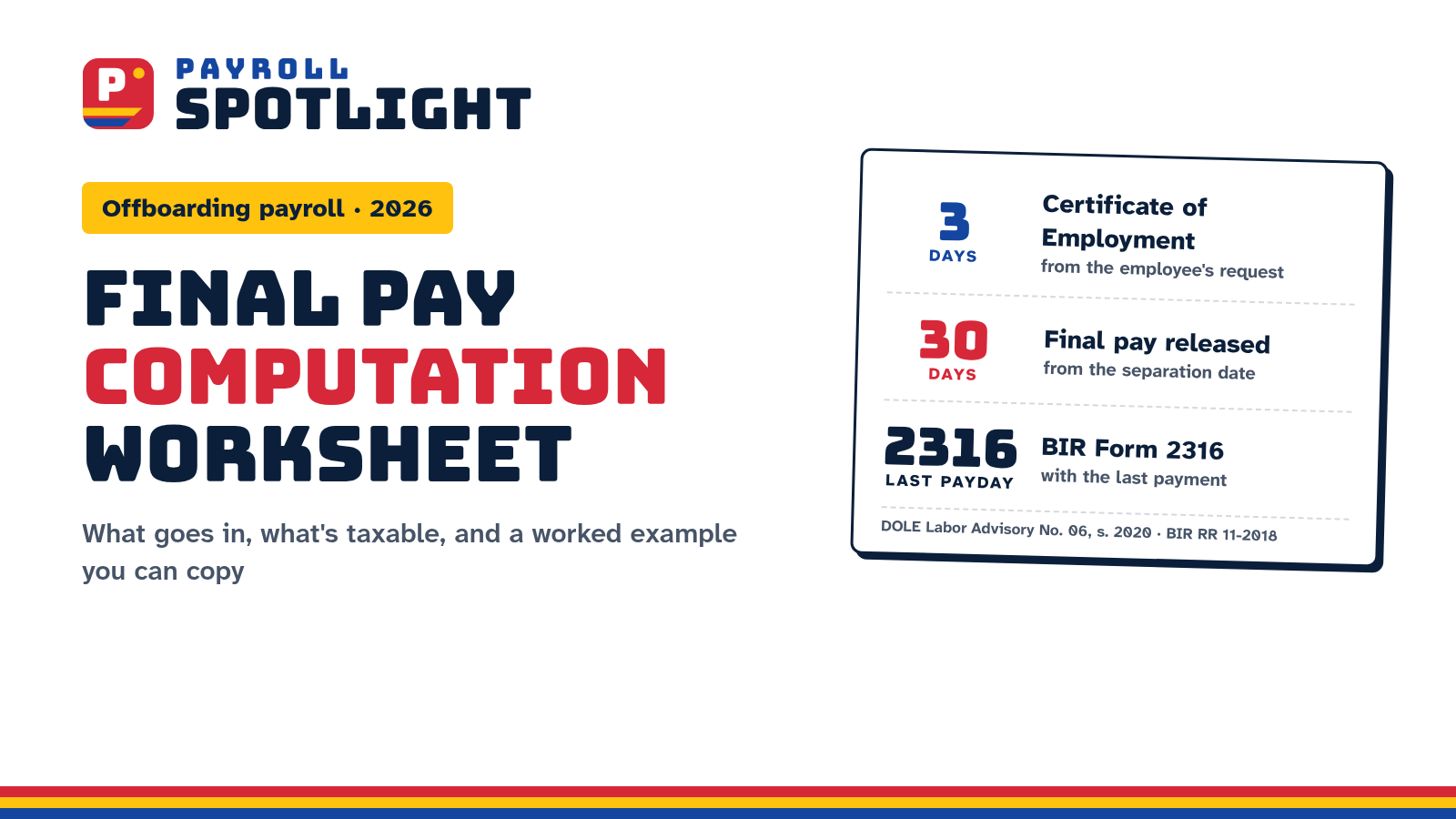
Short answer (as of October 23, 2026): Final pay computation in the Philippines means adding up everything still owed to a departing employee: unpaid salary, pro-rated 13th month pay, cash conversion of unused Service Incentive Leave (and other convertible leave under your policy), separation or retirement pay if it applies, any excess tax withheld, other agreed benefits, and returnable cash bonds. Then subtract only the deductions the law or the employee’s written authorization allows. Under DOLE Labor Advisory No. 06, s. 2020, final pay must be released within 30 days from separation unless a more favorable policy or agreement applies, and a Certificate of Employment (COE) is due within 3 days of the request. DOLE repeated both deadlines in a January 21, 2026 news release and said final pay was the most common labor standards concern in 2025: 23,496 of the 168,853 questions received by DOLE Hotline 1349.
This guide is for payroll officers, HR leads, owners, and NGO or campaign admins who have to close out a resignation or termination properly. It is also useful for employees who want to check their own last pay. You’ll get the full list of what goes in, the three deadlines, a worked worksheet with example numbers, and the tax rules that decide whether each line is taxable.
What goes into final pay
Labor Advisory No. 06, s. 2020 defines final pay (also called “last pay” or “back pay”) as all wages and monetary benefits due regardless of the cause of separation. That last part matters: a resigned employee and a terminated employee both get a final pay. What changes is which lines apply.
| Line item | Legal basis | Applies when |
|---|---|---|
| Unpaid earned salary | LA 06-20; Labor Code | Always, for days worked but not yet paid |
| Pro-rated 13th month pay | PD 851 and its Revised Guidelines | Always for rank-and-file employees who worked at least one month in the year |
| Unused Service Incentive Leave (SIL), in cash | Labor Code Art. 95 | Employee has at least 1 year of service and isn’t exempt from SIL |
| Other unused leave, in cash | Company policy, contract or CBA | Only if your policy says it converts |
| Separation pay | Labor Code Arts. 298–299 (renumbered), policy, contract or CBA | Authorized causes, or when your policy grants it |
| Retirement pay | Labor Code Art. 302 (renumbered) | Employee qualifies for retirement |
| Refund of excess tax withheld | BIR annualization rules | Withholding during the year was higher than the annual tax due |
| Other agreed compensation | Contract or CBA | If any |
| Cash bonds or deposits | Agreement | If the employee posted any |
Two items here are mandatory for almost everyone (salary and 13th month), two depend on tenure and cause (SIL and separation pay), and the rest depend on your own documents. If your 13th month pay computation process is already solid, the pro-rated version is the same formula with a shorter period.
The three deadlines: 3 days, 30 days, and the last payday
| What | Deadline | Source |
|---|---|---|
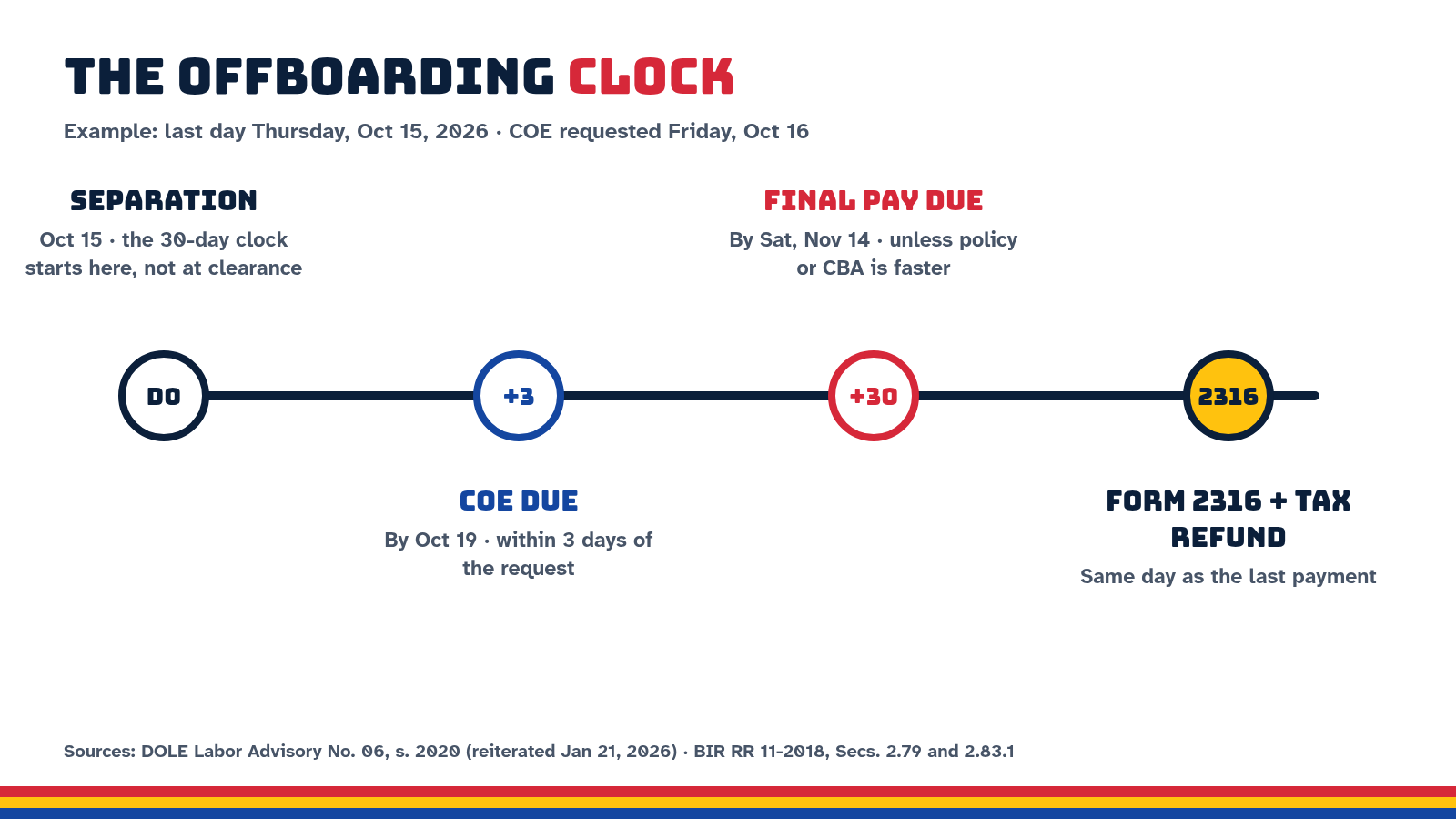
| Certificate of Employment | Within 3 days from the employee’s request (an employee who hasn’t left yet may also ask for one) | DOLE LA 06-20 |
| Final pay | Within 30 days from the date of separation, unless a more favorable policy or agreement applies | DOLE LA 06-20 |
| BIR Form 2316 | On the day the last payment of compensation is made, if employment ends before year-end | BIR RR 11-2018 (Sec. 2.83.1) |
| Tax refund or deficiency | Settled on the last payment of compensation, after annualizing January to separation | BIR RR 11-2018 (Sec. 2.79) |
The 30 days run from the separation date, not from the day clearance is finished. Put the release date on your calendar the day the resignation is accepted. Disputes about final pay or the COE go to the DOLE Regional, Provincial or Field Office covering the workplace, and employees can call Hotline 1349.
Final pay computation worksheet: a worked example
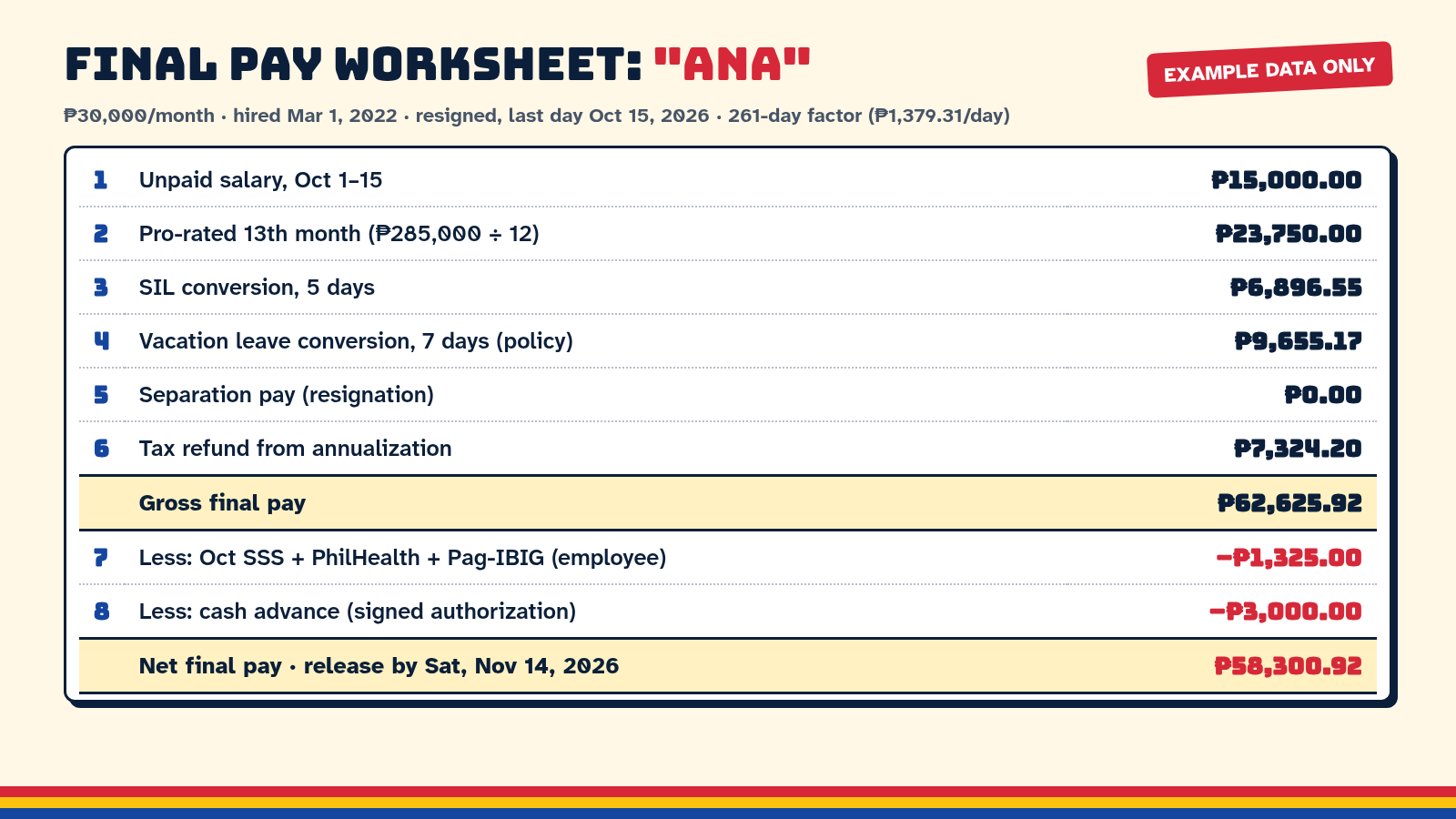
Example data only. “Ana” is a fictional rank-and-file employee. All names and figures below are illustrative, built to show the method, not taken from a real person.
- Monthly basic salary: ₱30,000, paid semi-monthly
- Hired March 1, 2022; resigned, last day Thursday, October 15, 2026
- October 1–15 salary not yet paid
- 5 days unused SIL for 2026; 7 days unused vacation leave that company policy says converts to cash
- Company uses a 261-day factor for monthly-paid staff (check your own factor; it changes the daily rate)
- ₱3,000 cash advance outstanding, with a signed salary-deduction authorization
- No separation pay: voluntary resignation, and no policy or contract grants it
| # | Line | Computation | Amount |
|---|---|---|---|
| 1 | Unpaid salary, Oct 1–15 | ₱30,000 ÷ 2 | ₱15,000.00 |
| 2 | Pro-rated 13th month | ₱285,000 basic earned Jan 1–Oct 15 ÷ 12 | ₱23,750.00 |
| 3 | SIL conversion, 5 days | ₱1,379.31 daily rate × 5 | ₱6,896.55 |
| 4 | Vacation leave conversion, 7 days (policy) | ₱1,379.31 × 7 | ₱9,655.17 |
| 5 | Separation pay | Not applicable (resignation) | ₱0.00 |
| 6 | Refund of excess tax withheld | ₱9,067.95 withheld − ₱1,743.75 annual tax due | ₱7,324.20 |
| Gross final pay | ₱62,625.92 | ||
| 7 | Less: October employee share of SSS, PhilHealth, Pag-IBIG | ₱750 + ₱375 + ₱200 | (₱1,325.00) |
| 8 | Less: cash advance (written authorization on file) | (₱3,000.00) | |
| Net final pay | ₱58,300.92 | ||
| Release no later than | Oct 15 + 30 days | Saturday, Nov 14, 2026 |
How each line was built
- Unpaid salary. Half of the monthly basic for the October 1–15 cut-off. If the last cut-off includes a holiday, apply the premium rules first; our November 2026 holiday pay guide covers the rates.
- Pro-rated 13th month. PD 851’s Revised Guidelines say an employee who resigned or was terminated before the payout date gets 13th month pay in proportion to the time worked during the year. Here: nine full months (₱270,000) plus half of October (₱15,000) = ₱285,000 basic salary earned, divided by 12. Basic salary only: no overtime, holiday premiums, or allowances unless your policy includes them.
- Daily rate. ₱30,000 × 12 ÷ 261 = ₱1,379.31. A company on a 313-day or 365-day factor will get a different number, so use the factor you already use for absences. Also check the rate never falls below your region’s minimum wage.
- SIL. Under Article 95 of the Labor Code, an employee with at least one year of service gets 5 days of paid SIL a year, and unused SIL converts to cash. If your company already gives at least 5 days of paid vacation leave, that leave can count as SIL; don’t pay the same days twice.
- Other leave. Converts only if your policy, contract or CBA says so. Ana’s handbook converts unused vacation leave, so 7 days go in.
- Tax refund. Ana’s monthly taxable pay was ₱27,550 (₱30,000 less ₱2,450 in employee contributions). Under the BIR withholding table for 2023 onward, that’s ₱1,007.55 a month, or ₱9,067.95 for January to September. Annualized to her separation date, taxable compensation is ₱285,000 less ₱23,375 in contributions = ₱261,625. The annual tax is 15% of the excess over ₱250,000 = ₱1,743.75. The difference comes back to her.
- Contributions. In this example the schedule computes October on the ₱15,000 earned in October (SSS 5% employee share, PhilHealth 2.5%, Pag-IBIG ₱200). Use your own SSS, PhilHealth and Pag-IBIG schedules; a full 2026 contribution table guide is coming next on this blog.
- Cash advance. Deducted because Ana signed a deduction authorization. Without one, don’t deduct; collect separately.
The pattern to notice: employees who leave mid-year often get a tax refund, because withholding assumed a full year of pay while the annual tax is computed on what they actually earned.
Separation pay: when it’s owed and how to count years
Separation pay is not part of every final pay. Under Articles 298 and 299 of the Labor Code (formerly Articles 283 and 284; text on Lawphil), it’s owed for authorized causes:
| Cause | Minimum separation pay |
|---|---|
| Labor-saving devices or redundancy | 1 month pay per year of service, or 1 month pay, whichever is higher |
| Retrenchment to prevent losses, or closure not due to serious losses | ½ month pay per year of service, or 1 month pay, whichever is higher |
| Disease (Art. 299) | ½ month salary per year of service, or 1 month salary, whichever is greater |
| Closure due to serious business losses | None required by the Labor Code |
| Voluntary resignation | None, unless policy, contract or CBA grants it |
A fraction of at least six months counts as one whole year. If Ana had been made redundant instead, her service from March 1, 2022 to October 15, 2026 is 4 years and 7½ months, which counts as 5 years. Redundancy pay: 5 × ₱30,000 = ₱150,000. Retrenchment: 5 × ₱15,000 = ₱75,000, which beats the one-month floor. Authorized-cause terminations also need a written notice to the employee and DOLE at least one month before the intended date.
Is final pay taxable? Line by line
| Line | Tax treatment | Basis |
|---|---|---|
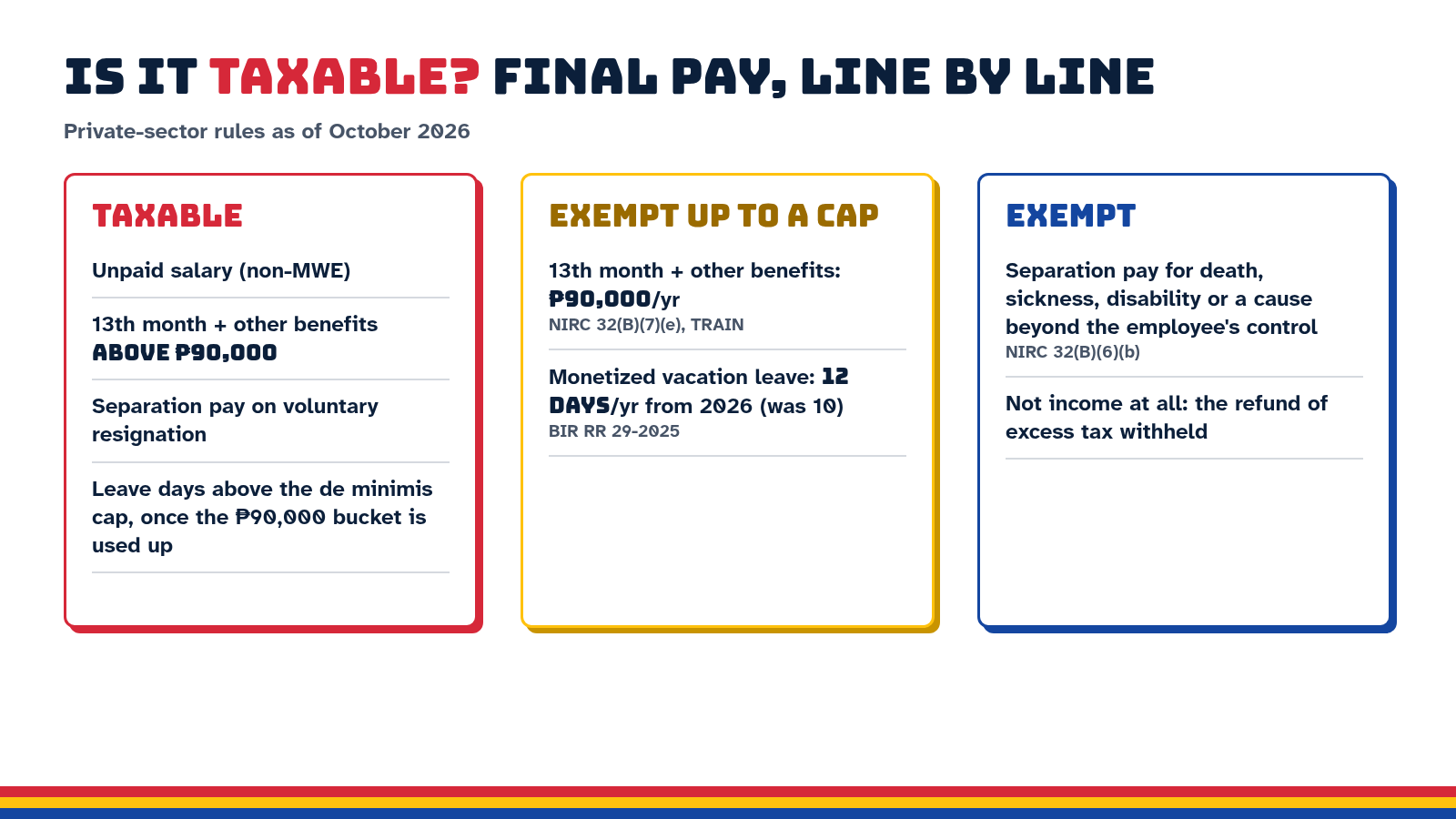
| Unpaid salary | Taxable compensation (unless the employee is a minimum wage earner) | NIRC; RR 11-2018 |
| 13th month and other benefits | Exempt up to ₱90,000 combined for the year; the excess is taxable | NIRC Sec. 32(B)(7)(e), as amended by TRAIN (RA 10963) |
| Monetized unused vacation leave | De minimis, exempt up to 12 days a year from 2026 (was 10 days); excess joins the ₱90,000 bucket | BIR RR 29-2025 |
| Separation pay for death, sickness, disability, or a cause beyond the employee’s control | Exempt | NIRC Sec. 32(B)(6)(b) |
| Separation pay given on voluntary resignation | Generally taxable | Not covered by the Sec. 32(B)(6)(b) exclusion |
The ₱90,000 ceiling is still the law as of this writing. Bills filed in 2026 to raise it have not been enacted, so don’t plan around a higher cap yet. RR 29-2025 raised several de minimis ceilings, including monetized leave, and took effect in January 2026, so final pays computed this year should use the 12-day figure.
In Ana’s case, ₱23,750 in 13th month pay is well under ₱90,000, and her 12 converted leave days fit the de minimis ceiling (and would fall into the ₱90,000 bucket if your tax adviser treats any of them differently). So only her salary was taxable.
Finally, hand over BIR Form 2316 on the same day as the last payment. Her next employer needs it to annualize her 2026 tax correctly.
Clearance, company property and deductions
This is where most disputes start. Two positions are on record:
- The Supreme Court in Milan v. NLRC (G.R. No. 202961, February 4, 2015) allowed an employer to withhold terminal benefits until employees returned company property, where the accountability was clear and agreed.
- DOLE Central Visayas (Regional Director Roy Buenafe, reported by CDN Digital on July 17, 2026) said benefits due as a matter of right, such as salary and 13th month pay, can’t be held back just because clearance isn’t finished, and that deductions should be limited to those authorized by law or in writing by the employee.
The safe practice: run clearance inside the 30 days, release the legally mandated items on time, and handle a genuine property dispute separately and on paper. Get legal advice before withholding anything.
Mistakes that turn a final pay into a complaint
- Starting the 30 days from clearance completion instead of the separation date
- Computing 13th month on total pay instead of basic salary, or forgetting to pro-rate it
- Paying SIL in cash when vacation leave already covered it, or skipping SIL for employees with over a year of service
- Treating resignation-based separation pay as tax-exempt
- Forgetting the tax annualization, so the refund (or deficiency) never shows up
- Releasing final pay without the BIR Form 2316 and the COE
- Deducting unreturned items or “training bonds” with no written basis
Pre-release checklist
- Confirm the separation date and cause; write the 30-day release date on the payroll calendar.
- Issue the COE within 3 days of the request.
- Compute unpaid salary, including any holiday or overtime in the last cut-off.
- Pro-rate the 13th month on basic salary earned January 1 to the last day.
- Count unused SIL and convertible leave; use your standard daily-rate factor.
- Decide if separation or retirement pay applies, and count years (6 months or more = 1 year).
- Annualize tax; apply the ₱90,000 and 12-day ceilings; compute the refund or deficiency.
- List deductions; keep only those with a legal basis or written authorization.
- Release pay, BIR Form 2316, and a signed computation sheet together.
FAQ
How many days does an employer have to release final pay?
Thirty days from the date of separation, under DOLE Labor Advisory No. 06, s. 2020, unless a company policy, contract or CBA gives a shorter period.
Is a resigned employee entitled to 13th month pay?
Yes. Under PD 851’s Revised Guidelines, a resigned or terminated employee gets 13th month pay in proportion to the time worked in the year: total basic salary earned from January 1 to the last day, divided by 12.
Can an employer hold final pay until clearance is done?
Clearance can run alongside, but it shouldn’t push release past 30 days. The Supreme Court has allowed withholding tied to clear, agreed accountabilities (Milan v. NLRC, 2015), while DOLE Central Visayas said in July 2026 that salary and 13th month pay can’t be withheld just because clearance is incomplete.
Is final pay taxable in the Philippines?
Partly. Unpaid salary is taxable. 13th month and other benefits are exempt up to ₱90,000 a year; monetized vacation leave up to 12 days is de minimis from 2026; separation pay for causes beyond the employee’s control is exempt.
When should I receive my BIR Form 2316 after resigning?
On the day your last compensation is paid, under BIR rules for employment that ends before year-end.
What to do next
Copy the worksheet above into your offboarding file and run it on your next resignation before the 30-day clock gets tight. If you’d rather have payroll keep the 13th month, leave balances and annualized tax ready the moment someone resigns, see what Payroll Spotlight does and start a free trial.
Educational overview only, based on DOLE Labor Advisory No. 06, s. 2020 and the DOLE news release of January 21, 2026; the Labor Code (Arts. 95, 298, 299, 302, as renumbered); PD 851 and its Revised Guidelines; NIRC Sec. 32(B) as amended by RA 10963; BIR RR 11-2018 and RR 29-2025; and Milan v. NLRC (2015), all retrieved October 23, 2026. “Ana” and all worksheet figures are example data. Rules change, and policies or CBAs may grant more. Not legal or tax advice.
Leave a Reply