
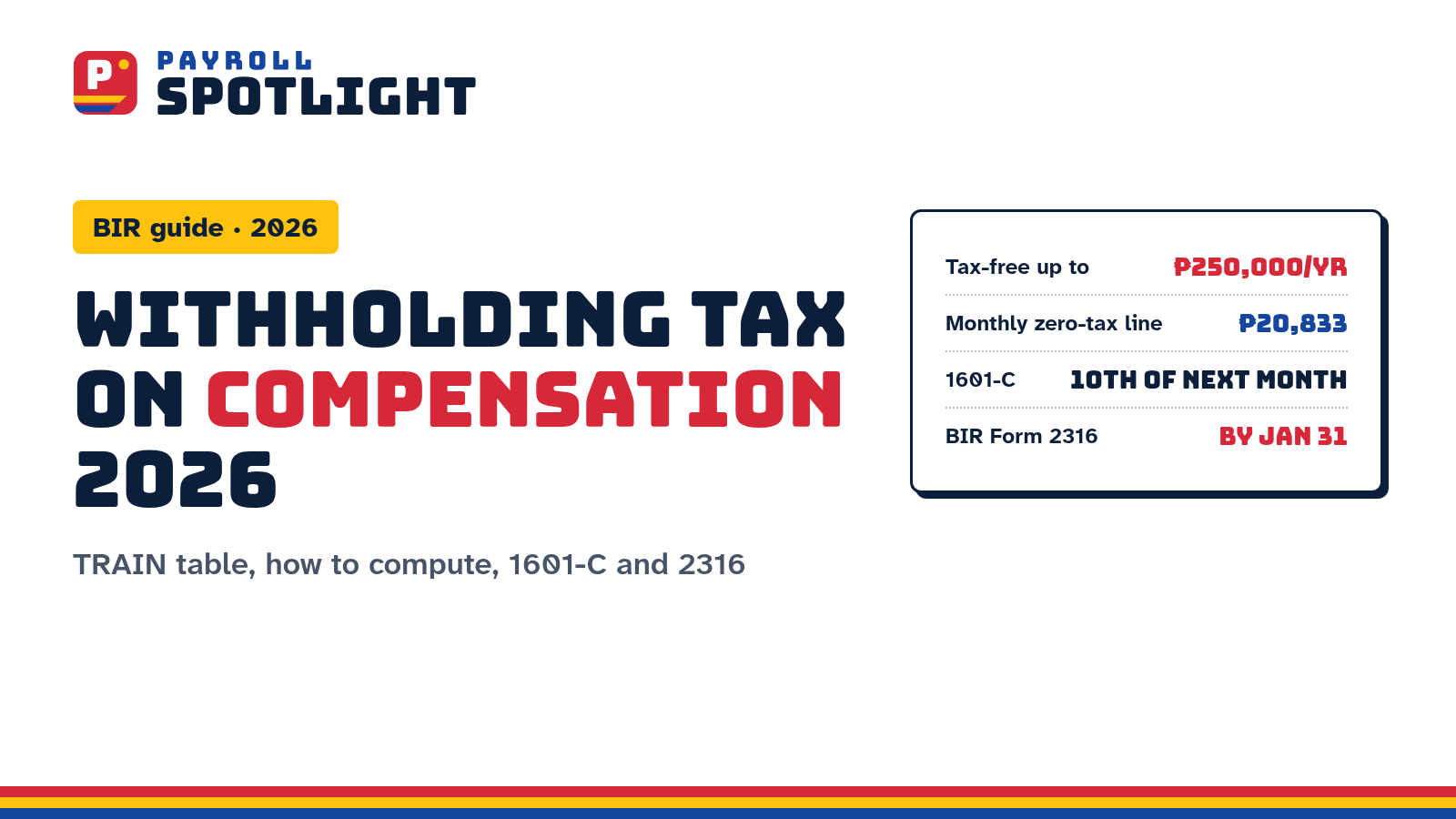
Short answer (as of October 23, 2026): Withholding tax on compensation in 2026 still uses the TRAIN law table that took effect on January 1, 2023. Annual taxable compensation up to ₱250,000 is tax-free; above that, rates run from 15% to 35%. In practice that means a monthly-paid employee with taxable pay (after SSS, PhilHealth and Pag-IBIG) of ₱20,833 or less has no tax withheld. Employers file and pay BIR Form 1601-C every month, annualize at year-end, and give each employee BIR Form 2316 by January 31. Sources: the BIR revised withholding tax table (RR 11-2018, Annex E), RA 10963 (TRAIN), and the BIR Form 1601-C guidelines.
This guide to withholding tax on compensation 2026 is for payroll staff, accountants and owners who run payroll in-house, and for employees who want to check the tax line on their payslip. It shows the 2026 table, how to compute tax each payday, a worked example, which pay is exempt, and the forms and dates you can’t miss.
The 2026 income tax table for employees
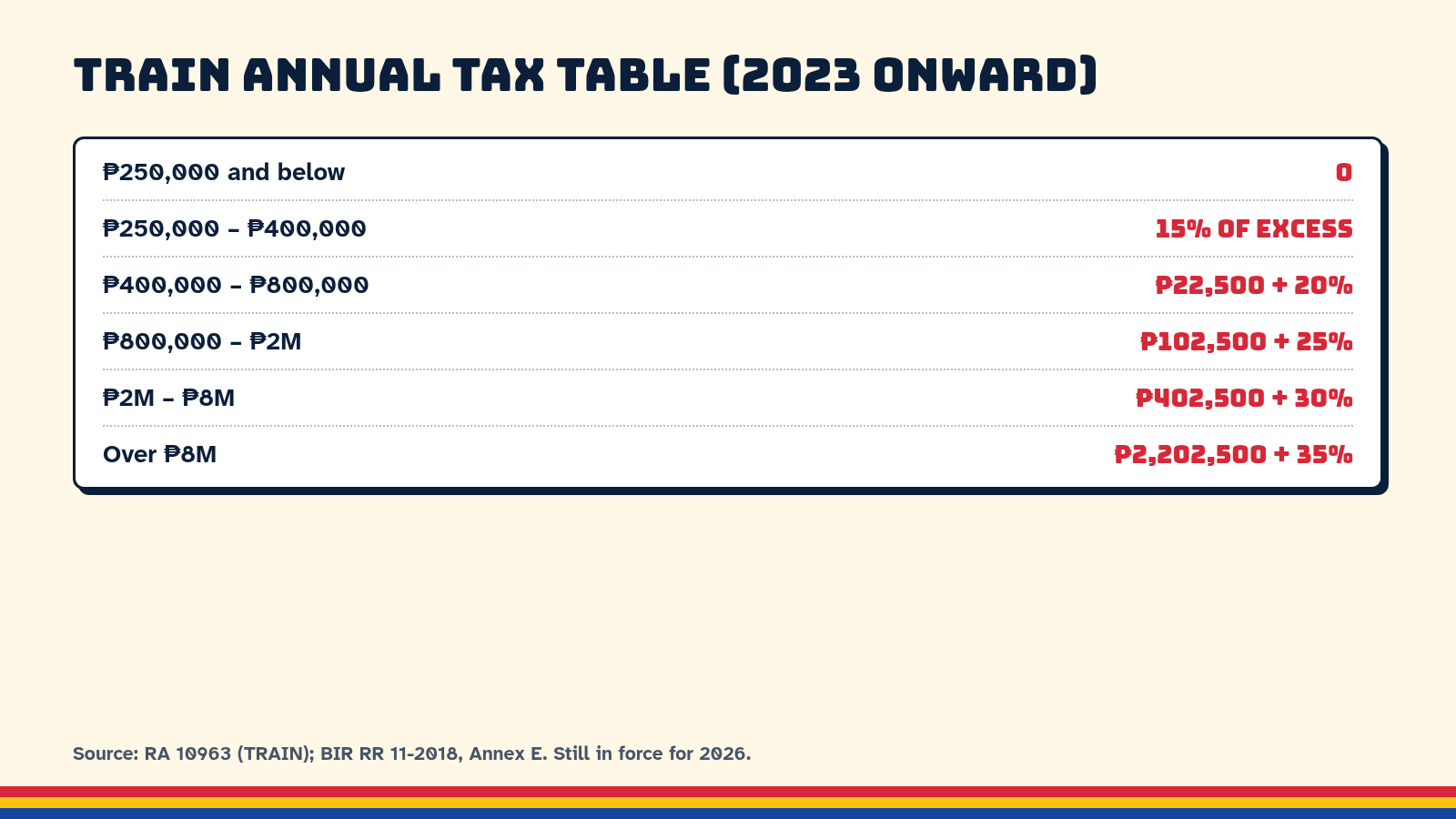
TRAIN set two schedules: one for 2018 to 2022 and a lower one from January 1, 2023 onward. No law has changed the 2023 schedule, so it is the one for 2026.
| Annual taxable compensation | Tax due |
|---|---|
| ₱250,000 and below | 0 |
| Over ₱250,000 to ₱400,000 | 15% of the excess over ₱250,000 |
| Over ₱400,000 to ₱800,000 | ₱22,500 + 20% of the excess over ₱400,000 |
| Over ₱800,000 to ₱2,000,000 | ₱102,500 + 25% of the excess over ₱800,000 |
| Over ₱2,000,000 to ₱8,000,000 | ₱402,500 + 30% of the excess over ₱2,000,000 |
| Over ₱8,000,000 | ₱2,202,500 + 35% of the excess over ₱8,000,000 |
The monthly and semi-monthly withholding tables
BIR converts the annual table into per-payday tables so tax comes out evenly across the year. These are the 2023-onward figures from Annex E of RR 11-2018.
| Monthly taxable pay | Withhold | Semi-monthly taxable pay | Withhold |
|---|---|---|---|
| ₱20,833 and below | 0 | ₱10,417 and below | 0 |
| ₱20,833 to ₱33,332 | 15% over ₱20,833 | ₱10,417 to ₱16,666 | 15% over ₱10,417 |
| ₱33,333 to ₱66,666 | ₱1,875 + 20% over ₱33,333 | ₱16,667 to ₱33,332 | ₱937.50 + 20% over ₱16,667 |
| ₱66,667 to ₱166,666 | ₱8,541.80 + 25% over ₱66,667 | ₱33,333 to ₱83,332 | ₱4,270.70 + 25% over ₱33,333 |
| ₱166,667 to ₱666,666 | ₱33,541.80 + 30% over ₱166,667 | ₱83,333 to ₱333,332 | ₱16,770.70 + 30% over ₱83,333 |
| ₱666,667 and above | ₱183,541.80 + 35% over ₱666,667 | ₱333,333 and above | ₱91,770.70 + 35% over ₱333,333 |
How to compute withholding tax each payday
- Start with gross taxable compensation for the period: basic pay, taxable allowances, overtime, holiday and night differential pay (unless the employee is a minimum wage earner), commissions and taxable bonuses.
- Subtract non-taxable items: the employee’s share of SSS, PhilHealth and Pag-IBIG; de minimis benefits within their ceilings; and 13th month pay and other benefits up to ₱90,000 for the year.
- Find the row in the table for your pay frequency and apply the fixed amount plus the percentage of the excess.
- Record it on the payslip and in the payroll register, and include it in that month’s 1601-C.
Worked example: ₱40,000 a month
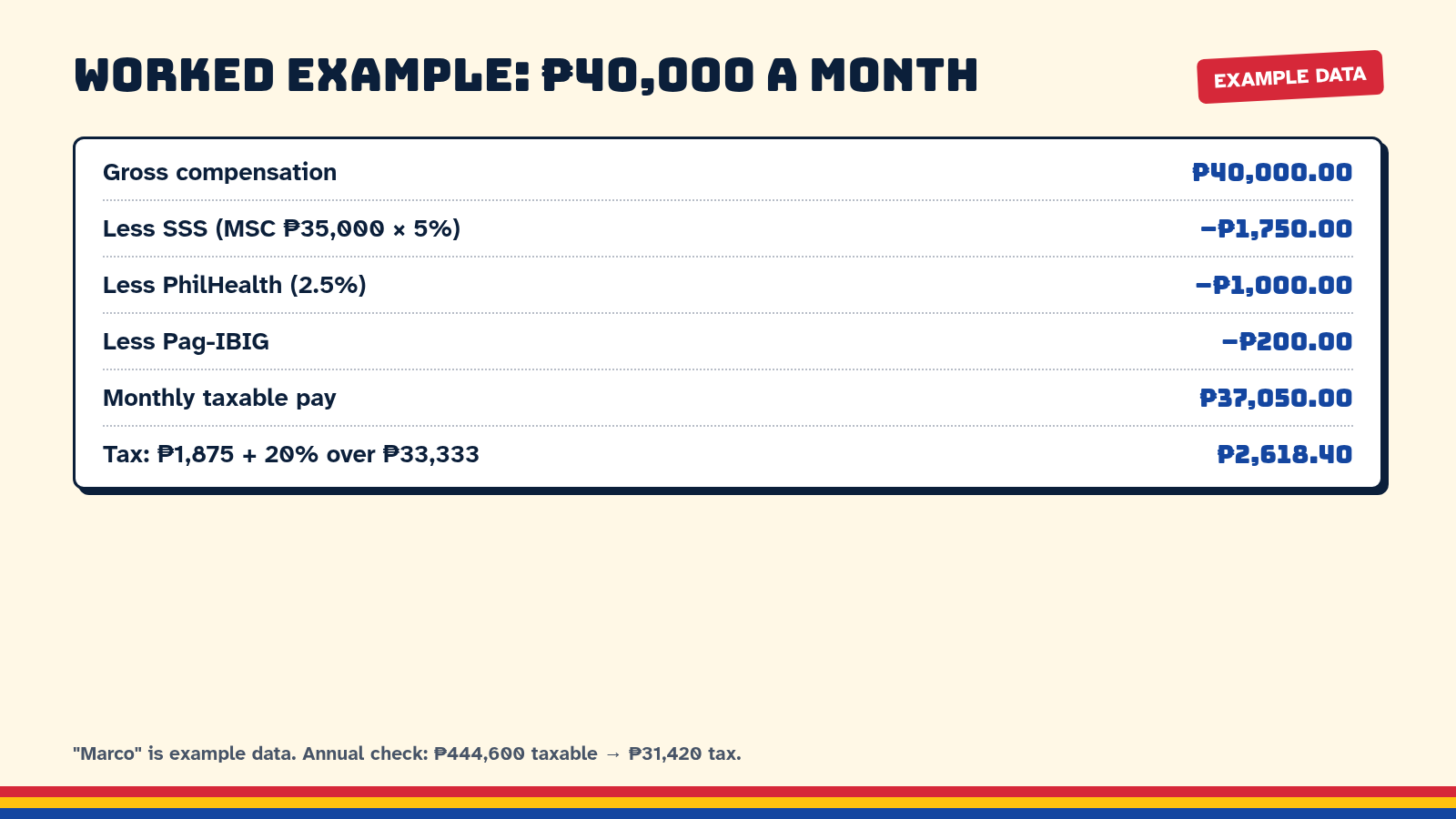
Marco (example data) earns ₱40,000 basic a month, no other pay this month.
| Step | Amount |
|---|---|
| Gross compensation | ₱40,000.00 |
| Less SSS employee share (MSC capped at ₱35,000 × 5%) | −₱1,750.00 |
| Less PhilHealth employee share (₱40,000 × 2.5%) | −₱1,000.00 |
| Less Pag-IBIG employee share (₱10,000 cap × 2%) | −₱200.00 |
| Monthly taxable compensation | ₱37,050.00 |
| Tax: ₱1,875 + 20% × (₱37,050 − ₱33,333) | ₱2,618.40 |
Check it against the annual table: ₱37,050 × 12 = ₱444,600. Tax = ₱22,500 + 20% × ₱44,600 = ₱31,420, or ₱2,618.33 a month. The few centavos of difference come from rounding in the table and are settled at year-end annualization.
For comparison, using the same method: an employee on ₱30,000 a month has taxable pay of ₱27,550 and about ₱1,007.55 withheld, while an employee on ₱20,000 has taxable pay of ₱18,300 and nothing withheld. The contribution amounts come from our 2026 SSS, PhilHealth and Pag-IBIG table.
What’s exempt from withholding
| Item | Treatment in 2026 |
|---|---|
| Statutory minimum wage, plus holiday, overtime, night differential and hazard pay of minimum wage earners | Exempt (NIRC Sec. 24(A)(2), as amended) |
| 13th month pay and other benefits (Christmas bonus, productivity incentives) | Exempt up to ₱90,000 a year combined; the excess is taxable |
| De minimis benefits within BIR ceilings | Exempt; monetized unused vacation leave of private employees is de minimis up to 12 days from 2026 under RR 29-2025 |
| Employee share of SSS, PhilHealth, Pag-IBIG and union dues | Excluded from taxable compensation |
| Separation pay for causes beyond the employee’s control | Exempt |
The ₱90,000 ceiling hasn’t changed in 2026. Bills to raise it have been filed, but none has been enacted as of this writing, so don’t apply a higher figure until a law and BIR regulations say so. The 13th month pay guide shows how to handle the excess in December.
Forms and deadlines you can’t miss
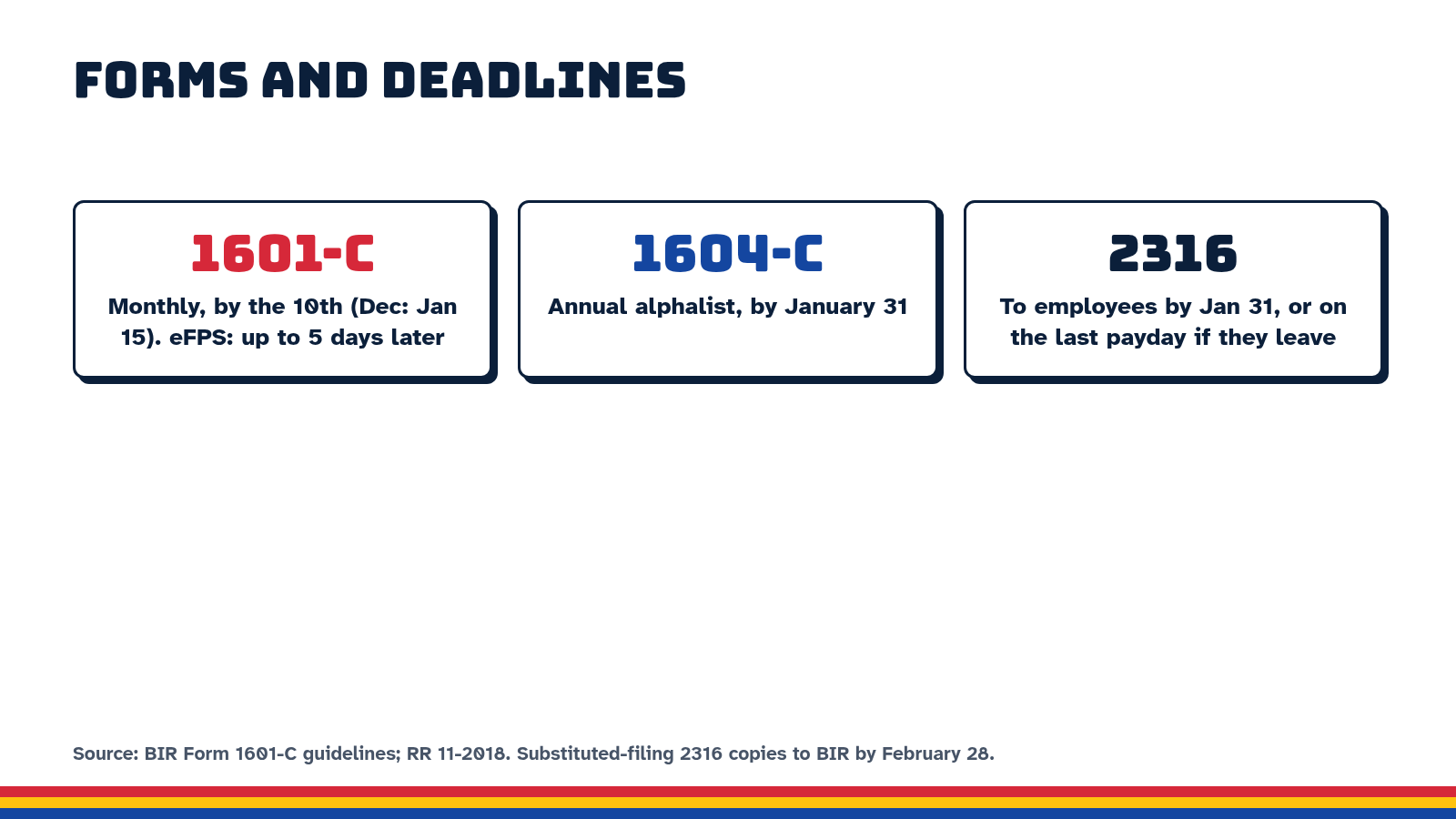
| Form | What it is | Deadline |
|---|---|---|
| BIR Form 1601-C | Monthly remittance return of income taxes withheld on compensation | 10th of the following month; December’s is due January 15. eFPS filers get up to 5 more days, staggered by group |
| BIR Form 1604-C | Annual information return with alphalist of employees | January 31 of the following year |
| BIR Form 2316 | Certificate of compensation and tax withheld, given to each employee | January 31 of the following year, or on the last payday for an employee who leaves mid-year |
| Signed 2316 copies for substituted filing | Employer submits to BIR for employees qualified for substituted filing | February 28 of the following year |
For the December 2026 payroll, that means 1601-C by January 15, 2027, and 1604-C and every 2316 by January 31, 2027.
Year-end annualization in four steps
Withholding each payday is an estimate. In the last payroll of the year (or the final pay of someone who resigns), the employer recomputes the whole year:
- Add up the year’s taxable compensation from January to December, including taxable bonuses above ₱90,000.
- Compute the annual tax using the annual table.
- Compare it with the total tax already withheld.
- Withhold the shortfall from the last payroll, or refund any excess to the employee no later than January 25 of the following year.
Mid-year hires need their previous employer’s 2316 so you can include that income. Without it, the employee can’t qualify for substituted filing and you risk under-withholding. Employees who leave before December are annualized in their final pay, often producing a refund.
Who should skip substituted filing
Substituted filing means the employee doesn’t file their own annual return; the 2316 stands in for it. It applies only when the employee had one employer for the whole year and the tax withheld equals the tax due. Employees with two employers in the same year, mixed income (a side business or professional practice), or non-resident status file their own BIR Form 1700 or 1701.
Mistakes that lead to BIR assessments
- Using the 2018 to 2022 table. It has higher rates. Old spreadsheets still carry it.
- Taxing contributions. Subtract the employee shares of SSS, PhilHealth and Pag-IBIG first.
- Exempting the whole 13th month regardless of amount. Only up to ₱90,000 combined with other benefits.
- Taxing a minimum wage earner’s overtime and holiday pay. These are exempt for MWEs.
- Skipping annualization. It’s how over- and under-withholding gets fixed.
- Late 2316s. Employees need them for loans, visas and their next employer.
FAQ
What is the withholding tax table for 2026 in the Philippines?
It’s the TRAIN law schedule effective January 1, 2023: zero tax on annual taxable compensation up to ₱250,000, then 15%, 20%, 25%, 30% and 35% brackets. In monthly terms, no tax is withheld on taxable pay of ₱20,833 or less.
Is the 13th month pay taxable in 2026?
Only the part above ₱90,000, counted together with other bonuses and benefits for the year. The ₱90,000 ceiling under NIRC Sec. 32(B)(7)(e) has not been raised as of October 2026.
When is BIR Form 1601-C due?
On or before the 10th day of the month after the withholding, except December’s, which is due January 15. eFPS filers get up to five extra days depending on their group.
When must employers give BIR Form 2316?
By January 31 of the following year, or on the day of the last payment of compensation if the employee leaves before year-end.
Are minimum wage earners subject to withholding tax?
No. Their statutory minimum wage and their holiday, overtime, night differential and hazard pay are exempt. Other taxable income, such as bonuses above ₱90,000, can still be taxed.
What to do next
Run one employee’s payroll through the steps above and compare the result with your system. If it’s off, the cause is usually the old table or taxed contributions. Then set your 1601-C and January 31 deadlines in your calendar now. If you’d like withholding, annualization and 2316s produced automatically, see what Payroll Spotlight does and start a free trial.
Educational overview only, based on the NIRC as amended by RA 10963 (TRAIN), BIR RR 11-2018 and its Annex E withholding table, BIR RR 29-2025, and the BIR Form 1601-C guidelines, all retrieved October 23, 2026. “Marco” and all worked figures are example data. Not legal or tax advice.
Leave a Reply