
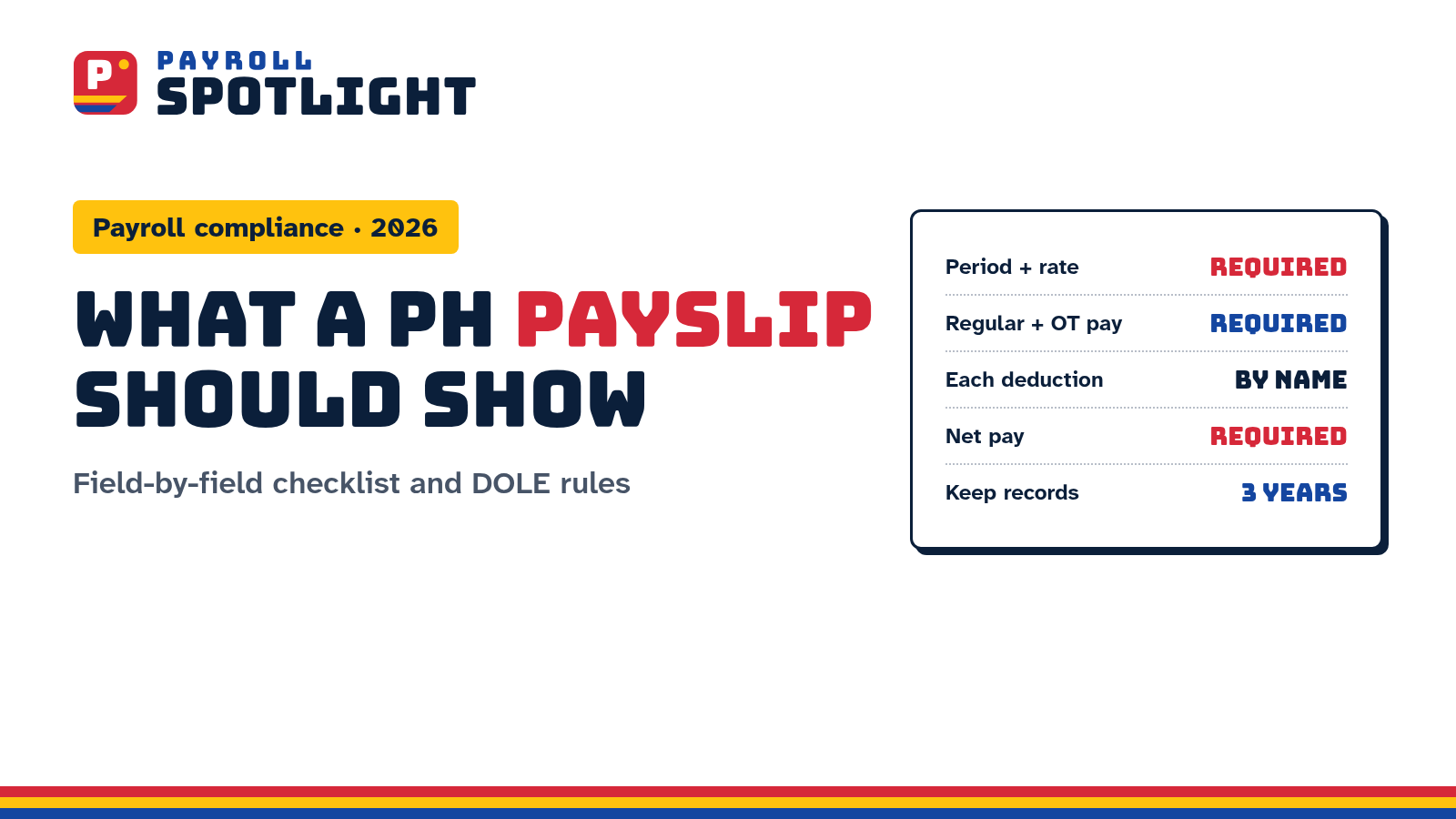
Short answer (as of October 23, 2026): Philippine law doesn’t prescribe one payslip form for private employers, but the rules on payroll records tell you what every pay statement needs to show. Under Book III, Rule X, Sec. 6 of the Labor Code’s implementing rules, the payroll must show for each employee the period covered, rate of pay, pay for regular work, pay for overtime, each deduction, and the amount actually paid. A payslip that gives the employee those same lines, every payday, is what lets them check their pay and lets you prove compliance in a DOLE inspection. For kasambahay, a payslip every payday is an explicit legal duty under RA 10361, Sec. 26, with copies kept for three years.
This guide to payslip requirements in the Philippines is for employers designing or checking their payslip, and for employees who want to read theirs. It gives a field-by-field checklist, an annotated sample, the rules on deductions, how electronic payslips should work, and the mistakes that lead to disputes.
The legal basis, in plain terms
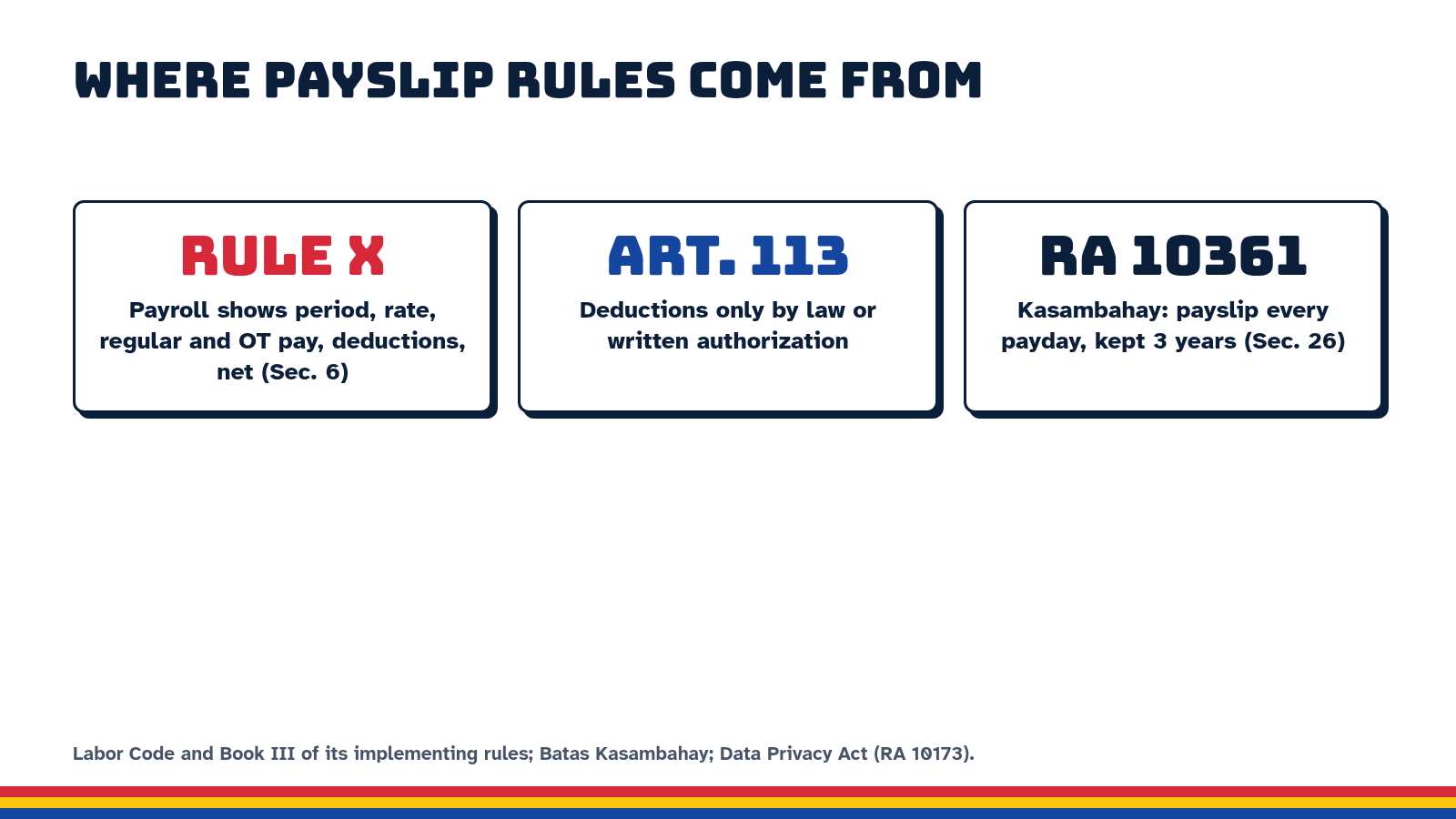
| Source | What it requires | Payslip takeaway |
|---|---|---|
| Labor Code Art. 103; Book III, Rule VIII, Sec. 3 | Pay at least twice a month, at intervals of no more than 16 days | One payslip per payday |
| Book III, Rule X, Sec. 6 | Payroll shows period, rate, regular pay, overtime pay, deductions and net pay per employee | Show the same lines on the payslip |
| Book III, Rule X, Sec. 12 | Keep employment records at least 3 years from the last entry | Keep payslip copies or data for 3 years |
| Labor Code Art. 113; Book III, Rule VIII, Sec. 13 | Deductions only when authorized by law or by the employee in writing | Name every deduction; keep the authorization |
| RA 10361 (Batas Kasambahay), Sec. 26 | Kasambahay get a payslip every payday showing cash paid and all deductions; copies kept 3 years | Mandatory for household employers |
| RA 10173 (Data Privacy Act) | Personal information must be processed securely and only as needed | Protect e-payslips; show only what’s needed |
DOLE labor inspectors check payrolls, time records and proof of payment during inspections under Department Order No. 238-23 (copy hosted by PALSCON). A clear payslip trail makes those checks quick.
The field-by-field payslip checklist
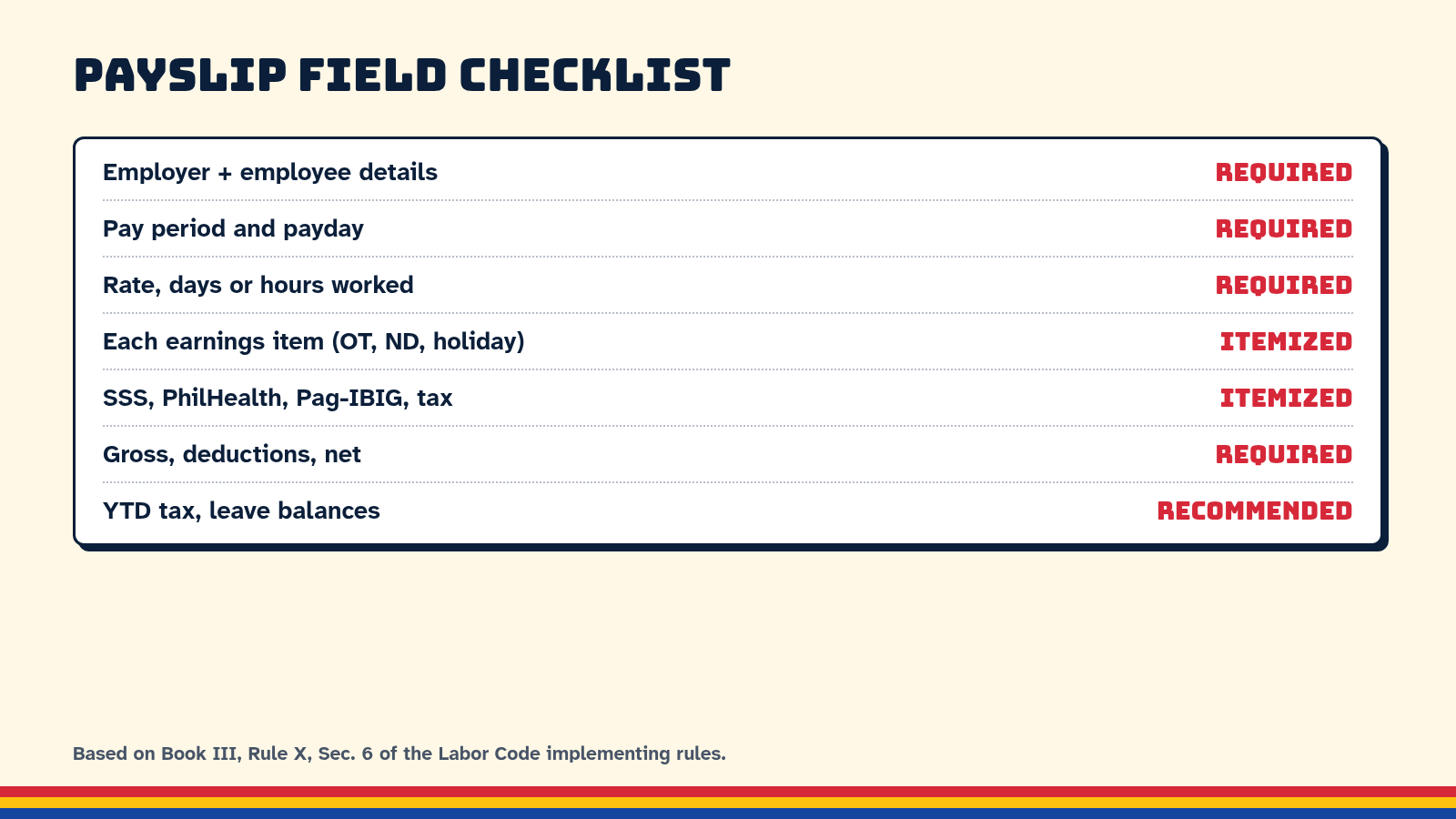
| Section | Fields | Why it matters |
|---|---|---|
| Header | Employer’s registered name and address; employee name, ID and position | Identifies who paid whom |
| Period | Cut-off dates and payday | Ties the slip to the 16-day rule |
| Rate | Monthly, daily or hourly rate, and the factor used for monthly-paid staff | Lets the employee recompute everything else |
| Time | Days or hours worked; absences, tardiness and undertime | Supports the regular pay line |
| Earnings | Basic pay; overtime hours and pay; night differential; holiday and rest-day premiums; allowances; commissions; 13th month or bonuses if paid | Each premium has its own legal rate |
| Statutory deductions | SSS, PhilHealth and Pag-IBIG employee shares; withholding tax | Employees verify the contribution and tax math |
| Other deductions | Loans (SSS, Pag-IBIG, company), cash advances, union dues, others, each by name | Only with legal basis or written authorization |
| Totals | Gross pay, total deductions, net pay | The amount actually paid |
| Year-to-date (recommended) | YTD taxable pay, tax withheld, 13th month accrued | Makes annualization and the 2316 easy to check |
| Leave (recommended) | Leave used and balances | Prevents year-end conversion disputes |
Annotated sample (example data)
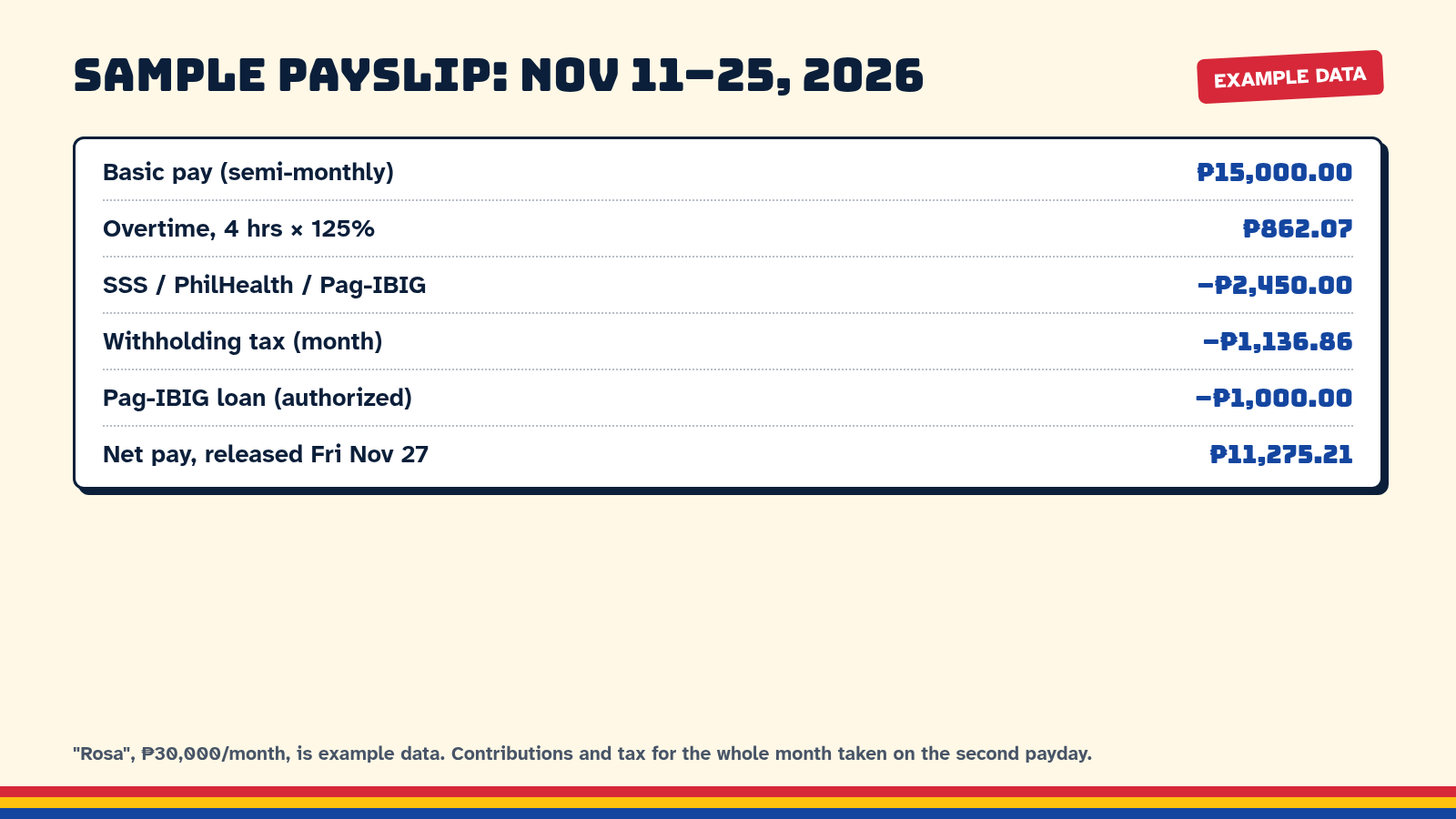
Rosa (example data) earns ₱30,000 a month, paid semi-monthly. This is her November 30, 2026 payslip, for November 11 to 25, released November 27 because November 30 is a regular holiday.
| Line | Amount |
|---|---|
| Basic pay, semi-monthly | ₱15,000.00 |
| Overtime, ordinary days, 4 hours at 125% (₱30,000 × 12 ÷ 261 ÷ 8 = ₱172.41/hour) | ₱862.07 |
| Gross pay | ₱15,862.07 |
| SSS employee share (full month, MSC ₱30,000) | −₱1,500.00 |
| PhilHealth employee share (₱30,000 × 2.5%) | −₱750.00 |
| Pag-IBIG employee share | −₱200.00 |
| Withholding tax (whole month) | −₱1,136.86 |
| Pag-IBIG salary loan (authorized) | −₱1,000.00 |
| Total deductions | −₱4,586.86 |
| Net pay | ₱11,275.21 |
This employer deducts the whole month’s contributions and tax on the second payday, which is common. Monthly taxable pay is ₱30,000.00 + ₱862.07 overtime − ₱2,450.00 contributions = ₱28,412.07, and the monthly table gives 15% × (₱28,412.07 − ₱20,833) = ₱1,136.86. Splitting deductions evenly across both paydays is also fine, as long as each payslip shows what was taken. The contribution amounts come from our 2026 SSS, PhilHealth and Pag-IBIG table, the overtime rate from the overtime and night differential guide, and the tax method from the withholding tax guide.
Deductions: what’s allowed on a payslip
- Allowed without written consent: deductions required by law, such as SSS, PhilHealth and Pag-IBIG employee shares and withholding tax.
- Allowed with written authorization: loan amortizations, salary deductions for third parties, union dues where check-off is recognized or authorized in writing.
- Restricted: deductions for loss or damage need the employee’s chance to explain, a showing of responsibility, and a reasonable amount, under the implementing rules on wage deductions.
- Not allowed: the employer’s own share of contributions; deposits for tools or equipment unless the practice is recognized and permitted; fines that have no legal basis.
Electronic payslips
Electronic payslips are common and practical. To keep them reliable:
- give each employee private access, by individual login or a protected file;
- let them download and print, and keep at least three years of history;
- secure the system under the Data Privacy Act, with access logs and limited admin rights; and
- give employees a way to check that a payslip they show a bank or landlord is genuine.
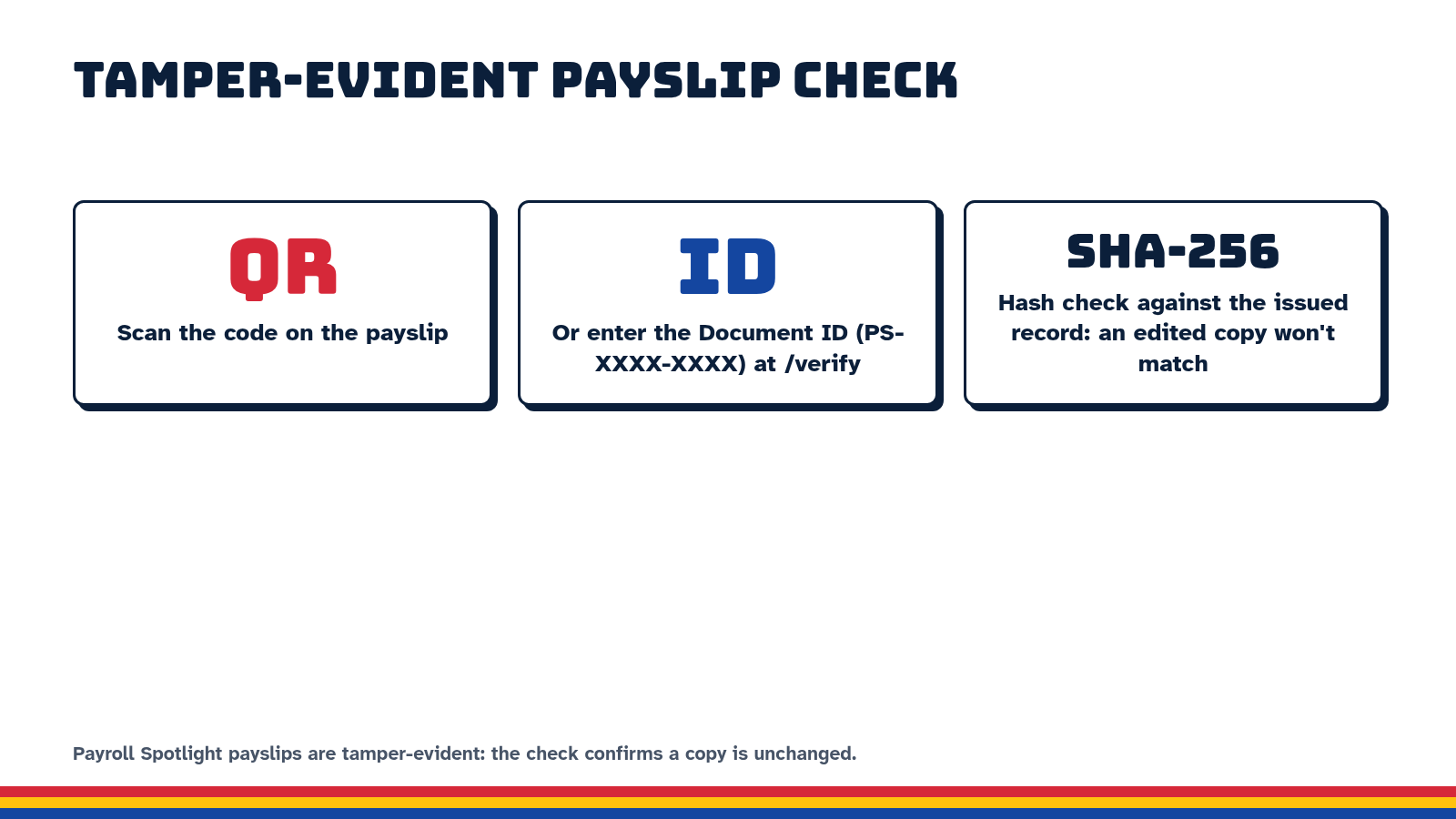
That last point is where many e-payslips fall short. Payroll Spotlight payslips carry a QR code and a Document ID (PS-XXXX-XXXX). Anyone can open the /verify page, enter the ID, and the system runs a SHA-256 check against the issued record. The check is tamper-evident: if someone edits the amounts on a copy, it won’t match the original. It confirms the document is unchanged; it isn’t a legal signature.
Mistakes that lead to disputes
- One lump “deductions” line. Employees can’t check what they can’t see. Name each deduction.
- No rate or hours. Without them, overtime and absences can’t be recomputed.
- Payslips only on request, or monthly when pay is semi-monthly. Issue one every payday.
- Screenshots in group chats. They expose personal data. Use private delivery.
- No records after three years, or none at all for resigned staff. Keep them; they’re needed for final pay disputes and inspections.
- Contribution lines that don’t match the remittance. If the payslip shows an SSS deduction, the remittance must show it too.
For employees: how to read your payslip in five checks
- Is the period correct and is payday within 16 days of the last one?
- Does the basic pay match your rate and days worked?
- Are overtime, night differential and holiday pay shown with hours?
- Do your SSS, PhilHealth and Pag-IBIG shares match the 2026 table? Check your SSS and Pag-IBIG online records to see they were remitted.
- Do you recognize and agree to every other deduction?
If something’s wrong, raise it with HR in writing first. If it isn’t resolved, DOLE’s Single Entry Approach (SEnA) offers free conciliation through the regional and field offices.
FAQ
Is a payslip required by law in the Philippines?
The rules require employers to keep a payroll showing each employee’s period, rate, regular and overtime pay, deductions and net pay. Giving employees those details on a payslip every payday is how employers meet and prove that. For kasambahay, RA 10361 expressly requires a payslip every payday.
What should a payslip contain?
At minimum: employer and employee details, pay period, rate, days or hours worked, each earnings item, each deduction by name, gross pay and net pay. Year-to-date tax and leave balances are recommended.
Are electronic payslips allowed?
Yes. Electronic payslips are widely used. Make sure each employee can privately access, download and print theirs, and protect the data under the Data Privacy Act.
How long should employers keep payslip records?
At least three years from the last entry, under Book III, Rule X, Sec. 12 of the Labor Code’s implementing rules. Batas Kasambahay also sets three years for kasambahay payslips.
How can a bank or landlord verify a Payroll Spotlight payslip?
They open payrollspotlight.com/verify, scan the QR code or enter the Document ID, and the system runs a SHA-256 check against the issued record. It’s tamper-evident: an edited copy won’t match.
What to do next
Lay your current payslip next to the checklist above and add anything missing, especially rates, hours and named deductions. If you’d like payslips that show every line, go out privately every payday, and can be verified, see what Payroll Spotlight does and start a free trial.
Educational overview only, based on the Labor Code Arts. 103 and 113 (as renumbered), Book III of its implementing rules (Rules VIII and X), RA 10361 Sec. 26, RA 10173 and DOLE Department Order No. 238-23, all retrieved October 23, 2026. “Rosa” and all figures are example data. Not legal or tax advice.
Leave a Reply